
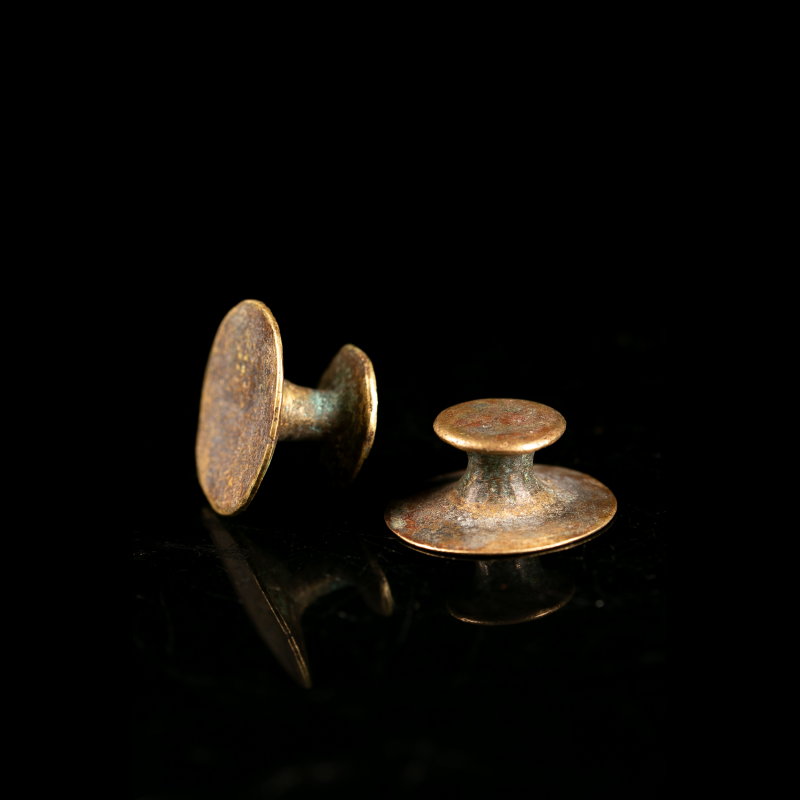
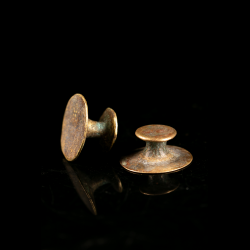
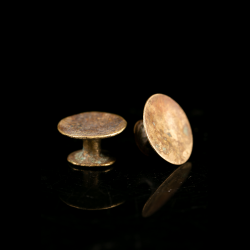
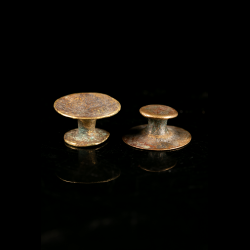
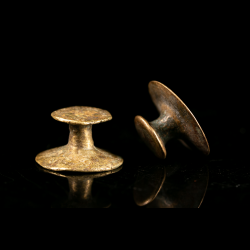
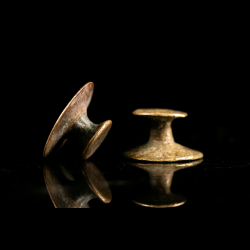
This antique pair of bronze (or brass) ear ornaments is most likely attributed to a West African culture, probably the Lobi or Akan peoples. Their distinctive spool-shaped design, formed by two circular discs connected by a short cylindrical neck, corresponds to ornaments traditionally worn in stretched earlobes.
Such ornaments were far more than decorative accessories. They reflected social identity, status, age, or cultural affiliation, while contributing to the rich traditions of body adornment practiced throughout West Africa.
Their attractive aged patina, combining warm golden-brown tones with natural green oxidation, testifies to their age and long history of use. The elegant simplicity of their design highlights the refined aesthetic characteristic of many West African metalworking traditions.
Today these ornaments represent fine examples of traditional African jewelry and would make an excellent addition to a collection of African tribal art, ethnographic jewelry, or historical metalwork.
Data sheet
This antique pair of bronze (or brass) ear ornaments is most likely attributed to a West African culture, probably the Lobi or Akan peoples. Their distinctive spool-shaped design, formed by two circular discs connected by a short cylindrical neck, corresponds to ornaments traditionally worn in stretched earlobes.
Such ornaments were far more than decorative accessories. They reflected social identity, status, age, or cultural affiliation, while contributing to the rich traditions of body adornment practiced throughout West Africa.
Their attractive aged patina, combining warm golden-brown tones with natural green oxidation, testifies to their age and long history of use. The elegant simplicity of their design highlights the refined aesthetic characteristic of many West African metalworking traditions.
Today these ornaments represent fine examples of traditional African jewelry and would make an excellent addition to a collection of African tribal art, ethnographic jewelry, or historical metalwork.