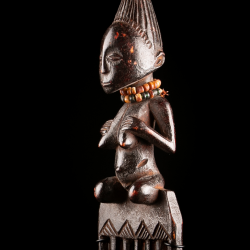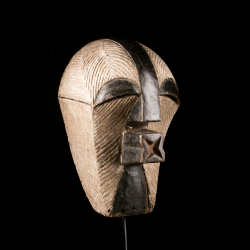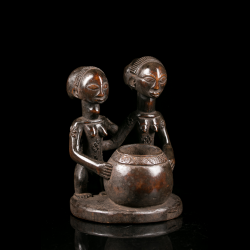
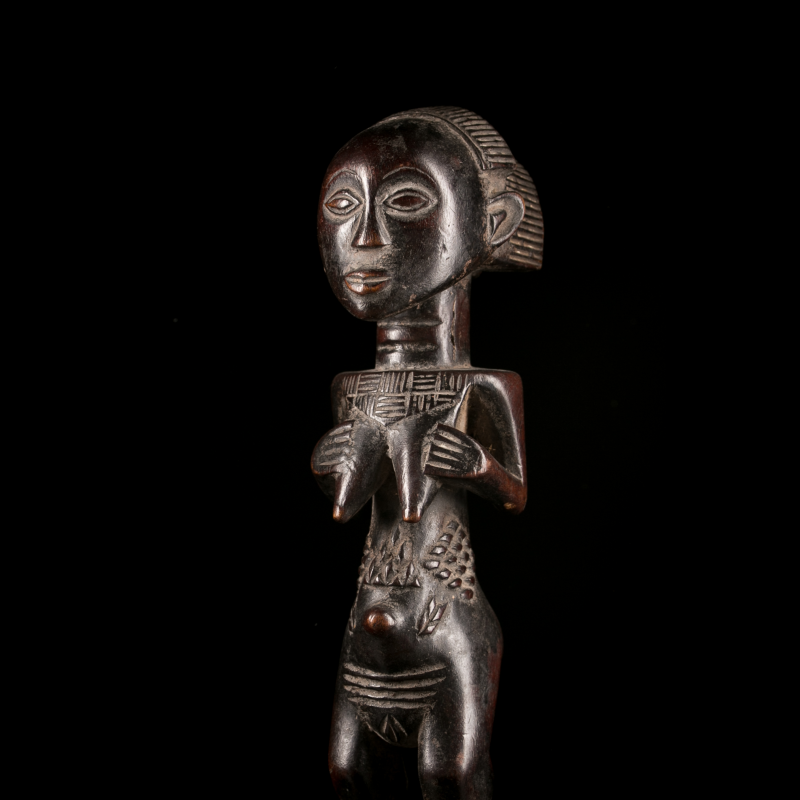
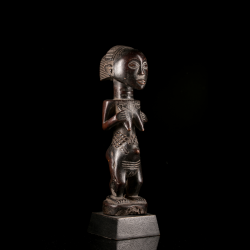

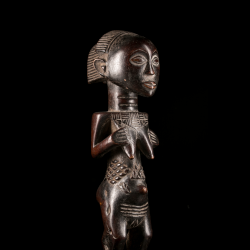
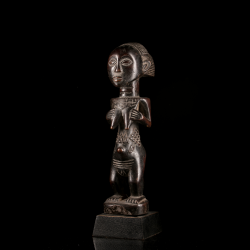
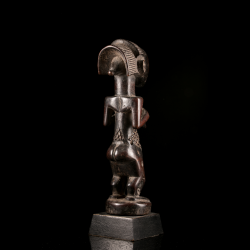
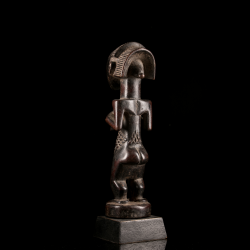
A remarkable example of Luba African art, an archetype of the sculptural quality of which the artists of the Baluba kingdom are capable.
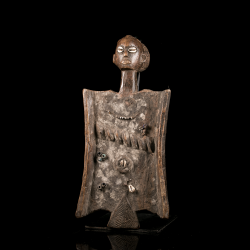
Luba female statues such as this one embody both aesthetic ideals and political and ritual functions: they are frequently associated with royal seats, supports for ceremonial objects (arrow holders, etc.), and the chieftaincy's memory archives (lukasa board), where women are seen as the custodians of power and memory.
Morphologically, these figures display a fine and refined modeling—smoothed features, slender proportions, stylized hairstyles, and meticulous polishing—that reflects the technical rigor of Luba workshops and an aesthetic of noble simplicity. Their gaze, often turned inward, and the placement of their hands on their chests evoke concentration and the transmission of knowledge.
The ventral and lateral scarifications, systematically rendered in small geometric networks, are not merely decorative: they signify beauty, status and above all fertility; on some royal supports these incisions evoke the capacity of the female body to receive and concentrate the spirits and secrets of the reign.
Data sheet
You might also like
A remarkable example of Luba African art, an archetype of the sculptural quality of which the artists of the Baluba kingdom are capable.
Luba female statues such as this one embody both aesthetic ideals and political and ritual functions: they are frequently associated with royal seats, supports for ceremonial objects (arrow holders, etc.), and the chieftaincy's memory archives (lukasa board), where women are seen as the custodians of power and memory.
Morphologically, these figures display a fine and refined modeling—smoothed features, slender proportions, stylized hairstyles, and meticulous polishing—that reflects the technical rigor of Luba workshops and an aesthetic of noble simplicity. Their gaze, often turned inward, and the placement of their hands on their chests evoke concentration and the transmission of knowledge.
The ventral and lateral scarifications, systematically rendered in small geometric networks, are not merely decorative: they signify beauty, status and above all fertility; on some royal supports these incisions evoke the capacity of the female body to receive and concentrate the spirits and secrets of the reign.