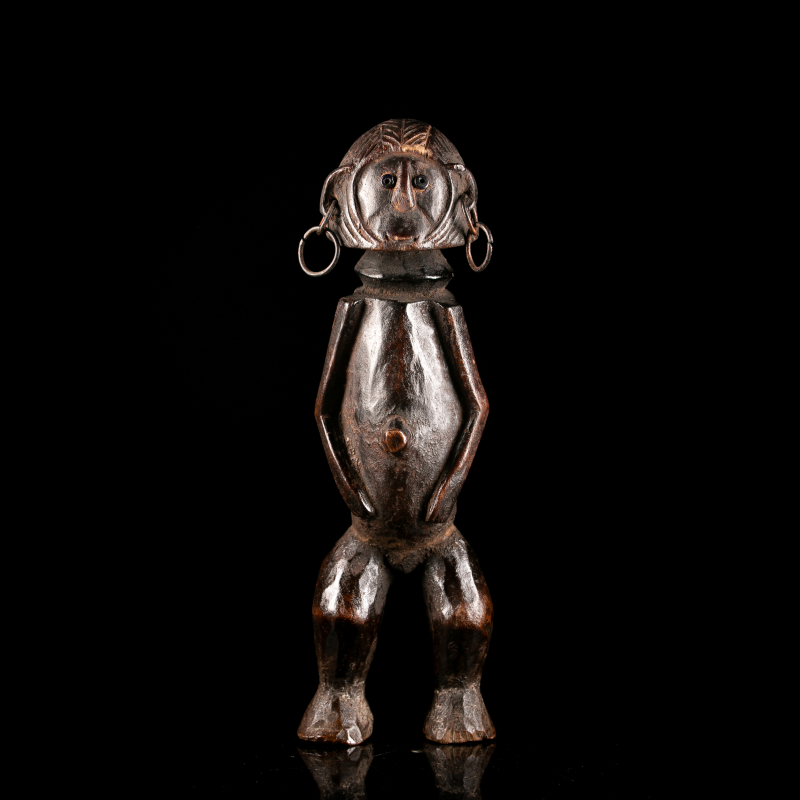
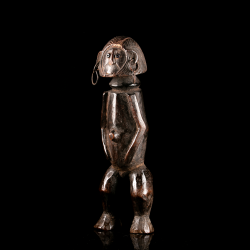
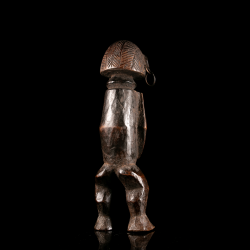
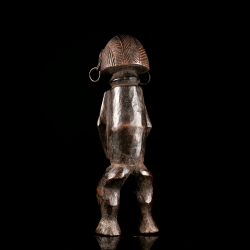
The Zande Mani statues, originating from the Zande (or Azande) people of northern Congo and the Central African Republic, are wooden sculptures with clean lines and harmonious proportions. These traditional figures, often of medium size, generally represent ancestors or idealized figures, characterized by stylized features, a slender torso, and a hieratic posture.
They played a central role in rituals of protection, divination, and ancestor worship. Placed in family shrines or used by diviners, these statues served as intermediaries between the living and the spirit world, allowing people to invoke the help of ancestors to resolve conflicts, ensure fertility, or ward off misfortune.
The Zande attributed a vital force to these works, reinforced by the addition of magical substances or metals.
Their understated aesthetics and sacred function make them striking testimonies to Zande spirituality and art, where every sculptural detail carries symbolic and social significance.
Data sheet
The Zande Mani statues, originating from the Zande (or Azande) people of northern Congo and the Central African Republic, are wooden sculptures with clean lines and harmonious proportions. These traditional figures, often of medium size, generally represent ancestors or idealized figures, characterized by stylized features, a slender torso, and a hieratic posture.
They played a central role in rituals of protection, divination, and ancestor worship. Placed in family shrines or used by diviners, these statues served as intermediaries between the living and the spirit world, allowing people to invoke the help of ancestors to resolve conflicts, ensure fertility, or ward off misfortune.
The Zande attributed a vital force to these works, reinforced by the addition of magical substances or metals.
Their understated aesthetics and sacred function make them striking testimonies to Zande spirituality and art, where every sculptural detail carries symbolic and social significance.