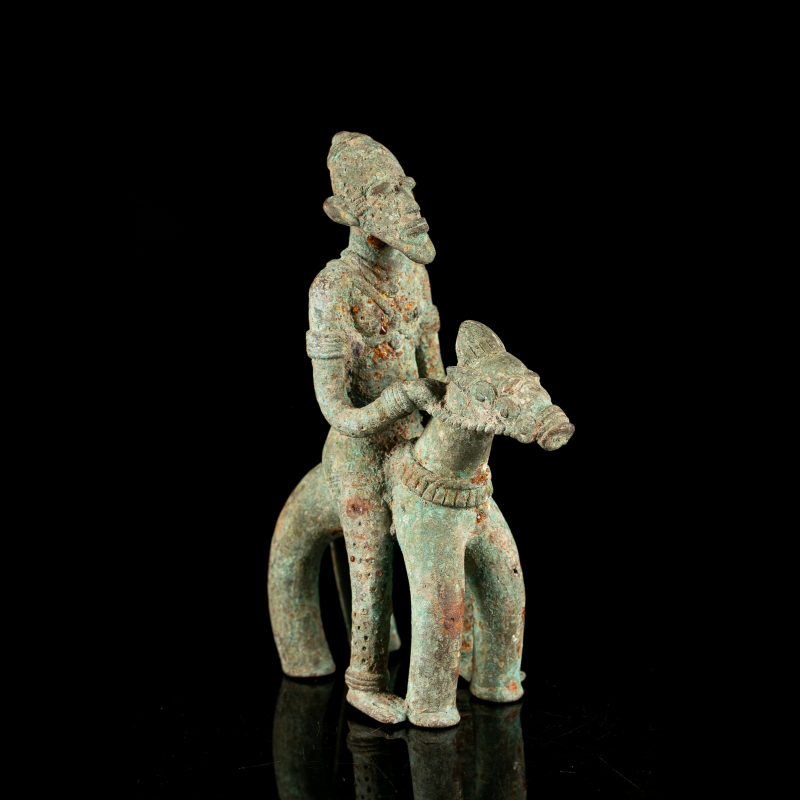
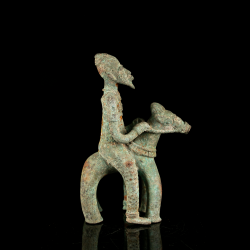
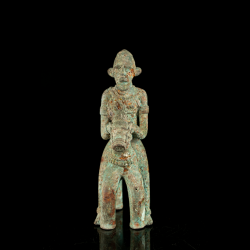
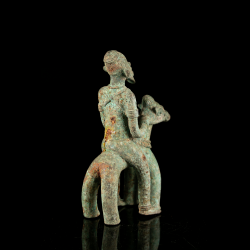
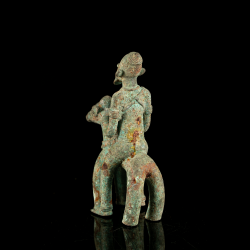
Remarkable copper-alloy equestrian figure attributable to the artistic traditions of Djenné and the Inland Niger Delta in Mali. At an unusually substantial 23 cm high, the work depicts an elongated rider seated upon a powerfully stylised horse. Its surface is enveloped in a dense green oxidation patina interspersed with brown and reddish tones, giving particular depth to the modelling.
The mounted rider occupies a privileged position within the ancient artistic traditions of the Middle Niger. Djenné and Djenné-Djeno stood at the heart of extensive commercial networks linking the Niger Valley with the trans-Saharan trade routes. Within this environment, horses were valuable possessions associated with wealth, political authority, military command and elite status. The equestrian image therefore conveyed considerably more than a simple riding scene: it embodied ideas of prestige and power.
Archaeological discoveries and museum collections document a corpus of small copper-alloy sculptures and ornaments from the Djenné region, including representations of mounted figures. Although the precise function of many such objects remains uncertain, their iconography reflects the considerable symbolic importance accorded to the horse within medieval and later Sahelian societies.
The present figure is especially notable for its ambitious scale. The rider is conceived as a tall, hieratic presence, with elongated limbs, an elevated coiffure and a strongly projected facial profile. Arm and body ornaments further suggest a figure of status. The horse is rendered with striking economy: its projecting muzzle, prominent eyes, upright mane and articulated collar create an exceptionally expressive profile.
The composition achieves a compelling balance between verticality and movement. The rider's arms descend toward the horse's neck while his long legs visually echo those of the animal, producing an unusually unified sculptural silhouette. This geometric fusion between rider and mount is among the most compelling features of equestrian imagery associated with the Middle Niger region.
Extensive green surface oxidation, together with reddish deposits and irregular encrustations, gives the figure a particularly evocative archaeological appearance. In the absence of a documented excavation history or metallurgical analysis, however, no precise early dating should be asserted; the present attribution is based upon the object's stylistic and iconographic characteristics.
With its scale, commanding silhouette and refined balance of human and animal forms, this is an especially striking example of equestrian sculpture inspired by the Djenné tradition.
Data sheet
Remarkable copper-alloy equestrian figure attributable to the artistic traditions of Djenné and the Inland Niger Delta in Mali. At an unusually substantial 23 cm high, the work depicts an elongated rider seated upon a powerfully stylised horse. Its surface is enveloped in a dense green oxidation patina interspersed with brown and reddish tones, giving particular depth to the modelling.
The mounted rider occupies a privileged position within the ancient artistic traditions of the Middle Niger. Djenné and Djenné-Djeno stood at the heart of extensive commercial networks linking the Niger Valley with the trans-Saharan trade routes. Within this environment, horses were valuable possessions associated with wealth, political authority, military command and elite status. The equestrian image therefore conveyed considerably more than a simple riding scene: it embodied ideas of prestige and power.
Archaeological discoveries and museum collections document a corpus of small copper-alloy sculptures and ornaments from the Djenné region, including representations of mounted figures. Although the precise function of many such objects remains uncertain, their iconography reflects the considerable symbolic importance accorded to the horse within medieval and later Sahelian societies.
The present figure is especially notable for its ambitious scale. The rider is conceived as a tall, hieratic presence, with elongated limbs, an elevated coiffure and a strongly projected facial profile. Arm and body ornaments further suggest a figure of status. The horse is rendered with striking economy: its projecting muzzle, prominent eyes, upright mane and articulated collar create an exceptionally expressive profile.
The composition achieves a compelling balance between verticality and movement. The rider's arms descend toward the horse's neck while his long legs visually echo those of the animal, producing an unusually unified sculptural silhouette. This geometric fusion between rider and mount is among the most compelling features of equestrian imagery associated with the Middle Niger region.
Extensive green surface oxidation, together with reddish deposits and irregular encrustations, gives the figure a particularly evocative archaeological appearance. In the absence of a documented excavation history or metallurgical analysis, however, no precise early dating should be asserted; the present attribution is based upon the object's stylistic and iconographic characteristics.
With its scale, commanding silhouette and refined balance of human and animal forms, this is an especially striking example of equestrian sculpture inspired by the Djenné tradition.