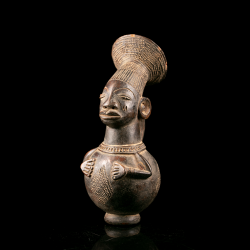
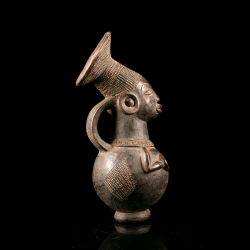
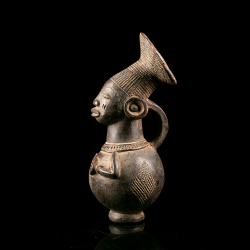
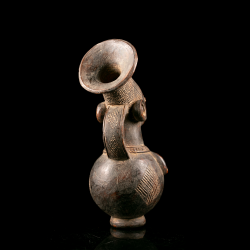
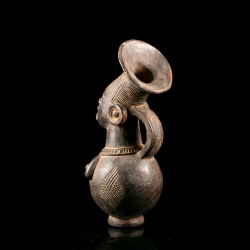
This remarkable Mangbetu anthropomorphic vessel, originating from the northeastern region of the Democratic Republic of the Congo, exemplifies one of the most refined expressions of Central African ceramic art. At the intersection of functional object and sculptural form, it reflects the exceptional level of sophistication developed within Mangbetu courts during the late 19th and early 20th centuries.
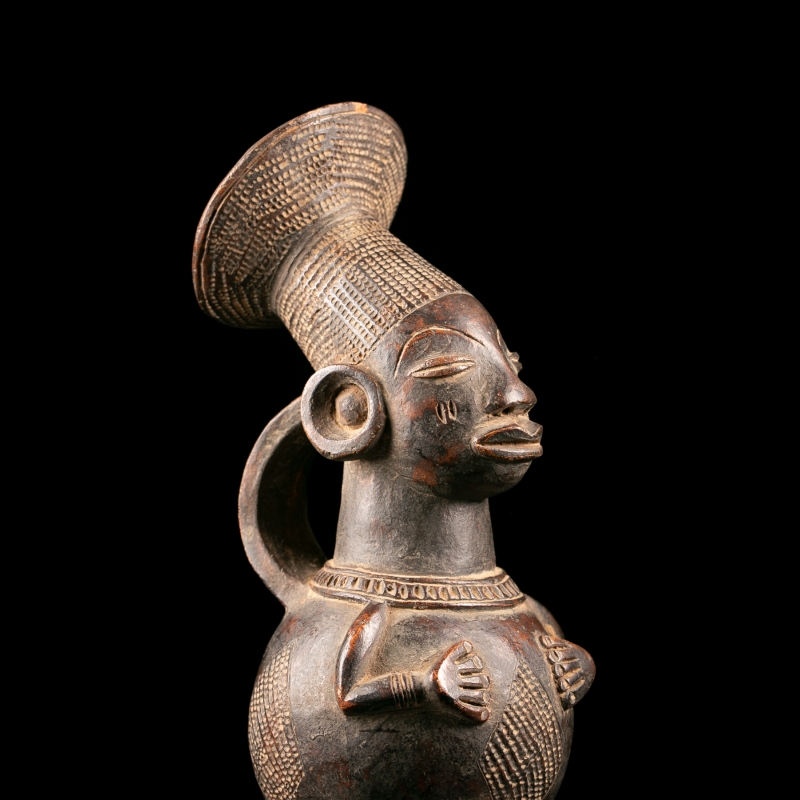
The piece immediately stands out for the quality of its modeling and the elegance of its female representation. The face, finely rendered, features delicate traits with half-closed eyes, a subtly shaped mouth, and a serene, composed expression. The overall presence conveys a sense of nobility and restraint characteristic of Mangbetu artistic tradition.
The most striking element lies in the elaborate coiffure, rising into a tall, cylindrical form adorned with finely incised linear patterns. This stylization directly references the complex hairstyles worn by high-ranking women and relates to the practice of lipombo, the intentional cranial elongation that served as a marker of beauty and social status within Mangbetu aristocracy.
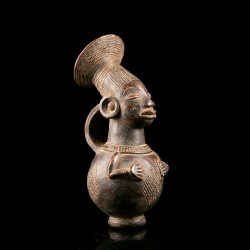
The harmonious proportions of the body, the arms held close to the chest, and the finely incised surface decoration all attest to a controlled and confident artistic hand, where each detail contributes to the overall balance of the composition. The vessel also retains a fine aged patina, with subtle signs of use and a softly burnished surface, reinforcing both its authenticity and its age.
Such vessels, both utilitarian and symbolic, were used in domestic and ceremonial contexts, often associated with idealized female figures embodying grace, fertility, and elevated social standing.
Through its refinement, quality of preservation, and strong cultural identity, this Mangbetu vessel stands as a significant work for any collection of African art, particularly for collectors drawn to elegance of form and the great aesthetic traditions of Central Africa.These potteries are distinguished by anthropomorphic forms, often decorated with heads with elongated skulls, echoing the tradition of cranial deformation.
Used both for the storage of water and foodstuffs and for symbolic rites, they illustrate the cultural richness of the Mangbetu people.
Their artistic corpus extends to musical instruments and ancestor figures testifying to a sophisticated aesthetic and exceptional know-how.
Data sheet
You might also like
This remarkable Mangbetu anthropomorphic vessel, originating from the northeastern region of the Democratic Republic of the Congo, exemplifies one of the most refined expressions of Central African ceramic art. At the intersection of functional object and sculptural form, it reflects the exceptional level of sophistication developed within Mangbetu courts during the late 19th and early 20th centuries.
The piece immediately stands out for the quality of its modeling and the elegance of its female representation. The face, finely rendered, features delicate traits with half-closed eyes, a subtly shaped mouth, and a serene, composed expression. The overall presence conveys a sense of nobility and restraint characteristic of Mangbetu artistic tradition.
The most striking element lies in the elaborate coiffure, rising into a tall, cylindrical form adorned with finely incised linear patterns. This stylization directly references the complex hairstyles worn by high-ranking women and relates to the practice of lipombo, the intentional cranial elongation that served as a marker of beauty and social status within Mangbetu aristocracy.
The harmonious proportions of the body, the arms held close to the chest, and the finely incised surface decoration all attest to a controlled and confident artistic hand, where each detail contributes to the overall balance of the composition. The vessel also retains a fine aged patina, with subtle signs of use and a softly burnished surface, reinforcing both its authenticity and its age.
Such vessels, both utilitarian and symbolic, were used in domestic and ceremonial contexts, often associated with idealized female figures embodying grace, fertility, and elevated social standing.
Through its refinement, quality of preservation, and strong cultural identity, this Mangbetu vessel stands as a significant work for any collection of African art, particularly for collectors drawn to elegance of form and the great aesthetic traditions of Central Africa.These potteries are distinguished by anthropomorphic forms, often decorated with heads with elongated skulls, echoing the tradition of cranial deformation.
Used both for the storage of water and foodstuffs and for symbolic rites, they illustrate the cultural richness of the Mangbetu people.
Their artistic corpus extends to musical instruments and ancestor figures testifying to a sophisticated aesthetic and exceptional know-how.