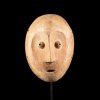

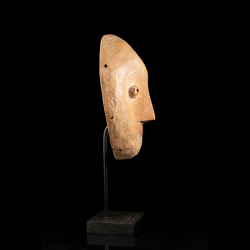
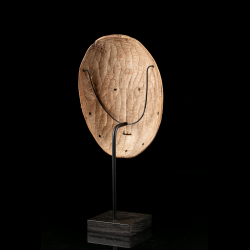
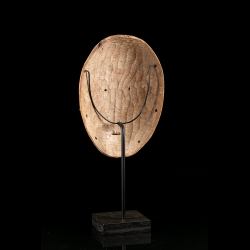
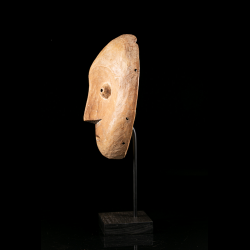

This remarkable Lega mask from the eastern region of the Democratic Republic of the Congo beautifully illustrates the pursuit of simplicity and symbolism that defines the artistic tradition of the Lega people. While seemingly austere at first glance, the mask reflects the profound philosophical and initiatory values associated with the Bwami society, the prestigious institution that shaped the social and spiritual life of the Lega.
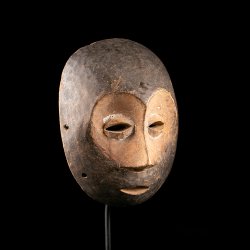
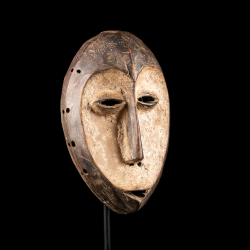
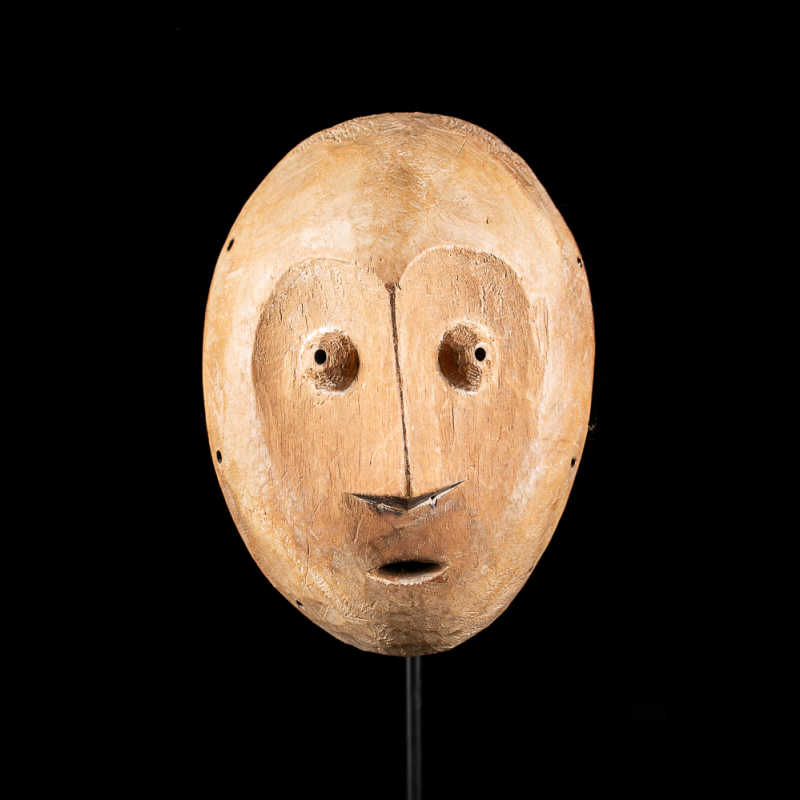
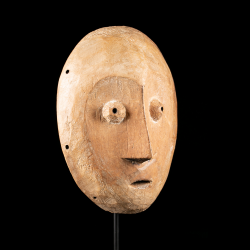
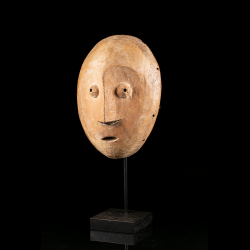
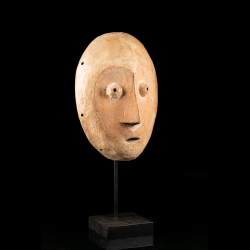
The face is carved in a perfectly balanced oval form, animated by small circular pierced eyes, a nose reduced to a few essential lines, and a discreetly open mouth. This economy of means creates a silent and contemplative presence, characteristic of the finest Lega masks and highly appreciated by collectors of early African art.
The surface displays a beautiful light-toned aged patina, softened by time and repeated handling. Visible traces of use, natural wear on the raised areas, and peripheral perforations once used to secure additional elements all attest to the object's original ritual and initiatory function.
Among the Lega, masks such as this were closely associated with the teachings of the Bwami society and served as visual tools for transmitting moral values, narratives, and knowledge reserved for initiates. Their apparent simplicity is never accidental; rather, it reflects a sophisticated artistic language in which every feature is reduced to its most essential form.
Highly sought after for its minimalist aesthetic and striking visual modernity, Lega art has played an important role in shaping the appreciation of African sculpture throughout the twentieth century. This example stands as a particularly fine representation of that tradition, combining authenticity, age, and strong formal qualities.
Through its understated elegance, aged patina, and powerful visual presence, this mask would be a distinguished addition to any collection devoted to Congolese art, Bwami-related objects, or the great sculptural traditions of Central Africa.
Data sheet
You might also like
This remarkable Lega mask from the eastern region of the Democratic Republic of the Congo beautifully illustrates the pursuit of simplicity and symbolism that defines the artistic tradition of the Lega people. While seemingly austere at first glance, the mask reflects the profound philosophical and initiatory values associated with the Bwami society, the prestigious institution that shaped the social and spiritual life of the Lega.
The face is carved in a perfectly balanced oval form, animated by small circular pierced eyes, a nose reduced to a few essential lines, and a discreetly open mouth. This economy of means creates a silent and contemplative presence, characteristic of the finest Lega masks and highly appreciated by collectors of early African art.
The surface displays a beautiful light-toned aged patina, softened by time and repeated handling. Visible traces of use, natural wear on the raised areas, and peripheral perforations once used to secure additional elements all attest to the object's original ritual and initiatory function.
Among the Lega, masks such as this were closely associated with the teachings of the Bwami society and served as visual tools for transmitting moral values, narratives, and knowledge reserved for initiates. Their apparent simplicity is never accidental; rather, it reflects a sophisticated artistic language in which every feature is reduced to its most essential form.
Highly sought after for its minimalist aesthetic and striking visual modernity, Lega art has played an important role in shaping the appreciation of African sculpture throughout the twentieth century. This example stands as a particularly fine representation of that tradition, combining authenticity, age, and strong formal qualities.
Through its understated elegance, aged patina, and powerful visual presence, this mask would be a distinguished addition to any collection devoted to Congolese art, Bwami-related objects, or the great sculptural traditions of Central Africa.