
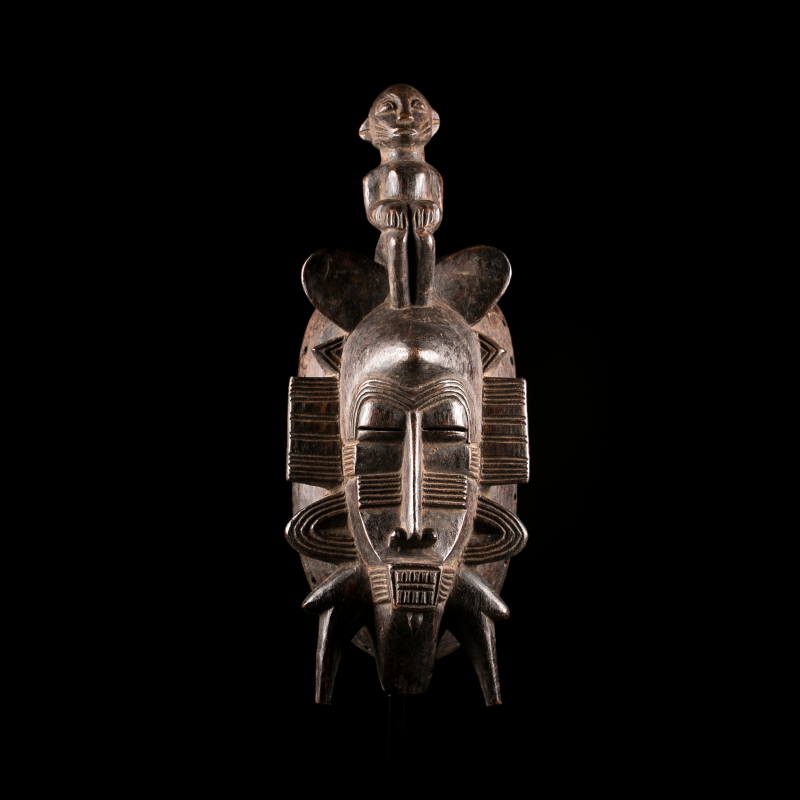
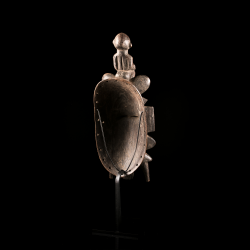
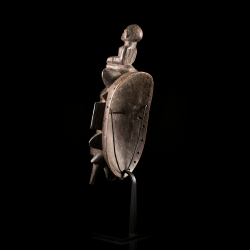
This Kpeliye mask from the Senufo people of Côte d’Ivoire, Burkina Faso, and Mali is a superb example of the elegance and symbolic richness of Senufo art. The elongated face, with its half-closed eyes and refined features, conveys serenity, wisdom, and self-control. On either side of the face are large wing-like projections and ornamental forms, while a small seated human figure crowns the composition. Geometric scarification patterns, harmonious proportions, and a deep, lustrous patina highlight the skill of the sculptor and the ceremonial importance of the piece.
Kpeliye masks are closely linked to the Poro society, the initiation institution that plays a central role in education, moral training, and social organization among the Senufo. Rather than evoking fear, the Kpeliye represents ideals of beauty, balance, and spiritual harmony. The various motifs surrounding the face—human figures, animal references, and abstract forms—symbolize protective forces, ancestral knowledge, and ethical values transmitted through initiation.
During ceremonies, the mask was worn with a raffia costume and activated through ritual dance. Its appearance marked important communal events, including initiation rites and major Poro celebrations. Today, Kpeliye masks are recognized as some of the finest achievements of African sculpture. This example perfectly demonstrates the Senufo artists’ ability to unite aesthetic refinement, spiritual meaning, and cultural knowledge within a single powerful work of art.
Data sheet
You might also like
This Kpeliye mask from the Senufo people of Côte d’Ivoire, Burkina Faso, and Mali is a superb example of the elegance and symbolic richness of Senufo art. The elongated face, with its half-closed eyes and refined features, conveys serenity, wisdom, and self-control. On either side of the face are large wing-like projections and ornamental forms, while a small seated human figure crowns the composition. Geometric scarification patterns, harmonious proportions, and a deep, lustrous patina highlight the skill of the sculptor and the ceremonial importance of the piece.
Kpeliye masks are closely linked to the Poro society, the initiation institution that plays a central role in education, moral training, and social organization among the Senufo. Rather than evoking fear, the Kpeliye represents ideals of beauty, balance, and spiritual harmony. The various motifs surrounding the face—human figures, animal references, and abstract forms—symbolize protective forces, ancestral knowledge, and ethical values transmitted through initiation.
During ceremonies, the mask was worn with a raffia costume and activated through ritual dance. Its appearance marked important communal events, including initiation rites and major Poro celebrations. Today, Kpeliye masks are recognized as some of the finest achievements of African sculpture. This example perfectly demonstrates the Senufo artists’ ability to unite aesthetic refinement, spiritual meaning, and cultural knowledge within a single powerful work of art.
