Complex Lega Mask – Central Africa
This ancient mask of remarkable intensity belongs to the most demanding corpus of Central African ritual art. Through its formal power, extraordinary patina, and the complexity of its attribution, it stands as a major work, intended for a knowledgeable eye and a high-level collection.
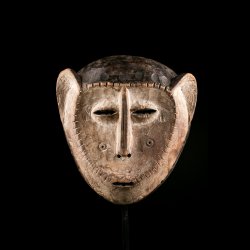
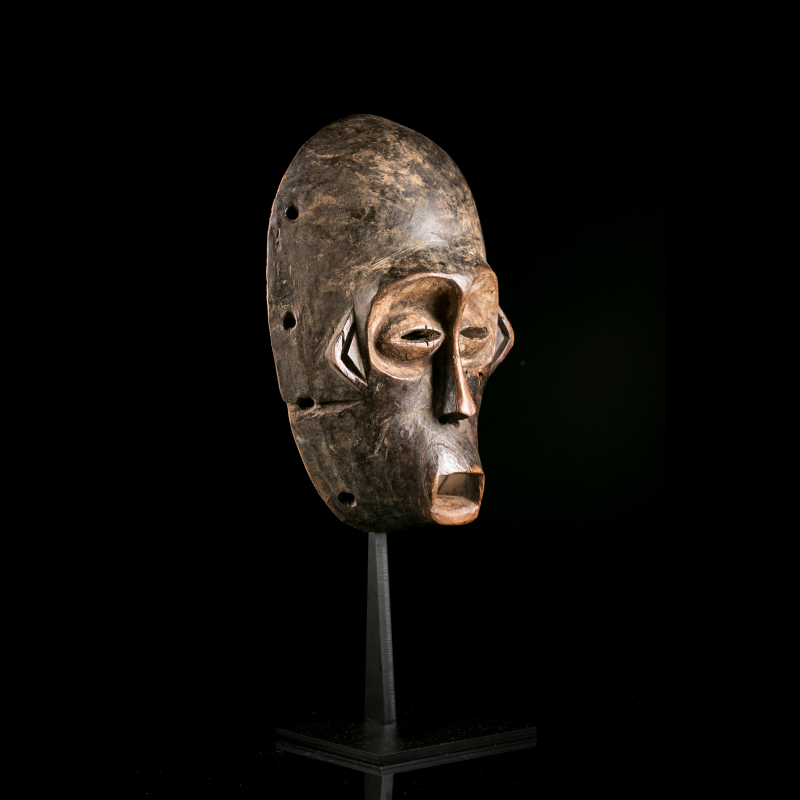
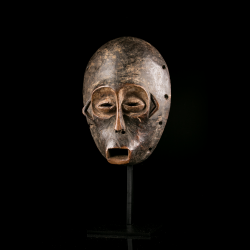
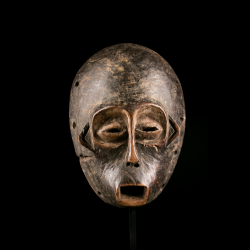
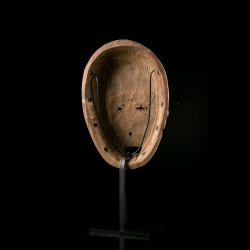
The face is defined by a pronounced central concavity, giving the mask an almost primal presence. Deeply carved, narrow eyes engage with a wide, gaping mouth of strong contours, while the ears—sculpted in relief and slightly projecting—reinforce the overall expressiveness. The ensemble evokes a deliberately archaic register, hovering between the primitive and the symbolic, where the human merges with a force-figure, almost primate in nature, suggesting states of transition, tension, or revelation.
The surface of the mask is covered with an ancient, dense, and nuanced patina resulting from prolonged ritual use. This deep and vibrant patina leaves no doubt as to the object’s age and authenticity. Let us not hesitate in our words: this is a masterpiece within its corpus, both in the mastery of volumes and in the emotional charge it conveys.
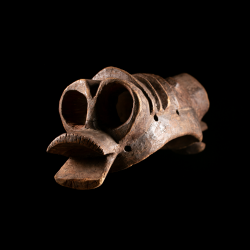
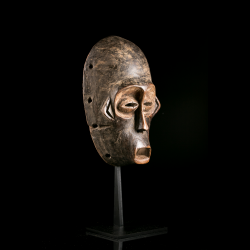
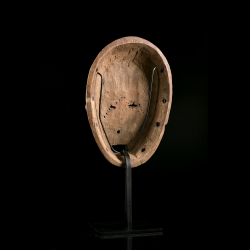
The reverse of the mask offers a striking counterpoint. The old, dry, and sound wood reveals clear traces of traditional tools, most likely adze marks, fully consistent with a production dating to the mid-20th century or earlier. The perimeter is pierced with unusually large holes, partially burned and heavily worn, bearing witness to the repeated passage of natural fiber cords used for fastening and wearing the mask. These technical details, rarely so legible, constitute decisive material criteria in the evaluation of the piece.
The provenance of this mask further enhances its importance. It is believed to have been collected in the early 1960s by Émile Van der Straeten, a Belgian engineer on an independent mission in the region. During a prolonged stay in a Kuba village far from major routes, he reportedly established a relationship of trust with an elderly local notable. Converted for several years, the latter nevertheless preserved certain ritual objects that had become inactive—too charged with memory to be abandoned or destroyed. The mask was transmitted voluntarily, not as a still-active sacred object, but as a silent witness to a world in transition.
Upon returning to Europe, the object reportedly remained for decades within a strictly private setting, shielded from public exposure. This discreet conservation explains the remarkable integrity of the piece, both structurally and symbolically.
The ethnic attribution of this mask has been the subject of extensive expert debate. Lega, Nyanga, Zande, and Ngbaka hypotheses have all been successively considered, reflecting the porous stylistic and ritual boundaries between these groups. These cultures share zones of contact, circulation of forms, and symbolic borrowings that render any categorical attribution problematic. It is precisely this complexity that led the expertise process to its highest level, bringing together the opinions of Belgian and international specialists across several continents. The convergence of these analyses confirms the antiquity, authenticity, and exceptional importance of the work, even as it rightfully claims a plural identity.
In terms of use, this type of mask belongs to complex ritual contexts linked to initiatory societies, social regulation, or manifestations of symbolic authority. It was not worn to represent, but to transform—to temporarily embody an active force capable of imposing silence, respect, and fear.
Rare, powerful, and intellectually demanding, this complex Lega mask stands as a work of the highest order. It is intended for collectors who understand the depth of Central African cultures and are drawn to boundary works—those moments where categories dissolve and art becomes memory, tension, and presence.
More than an object, this mask is an encounter. A work that does not reveal itself at once, but continues to speak to those willing to engage with it over time.
Data sheet
You might also like
Complex Lega Mask – Central Africa
This ancient mask of remarkable intensity belongs to the most demanding corpus of Central African ritual art. Through its formal power, extraordinary patina, and the complexity of its attribution, it stands as a major work, intended for a knowledgeable eye and a high-level collection.
The face is defined by a pronounced central concavity, giving the mask an almost primal presence. Deeply carved, narrow eyes engage with a wide, gaping mouth of strong contours, while the ears—sculpted in relief and slightly projecting—reinforce the overall expressiveness. The ensemble evokes a deliberately archaic register, hovering between the primitive and the symbolic, where the human merges with a force-figure, almost primate in nature, suggesting states of transition, tension, or revelation.
The surface of the mask is covered with an ancient, dense, and nuanced patina resulting from prolonged ritual use. This deep and vibrant patina leaves no doubt as to the object’s age and authenticity. Let us not hesitate in our words: this is a masterpiece within its corpus, both in the mastery of volumes and in the emotional charge it conveys.
The reverse of the mask offers a striking counterpoint. The old, dry, and sound wood reveals clear traces of traditional tools, most likely adze marks, fully consistent with a production dating to the mid-20th century or earlier. The perimeter is pierced with unusually large holes, partially burned and heavily worn, bearing witness to the repeated passage of natural fiber cords used for fastening and wearing the mask. These technical details, rarely so legible, constitute decisive material criteria in the evaluation of the piece.
The provenance of this mask further enhances its importance. It is believed to have been collected in the early 1960s by Émile Van der Straeten, a Belgian engineer on an independent mission in the region. During a prolonged stay in a Kuba village far from major routes, he reportedly established a relationship of trust with an elderly local notable. Converted for several years, the latter nevertheless preserved certain ritual objects that had become inactive—too charged with memory to be abandoned or destroyed. The mask was transmitted voluntarily, not as a still-active sacred object, but as a silent witness to a world in transition.
Upon returning to Europe, the object reportedly remained for decades within a strictly private setting, shielded from public exposure. This discreet conservation explains the remarkable integrity of the piece, both structurally and symbolically.
The ethnic attribution of this mask has been the subject of extensive expert debate. Lega, Nyanga, Zande, and Ngbaka hypotheses have all been successively considered, reflecting the porous stylistic and ritual boundaries between these groups. These cultures share zones of contact, circulation of forms, and symbolic borrowings that render any categorical attribution problematic. It is precisely this complexity that led the expertise process to its highest level, bringing together the opinions of Belgian and international specialists across several continents. The convergence of these analyses confirms the antiquity, authenticity, and exceptional importance of the work, even as it rightfully claims a plural identity.
In terms of use, this type of mask belongs to complex ritual contexts linked to initiatory societies, social regulation, or manifestations of symbolic authority. It was not worn to represent, but to transform—to temporarily embody an active force capable of imposing silence, respect, and fear.
Rare, powerful, and intellectually demanding, this complex Lega mask stands as a work of the highest order. It is intended for collectors who understand the depth of Central African cultures and are drawn to boundary works—those moments where categories dissolve and art becomes memory, tension, and presence.
More than an object, this mask is an encounter. A work that does not reveal itself at once, but continues to speak to those willing to engage with it over time.