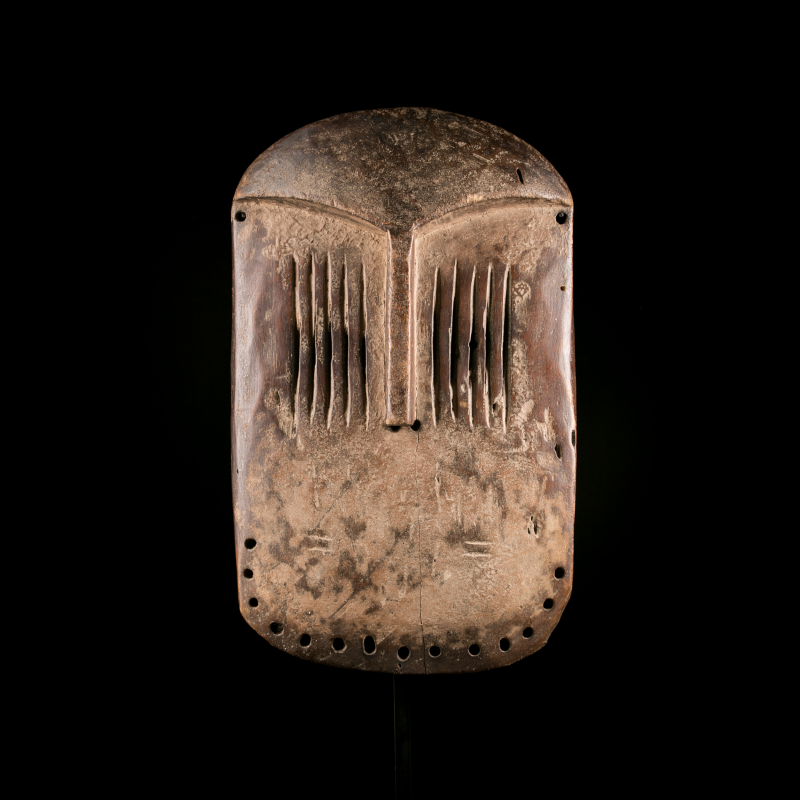

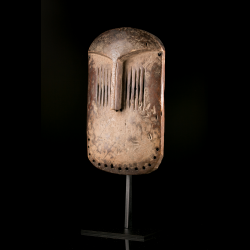
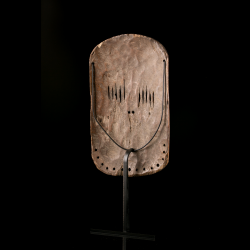
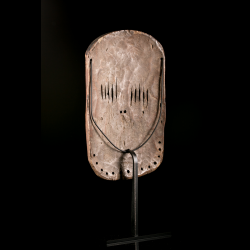
This African mask, described as a "plank" due to its flatness, is easily identified as a traditional Ekanga mask from the Mbole or Yela people of the Democratic Republic of Congo. Its simple face is marked by parallel striations serving as eyes. This mask is associated with the Lilwa society, one of the most important among the Mbole.
The Mbole are a people of the Democratic Republic of Congo, primarily located in the Tshuapa province and the region between the Lomami and Tshuapa rivers (formerly the provinces of Équateur and Kasaï).
The dancer wore a full-body costume made of plant fibers.
Data sheet
This African mask, described as a "plank" due to its flatness, is easily identified as a traditional Ekanga mask from the Mbole or Yela people of the Democratic Republic of Congo. Its simple face is marked by parallel striations serving as eyes. This mask is associated with the Lilwa society, one of the most important among the Mbole.
The Mbole are a people of the Democratic Republic of Congo, primarily located in the Tshuapa province and the region between the Lomami and Tshuapa rivers (formerly the provinces of Équateur and Kasaï).
The dancer wore a full-body costume made of plant fibers.