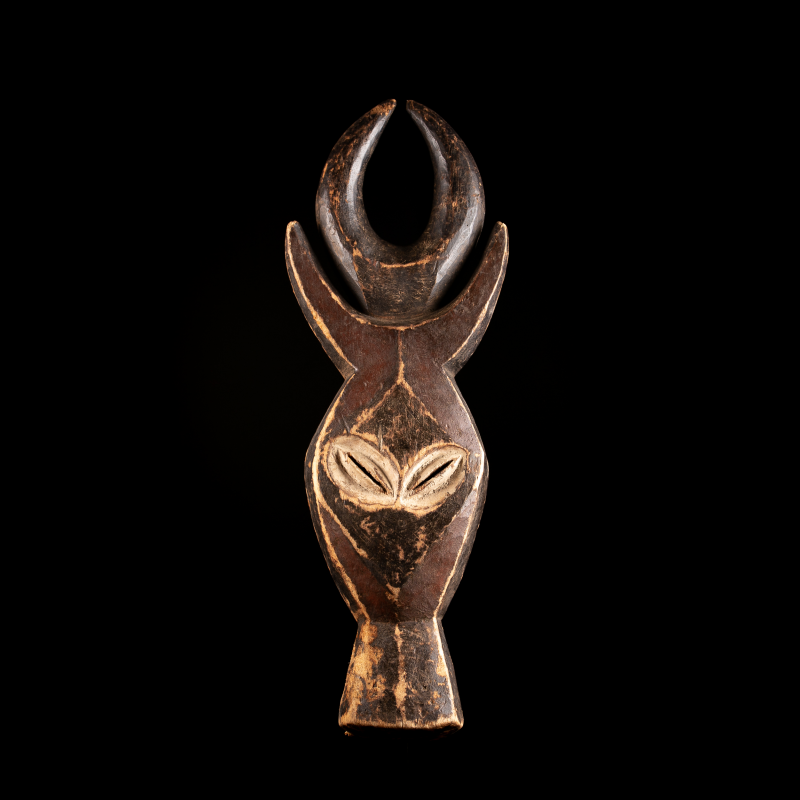
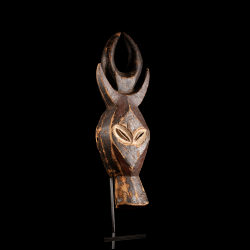
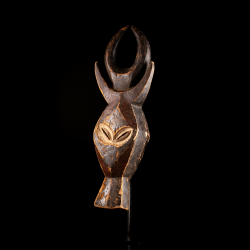
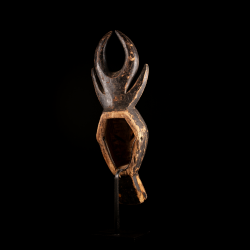
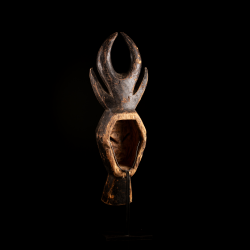
A prestigious Kwele mask from Africa depicting an antelope with erect horns that curve inward, likely related to the kob.
These masks were made by the Bakwele, a forest people of Central Africa (Gabon), and were used in agricultural rituals celebrating the end of the rainy season, when animals approached cultivated areas.
Unlike other variations where the horns project forward, these are carved in the same plane as the face, reinforcing the figure's frontality and power.
The mask was used in ritual ceremonies associated with hunting and sacred banquets, during which the spirit of the antelope was invoked through dance.
Data sheet
A prestigious Kwele mask from Africa depicting an antelope with erect horns that curve inward, likely related to the kob.
These masks were made by the Bakwele, a forest people of Central Africa (Gabon), and were used in agricultural rituals celebrating the end of the rainy season, when animals approached cultivated areas.
Unlike other variations where the horns project forward, these are carved in the same plane as the face, reinforcing the figure's frontality and power.
The mask was used in ritual ceremonies associated with hunting and sacred banquets, during which the spirit of the antelope was invoked through dance.