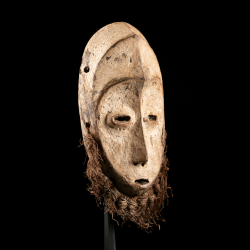
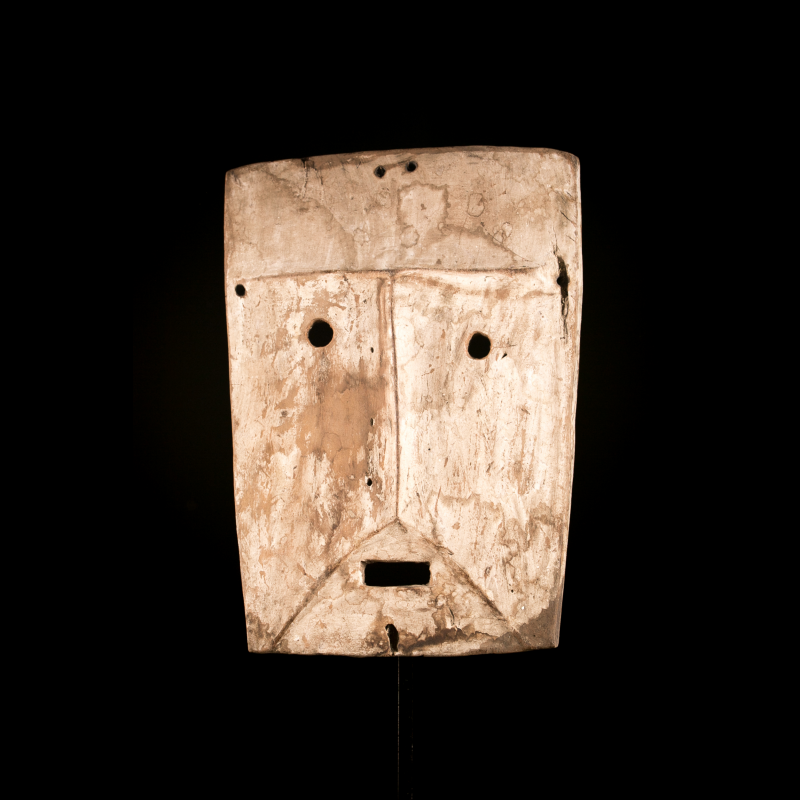
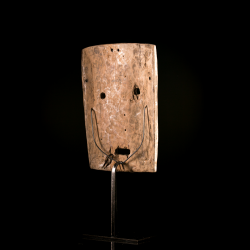
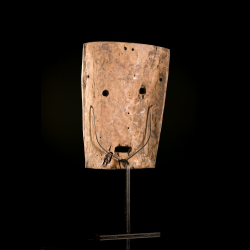
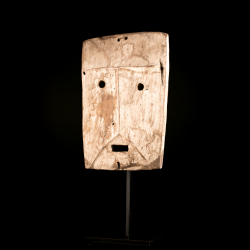
A rare Lega mask designed to be worn in front of the face, which is noteworthy given that the majority of Bwami masks were not worn in this way.
Traditional Lega masks, originating from eastern Democratic Republic of Congo, are inseparable from the Bwami initiation society.
Among the Lega, art is not conceived as a mere aesthetic expression, but as a tool for moral and philosophical transmission. The Bwami is a central institution that organizes the social and spiritual life of the community.
Open to both men and women, it is based on a system of initiation through degrees, each corresponding to a level of wisdom, responsibility, and self-mastery.
Bwami rites combine ceremonies, oral teachings, proverbs, and symbolic objects. Masks play an essential pedagogical role in these rites. Unlike other African traditions, they are rarely worn: they are displayed or manipulated during initiations to illustrate values such as humility, justice, social harmony, or the dangers of disorder.
Their refined and deliberately abstract style reinforces their symbolic power. Lega masks only acquire meaning through the words of the elders, making art a mediator between ancestral wisdom and the development of the individual.
Data sheet
You might also like
A rare Lega mask designed to be worn in front of the face, which is noteworthy given that the majority of Bwami masks were not worn in this way.
Traditional Lega masks, originating from eastern Democratic Republic of Congo, are inseparable from the Bwami initiation society.
Among the Lega, art is not conceived as a mere aesthetic expression, but as a tool for moral and philosophical transmission. The Bwami is a central institution that organizes the social and spiritual life of the community.
Open to both men and women, it is based on a system of initiation through degrees, each corresponding to a level of wisdom, responsibility, and self-mastery.
Bwami rites combine ceremonies, oral teachings, proverbs, and symbolic objects. Masks play an essential pedagogical role in these rites. Unlike other African traditions, they are rarely worn: they are displayed or manipulated during initiations to illustrate values such as humility, justice, social harmony, or the dangers of disorder.
Their refined and deliberately abstract style reinforces their symbolic power. Lega masks only acquire meaning through the words of the elders, making art a mediator between ancestral wisdom and the development of the individual.