
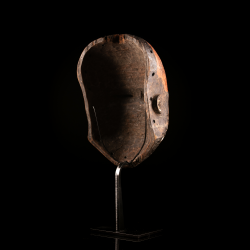
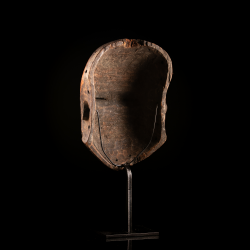
Kete Mask – Democratic Republic of the Congo
Central African tribal art – Ancient ritual mask
Rare and expressive, this ancient Kete mask originates from the central region of the Democratic Republic of the Congo, an area renowned for the richness and symbolic power of its sculptural traditions. It represents a remarkable example of Kete aesthetics, combining formal rigor, expressive strength, and deep ritual significance.
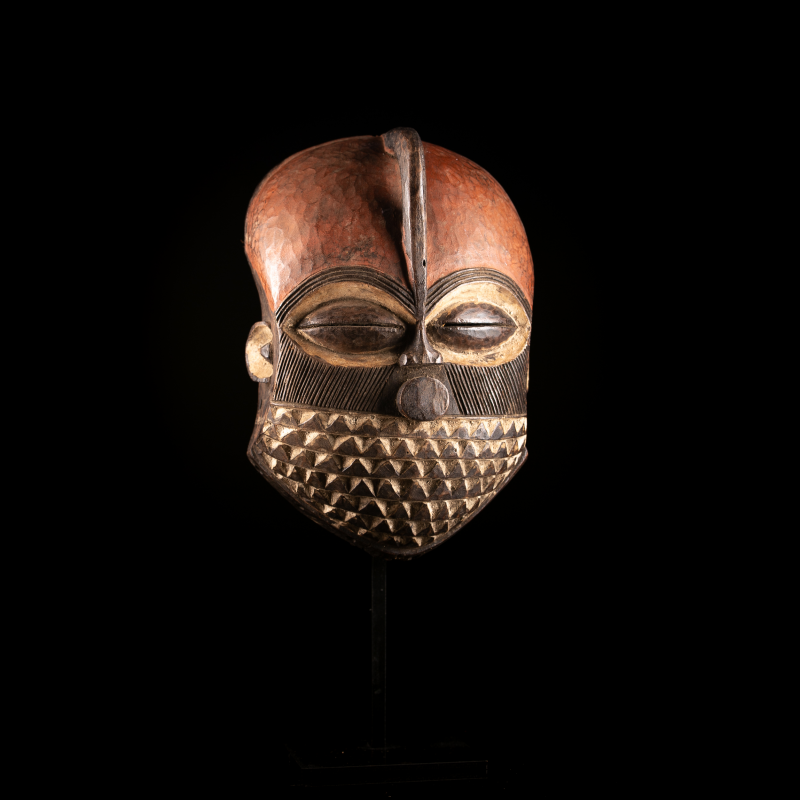
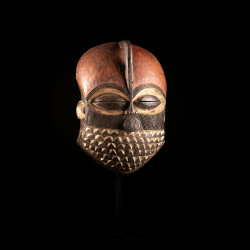
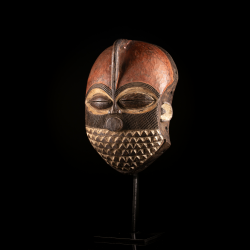
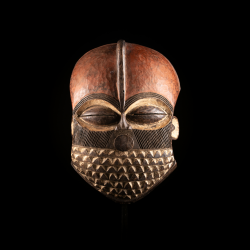
The face is structured around a pronounced central sagittal crest, emphasizing the vertical axis of the composition and giving the mask a distinctly hieratic presence. The half-closed eyes, subtly elongated, convey a sense of inner calm and restraint, characteristic of works associated with ritual and initiatory practices. The short, solid nose brings balance and sobriety to the overall composition.
The lower part of the face is entirely carved with a geometric relief pattern composed of projecting triangular motifs. This rhythmic treatment, both decorative and symbolic, enhances the visual impact of the mask and demonstrates a high level of technical mastery. Fine lateral incisions further define the volumes and reinforce the clarity of the sculptural forms.
The deep and nuanced aged patina displays tones of dark brown, ochre, and blackened areas. It results from prolonged use and repeated handling in a ritual context, attesting to the authenticity and age of the piece. This patina gives the mask a strong sculptural dimension and a particularly striking presence.
Within Kete culture, masks were used during community ceremonies and social or initiatory rituals, serving as mediators between the visible world and invisible forces. Through its assertive style, formal balance, and the quality of its patina, this example fully embodies that tradition.
Today, this Kete mask represents an important acquisition for a collector of African art or for a collection focused on the ritual arts of Central Africa. Its rarity, powerful aesthetic, and authenticity make it both an ethnographic and sculptural object, capable of standing alongside major works of tribal art.
Data sheet
Kete Mask – Democratic Republic of the Congo
Central African tribal art – Ancient ritual mask
Rare and expressive, this ancient Kete mask originates from the central region of the Democratic Republic of the Congo, an area renowned for the richness and symbolic power of its sculptural traditions. It represents a remarkable example of Kete aesthetics, combining formal rigor, expressive strength, and deep ritual significance.
The face is structured around a pronounced central sagittal crest, emphasizing the vertical axis of the composition and giving the mask a distinctly hieratic presence. The half-closed eyes, subtly elongated, convey a sense of inner calm and restraint, characteristic of works associated with ritual and initiatory practices. The short, solid nose brings balance and sobriety to the overall composition.
The lower part of the face is entirely carved with a geometric relief pattern composed of projecting triangular motifs. This rhythmic treatment, both decorative and symbolic, enhances the visual impact of the mask and demonstrates a high level of technical mastery. Fine lateral incisions further define the volumes and reinforce the clarity of the sculptural forms.
The deep and nuanced aged patina displays tones of dark brown, ochre, and blackened areas. It results from prolonged use and repeated handling in a ritual context, attesting to the authenticity and age of the piece. This patina gives the mask a strong sculptural dimension and a particularly striking presence.
Within Kete culture, masks were used during community ceremonies and social or initiatory rituals, serving as mediators between the visible world and invisible forces. Through its assertive style, formal balance, and the quality of its patina, this example fully embodies that tradition.
Today, this Kete mask represents an important acquisition for a collector of African art or for a collection focused on the ritual arts of Central Africa. Its rarity, powerful aesthetic, and authenticity make it both an ethnographic and sculptural object, capable of standing alongside major works of tribal art.
