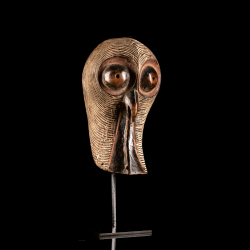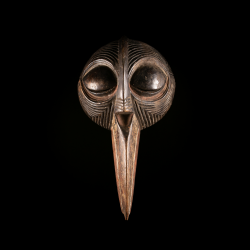
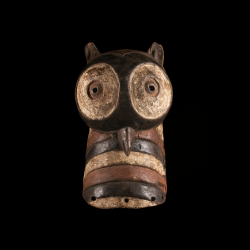
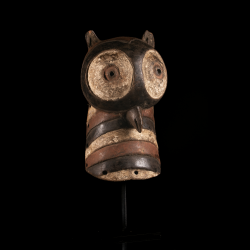
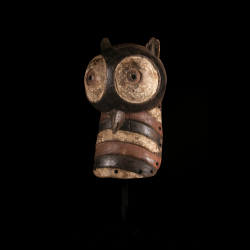
This remarkable Luba mask, originating from southeastern Democratic Republic of the Congo, belongs to the prestigious ritual tradition of the Bwadi bwa Kifwebe society. A particularly rare type, it is distinguished by its unmistakably zoomorphic iconography, representing a bird, most likely a parrot or bird of prey, animals traditionally associated with spiritual knowledge, vigilance, and the invisible world.
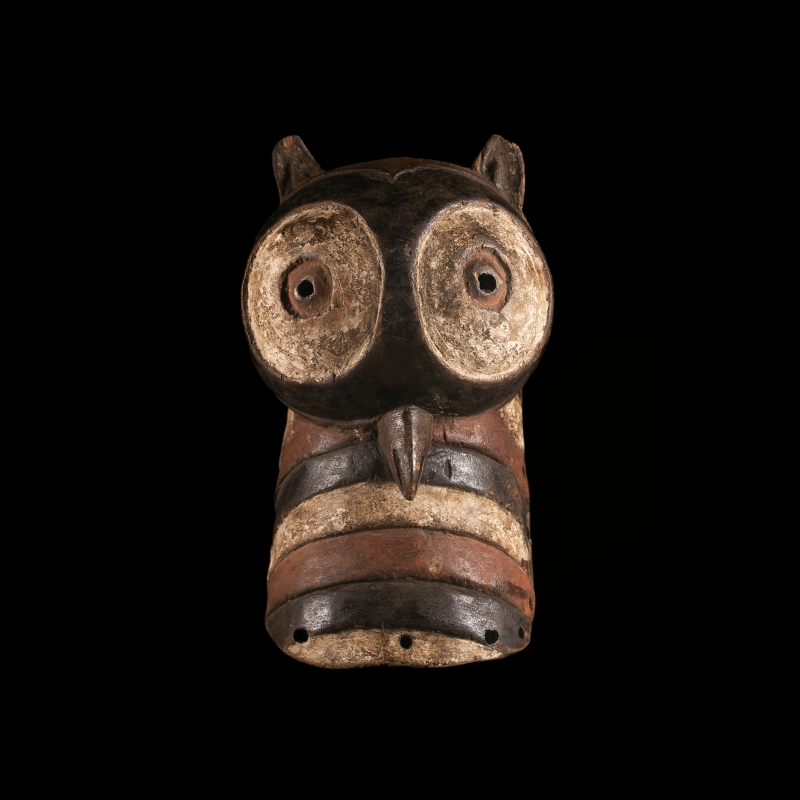
The powerful face is dominated by two large circular eyes, a prominent beak, and small upright ears that reinforce its supernatural appearance. This bold stylization, enhanced by a restrained palette of black, white, and reddish-brown pigments, gives the mask an exceptional graphic quality and an immediately recognizable visual impact.
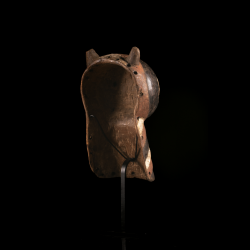
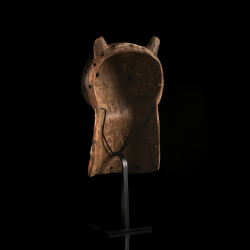
The surface displays a fine aged patina, with coherent traces of use and natural wear that attest to its authenticity. Small perforations along the lower edge indicate its original attachment to a fiber costume during ritual performances.
Ornithomorphic masks are among the rarest forms of Luba ceremonial sculpture and occupy a distinctive place within the artistic repertoire of the Kifwebe tradition. They perfectly illustrate the ability of Luba artists to merge human and animal characteristics, creating powerful spiritual beings embodied through ritual performance.
With its rare typology, remarkable sculptural balance, and commanding presence, this mask is an outstanding example of traditional Luba art and an exceptional addition to any collection of early Central African tribal art.
Data sheet
You might also like
This remarkable Luba mask, originating from southeastern Democratic Republic of the Congo, belongs to the prestigious ritual tradition of the Bwadi bwa Kifwebe society. A particularly rare type, it is distinguished by its unmistakably zoomorphic iconography, representing a bird, most likely a parrot or bird of prey, animals traditionally associated with spiritual knowledge, vigilance, and the invisible world.
The powerful face is dominated by two large circular eyes, a prominent beak, and small upright ears that reinforce its supernatural appearance. This bold stylization, enhanced by a restrained palette of black, white, and reddish-brown pigments, gives the mask an exceptional graphic quality and an immediately recognizable visual impact.
The surface displays a fine aged patina, with coherent traces of use and natural wear that attest to its authenticity. Small perforations along the lower edge indicate its original attachment to a fiber costume during ritual performances.
Ornithomorphic masks are among the rarest forms of Luba ceremonial sculpture and occupy a distinctive place within the artistic repertoire of the Kifwebe tradition. They perfectly illustrate the ability of Luba artists to merge human and animal characteristics, creating powerful spiritual beings embodied through ritual performance.
With its rare typology, remarkable sculptural balance, and commanding presence, this mask is an outstanding example of traditional Luba art and an exceptional addition to any collection of early Central African tribal art.