This striking Pwoom Itok mask belongs to the artistic tradition of the Kuba peoples of the Kasai region in the Democratic Republic of the Congo. Within Kuba court culture, masks played a central role in royal ceremonies, investitures, and important public performances associated with political authority and social order.
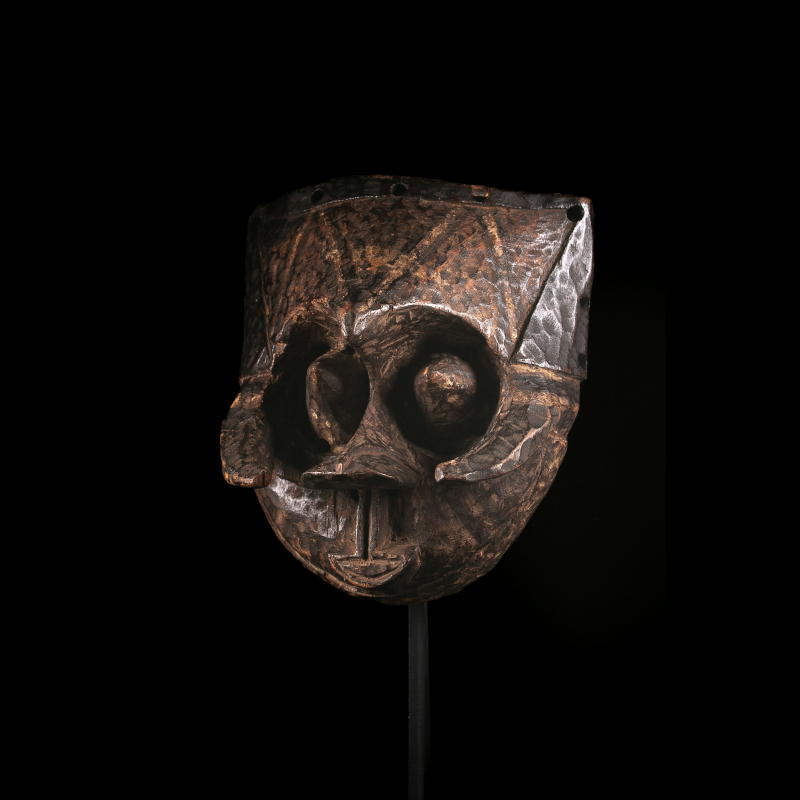
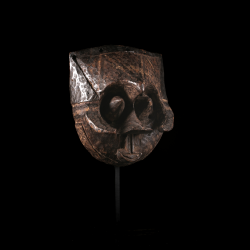
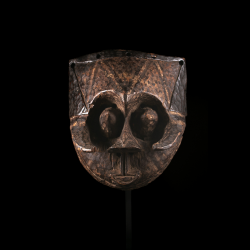
The Pwoom Itok is regarded as one of the oldest and most enigmatic characters within the Kuba masquerade tradition. The present example displays a highly stylized face characterized by deep circular eye cavities, a prominent triangular nose, and a carefully structured arrangement of angular planes and geometric volumes. This abstract visual language is a defining feature of Kuba aesthetics and contributes greatly to the mask’s sculptural power.
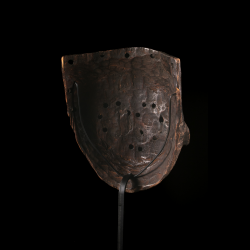
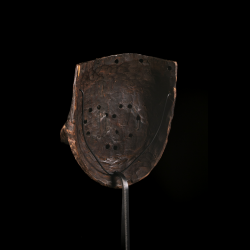
The mask exhibits a fine aged patina, visible ritual wear, and numerous peripheral attachment holes once used to secure the fiber costume worn during ceremonial dances. These details attest to its original function and long history of use.
Beyond its artistic qualities, the piece benefits from an especially attractive provenance, having belonged to the former Azzi Cheyssial Collection. Among collectors of African tribal art, documented provenance has become an essential criterion of appreciation. A known collection history provides historical context, traces the object’s journey through time, and enhances both scholarly and collecting interest. Works originating from established private collections are particularly valued because they form part of the broader history of African art collecting.
Combining strong visual presence, historical authenticity, and documented provenance, this Kuba Pwoom Itok mask represents an outstanding example of traditional Kuba court art and a highly desirable piece for serious collectors of African art.
Data sheet
You might also like
This striking Pwoom Itok mask belongs to the artistic tradition of the Kuba peoples of the Kasai region in the Democratic Republic of the Congo. Within Kuba court culture, masks played a central role in royal ceremonies, investitures, and important public performances associated with political authority and social order.
The Pwoom Itok is regarded as one of the oldest and most enigmatic characters within the Kuba masquerade tradition. The present example displays a highly stylized face characterized by deep circular eye cavities, a prominent triangular nose, and a carefully structured arrangement of angular planes and geometric volumes. This abstract visual language is a defining feature of Kuba aesthetics and contributes greatly to the mask’s sculptural power.
The mask exhibits a fine aged patina, visible ritual wear, and numerous peripheral attachment holes once used to secure the fiber costume worn during ceremonial dances. These details attest to its original function and long history of use.
Beyond its artistic qualities, the piece benefits from an especially attractive provenance, having belonged to the former Azzi Cheyssial Collection. Among collectors of African tribal art, documented provenance has become an essential criterion of appreciation. A known collection history provides historical context, traces the object’s journey through time, and enhances both scholarly and collecting interest. Works originating from established private collections are particularly valued because they form part of the broader history of African art collecting.
Combining strong visual presence, historical authenticity, and documented provenance, this Kuba Pwoom Itok mask represents an outstanding example of traditional Kuba court art and a highly desirable piece for serious collectors of African art.