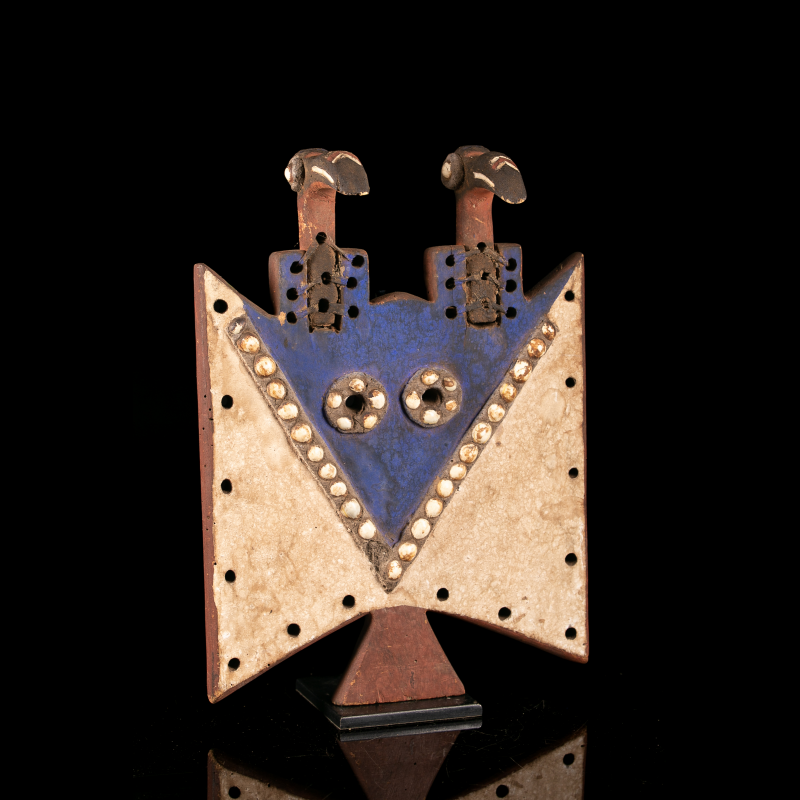
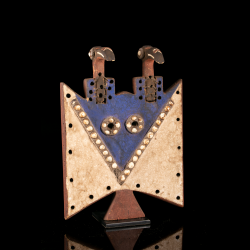
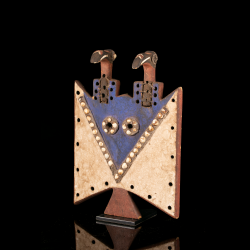
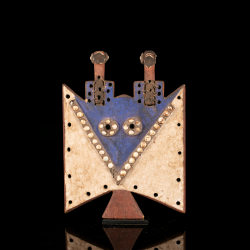
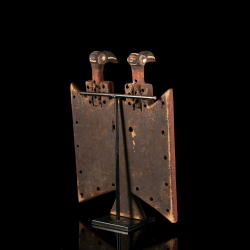
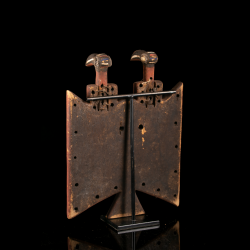
Striking Toussian plank mask of the Ioniake / Loniaken type, carved in wood and enlivened by a bold palette of deep blue, white and red. Its highly architectural composition forms a broad, wing-like geometric structure surmounted by two elongated necks terminating in stylised bird heads, most probably hornbills. Applied elements, peripheral perforations and pale inlays further animate the surface.
The Toussian, who live in southwestern Burkina Faso, produced a relatively restricted yet highly distinctive corpus of masks. Loniaken masks were associated with the Do or Lo initiation institution, through which young people were progressively introduced to the religious and social structures of the community. During initiation, boys could receive secret names referring to birds or wild animals, whose symbolic identities were embodied by masks.
These large zoomorphic masks rank among the most radically abstract sculptural traditions of Burkina Faso. Their appearance was reserved for important ceremonial occasions; Christie’s notes both their rarity in Western collections and the exceptional nature of the major initiation cycles during which such masks were danced. The paired birds crowning the present example further reinforce its emblematic character and striking sculptural presence.
With its bold geometry, preserved polychromy and almost modernist formal economy, this work is a particularly compelling expression of Toussian aesthetics, in which animal imagery is transformed into powerful abstraction.
Data sheet
You might also like
Striking Toussian plank mask of the Ioniake / Loniaken type, carved in wood and enlivened by a bold palette of deep blue, white and red. Its highly architectural composition forms a broad, wing-like geometric structure surmounted by two elongated necks terminating in stylised bird heads, most probably hornbills. Applied elements, peripheral perforations and pale inlays further animate the surface.
The Toussian, who live in southwestern Burkina Faso, produced a relatively restricted yet highly distinctive corpus of masks. Loniaken masks were associated with the Do or Lo initiation institution, through which young people were progressively introduced to the religious and social structures of the community. During initiation, boys could receive secret names referring to birds or wild animals, whose symbolic identities were embodied by masks.
These large zoomorphic masks rank among the most radically abstract sculptural traditions of Burkina Faso. Their appearance was reserved for important ceremonial occasions; Christie’s notes both their rarity in Western collections and the exceptional nature of the major initiation cycles during which such masks were danced. The paired birds crowning the present example further reinforce its emblematic character and striking sculptural presence.
With its bold geometry, preserved polychromy and almost modernist formal economy, this work is a particularly compelling expression of Toussian aesthetics, in which animal imagery is transformed into powerful abstraction.