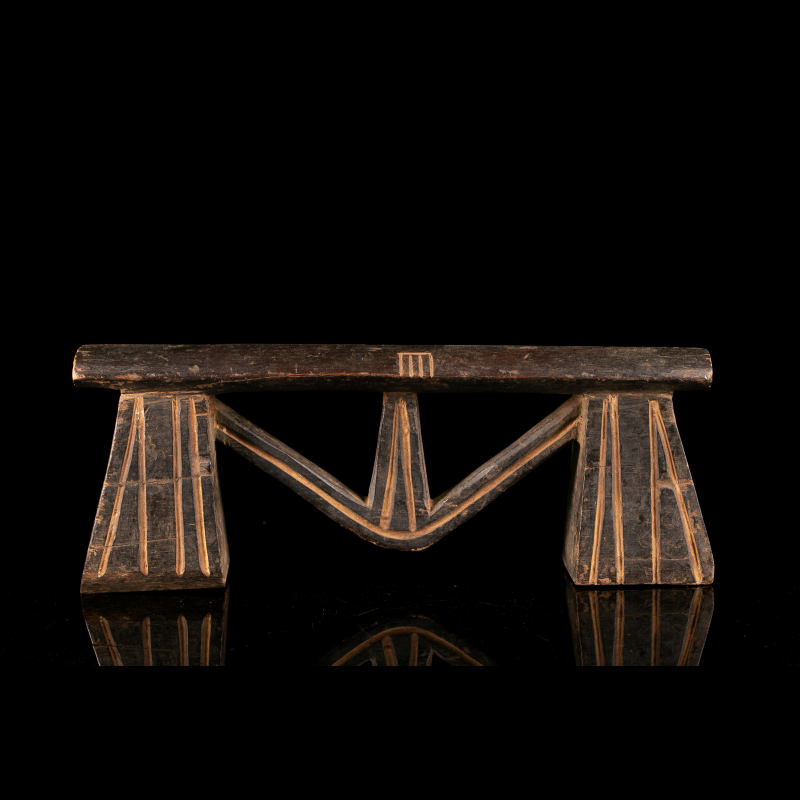
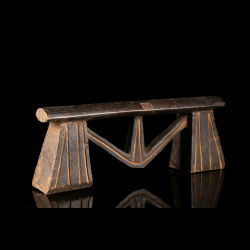
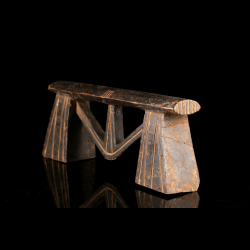
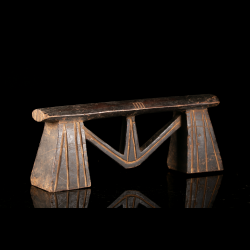
Rare and elegant carved wooden headrest attributable to the Zulu or, more broadly, Nguni peoples of Southern Africa. Its architectural composition rests on two strong trapezoidal supports linked by a central V-shaped element, creating a structure that is both rigorous and remarkably balanced. Fine linear incisions articulate the supports and enliven the dark surface of the wood.
Within Zulu and neighbouring societies, the headrest was far more than a simple sleeping accessory. It elevated the head and protected elaborate hairstyles, which could communicate age, social standing or marital status. Such objects were closely associated with their owners and could also function as valued personal and prestige possessions.
Zulu headrests display considerable sculptural diversity, ranging from examples supported by multiple legs to highly geometric constructions. Some formed part of marriage-related exchanges and could be commissioned for a bride and groom. Smithsonian documentation also notes the symbolic importance of cattle in certain Zulu headrest forms, with multiple supports sometimes interpreted as evoking a herd, traditionally associated with wealth and social status.
The present example is distinguished by the almost abstract purity of its design. A long horizontal upper support, subtly softened through use, crowns an open construction in which solids and voids are carefully balanced. Incised lines emphasise the verticality of the feet and the tension of the central support, while a small geometric motif at the centre of the upper bar provides a restrained decorative accent.
The deep brown patina, heightened by lighter areas of wear, conveys prolonged handling and use and further enhances the sculptural quality of this intimate object. With its restrained architecture and powerful graphic presence, this headrest offers a particularly elegant expression of the formal inventiveness found in the utilitarian arts of Southern Africa.
Data sheet
You might also like
Rare and elegant carved wooden headrest attributable to the Zulu or, more broadly, Nguni peoples of Southern Africa. Its architectural composition rests on two strong trapezoidal supports linked by a central V-shaped element, creating a structure that is both rigorous and remarkably balanced. Fine linear incisions articulate the supports and enliven the dark surface of the wood.
Within Zulu and neighbouring societies, the headrest was far more than a simple sleeping accessory. It elevated the head and protected elaborate hairstyles, which could communicate age, social standing or marital status. Such objects were closely associated with their owners and could also function as valued personal and prestige possessions.
Zulu headrests display considerable sculptural diversity, ranging from examples supported by multiple legs to highly geometric constructions. Some formed part of marriage-related exchanges and could be commissioned for a bride and groom. Smithsonian documentation also notes the symbolic importance of cattle in certain Zulu headrest forms, with multiple supports sometimes interpreted as evoking a herd, traditionally associated with wealth and social status.
The present example is distinguished by the almost abstract purity of its design. A long horizontal upper support, subtly softened through use, crowns an open construction in which solids and voids are carefully balanced. Incised lines emphasise the verticality of the feet and the tension of the central support, while a small geometric motif at the centre of the upper bar provides a restrained decorative accent.
The deep brown patina, heightened by lighter areas of wear, conveys prolonged handling and use and further enhances the sculptural quality of this intimate object. With its restrained architecture and powerful graphic presence, this headrest offers a particularly elegant expression of the formal inventiveness found in the utilitarian arts of Southern Africa.