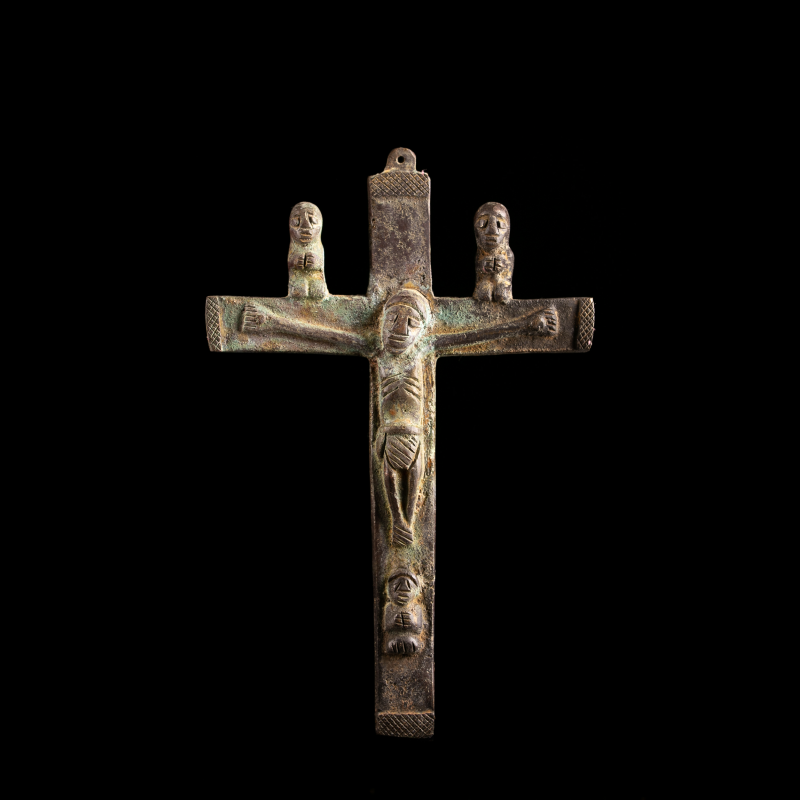
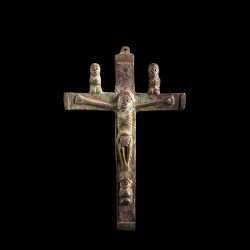
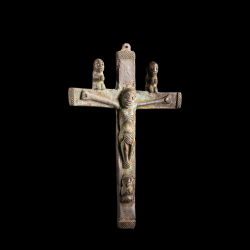
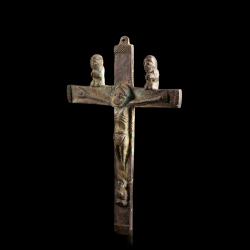
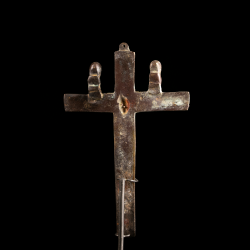
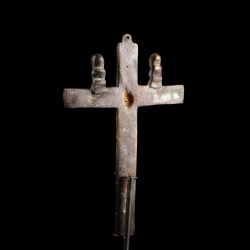
Known in traditional African art of the Bakongo, kiditu crucifixes, also called nkangi kiditu (“protective Christ”), hold a special place in the art and spirituality of the Kongo people, who live between Angola, the Democratic Republic of Congo, and the Republic of Congo.
Their history dates back to the 15th century, when the first Portuguese missionaries introduced Christianity to the Kongo Kingdom. Local artisans quickly adopted this iconography, creating unique crucifixes, often made of copper alloy, ivory, or wood, where Christ is depicted with African features and traditional geometric patterns.
These objects are not simply religious symbols: they embody a profound syncretism between the Christian faith and ancestral Kongo beliefs. In the local culture, the cross represents the yowa, the four creative forces associated with the cardinal directions and the cycles of life.
Nkangi kiditu crucifixes were frequently owned by chiefs (mfumu) and used in power rituals (kimpasi), serving as status symbols, objects of protection against misfortune, and a link to ancestors.
Their creation reflects this cultural fusion: while the form is inspired by European models, the materials, casting techniques, and ornamental details are typically Kongo. Some crucifixes, such as those exhibited at the Musée du Quai Branly or the Royal Museum for Central Africa, still bear traces of "magical charges" added to reinforce their spiritual power.
Data sheet
You might also like
Known in traditional African art of the Bakongo, kiditu crucifixes, also called nkangi kiditu (“protective Christ”), hold a special place in the art and spirituality of the Kongo people, who live between Angola, the Democratic Republic of Congo, and the Republic of Congo.
Their history dates back to the 15th century, when the first Portuguese missionaries introduced Christianity to the Kongo Kingdom. Local artisans quickly adopted this iconography, creating unique crucifixes, often made of copper alloy, ivory, or wood, where Christ is depicted with African features and traditional geometric patterns.
These objects are not simply religious symbols: they embody a profound syncretism between the Christian faith and ancestral Kongo beliefs. In the local culture, the cross represents the yowa, the four creative forces associated with the cardinal directions and the cycles of life.
Nkangi kiditu crucifixes were frequently owned by chiefs (mfumu) and used in power rituals (kimpasi), serving as status symbols, objects of protection against misfortune, and a link to ancestors.
Their creation reflects this cultural fusion: while the form is inspired by European models, the materials, casting techniques, and ornamental details are typically Kongo. Some crucifixes, such as those exhibited at the Musée du Quai Branly or the Royal Museum for Central Africa, still bear traces of "magical charges" added to reinforce their spiritual power.