This Lobi miniature chameleon figure, originating from Burkina Faso, is a compelling example of African tribal art where animal forms are used to express complex symbolic and spiritual ideas.
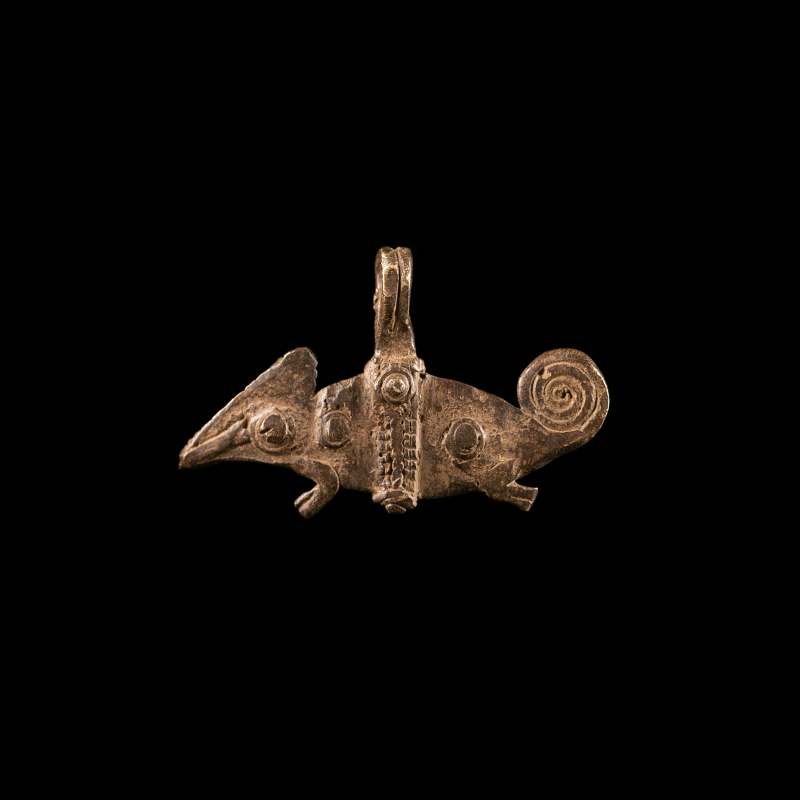
Rendered in a refined and stylized manner, this zoomorphic sculpture captures the essential characteristics of the chameleon. The elongated head and prominent eyes evoke its unique ability to observe its surroundings with precision, while the body is structured along a central axis, giving the piece a strong visual balance. The tail, shaped into a spiral, departs from naturalistic depiction but reflects an important symbolic language found throughout African art.
The surface displays a deep, nuanced patina, testifying to age and handling, and enhancing the tactile presence of this African miniature. The abstraction is deliberate, emphasizing meaning over realism, in line with Lobi artistic traditions.
In Lobi culture, as well as across parts of West and Central Africa, the chameleon holds significant symbolic value. Its ability to change color makes it a powerful metaphor for transformation, adaptability, and intelligence. It is closely associated with diviners and healers, who, like the chameleon, must navigate shifting realities and unseen forces.
The spiral tail, a recurring motif in African tribal sculpture, is particularly meaningful. It often relates to concepts of time, continuity, and the presence of ancestors, reinforcing the object’s connection to spiritual cycles and inherited knowledge.
The chameleon is also a figure of duality. Its slow, deliberate movement is traditionally compared to that of an elder, embodying wisdom and experience. At the same time, its capacity for rapid adaptation and discreet observation associates it with cunning and strategic intelligence. In some contexts, it may even symbolize ambiguity or hidden intent.
Such Lobi figures were not merely decorative. They could serve as personal protective objects, elements of divination practices, or symbolic tools within a broader spiritual framework. Their small scale reinforces their intimate function, often kept close to the individual.
This Lobi chameleon sculpture from Burkina Faso stands as a refined example of African tribal art, where form, symbolism, and function are deeply interconnected, offering insight into a worldview shaped by transformation, ancestry, and knowledge.
Data sheet
This Lobi miniature chameleon figure, originating from Burkina Faso, is a compelling example of African tribal art where animal forms are used to express complex symbolic and spiritual ideas.
Rendered in a refined and stylized manner, this zoomorphic sculpture captures the essential characteristics of the chameleon. The elongated head and prominent eyes evoke its unique ability to observe its surroundings with precision, while the body is structured along a central axis, giving the piece a strong visual balance. The tail, shaped into a spiral, departs from naturalistic depiction but reflects an important symbolic language found throughout African art.
The surface displays a deep, nuanced patina, testifying to age and handling, and enhancing the tactile presence of this African miniature. The abstraction is deliberate, emphasizing meaning over realism, in line with Lobi artistic traditions.
In Lobi culture, as well as across parts of West and Central Africa, the chameleon holds significant symbolic value. Its ability to change color makes it a powerful metaphor for transformation, adaptability, and intelligence. It is closely associated with diviners and healers, who, like the chameleon, must navigate shifting realities and unseen forces.
The spiral tail, a recurring motif in African tribal sculpture, is particularly meaningful. It often relates to concepts of time, continuity, and the presence of ancestors, reinforcing the object’s connection to spiritual cycles and inherited knowledge.
The chameleon is also a figure of duality. Its slow, deliberate movement is traditionally compared to that of an elder, embodying wisdom and experience. At the same time, its capacity for rapid adaptation and discreet observation associates it with cunning and strategic intelligence. In some contexts, it may even symbolize ambiguity or hidden intent.
Such Lobi figures were not merely decorative. They could serve as personal protective objects, elements of divination practices, or symbolic tools within a broader spiritual framework. Their small scale reinforces their intimate function, often kept close to the individual.
This Lobi chameleon sculpture from Burkina Faso stands as a refined example of African tribal art, where form, symbolism, and function are deeply interconnected, offering insight into a worldview shaped by transformation, ancestry, and knowledge.