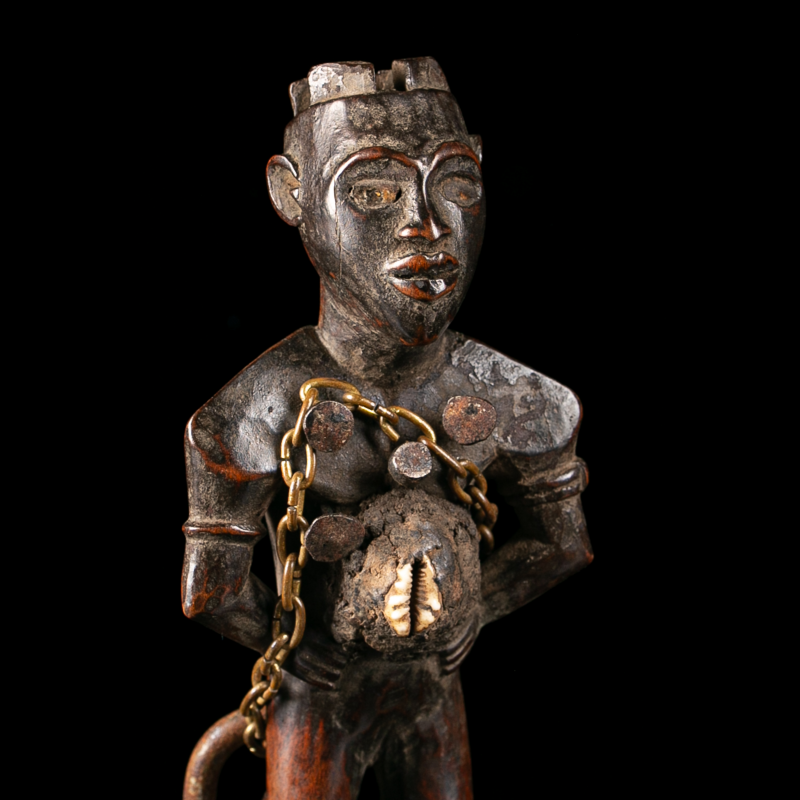
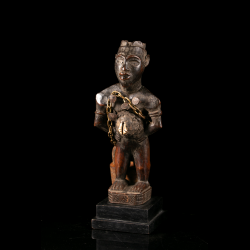
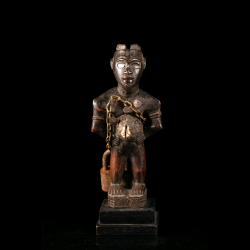
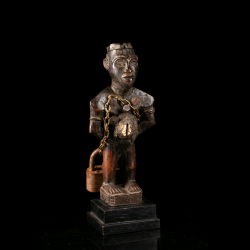
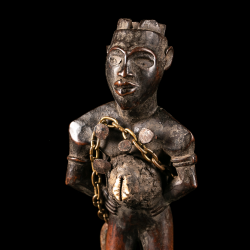
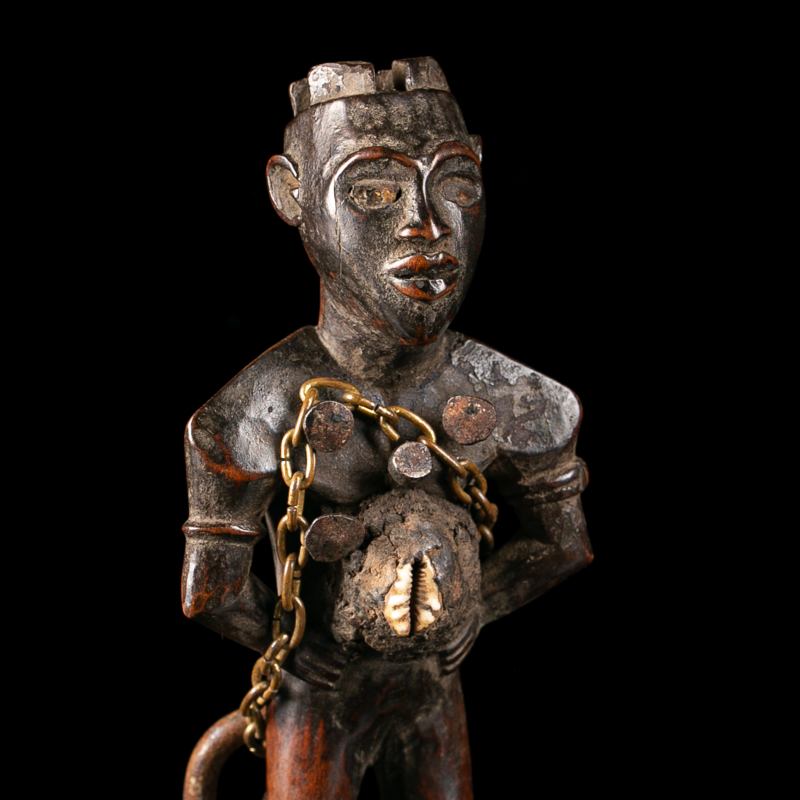
Despite its compact height of 19 cm, this remarkable Kongo nkisi power figure incorporates several essential features of the minkisi tradition. The standing male figure adopts a firm posture, his bent arms framing a prominent ritual charge on the abdomen. Made of an earthy or resinous composite substance, this receptacle is centred by a cowrie shell, a particularly evocative feature in an assemblage intended to concentrate and materialise the object's power.
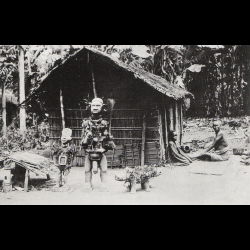
Within Kongo thought, an nkisi was far more than a carved figure. It became operative through the intervention of a ritual specialist, the nganga, who introduced empowering substances known as bilongo into cavities or attached receptacles. Such preparations could combine plant, mineral and animal materials according to the intended purpose: protection, healing, dispute settlement or the punishment of wrongdoing.
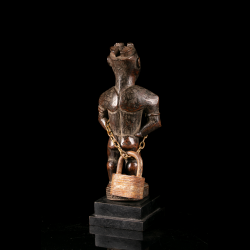
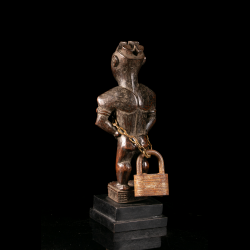
Several metal points remain embedded in the torso, while a chain crosses the chest and extends towards a padlock. Such additions belong to the vocabulary of certain minkisi: inserted metal could accompany the activation of their powers, while chains could metaphorically evoke the ability to bind, immobilise or control a force or adversary. Combined with the figure's assertive stance, these features cautiously suggest a relationship with the nkisi nkondi category, the “hunters” invoked to pursue wrongdoers or sources of disorder.
Its small scale is fully compatible with ritual use. The Metropolitan Museum, for example, preserves a male Kongo nkisi measuring 19.7 cm, while the Smithsonian documents miniature minkisi capable of functioning as independent power objects.
The accomplished carving, deep brown-black patina, geometrically decorated base and, above all, the survival of a complex ritual assemblage give this figure an unusually concentrated visual presence.
This exceptional piece has been entrusted to us by Lucien Mbungu Mbuka—an antique dealer, President of ASSONACO (National Association of Antique Dealers of the Congo), and an accredited expert for MUSAFRICA (Namur) and the National Museum of the Democratic Republic of the Congo.
Data sheet
You might also like
Despite its compact height of 19 cm, this remarkable Kongo nkisi power figure incorporates several essential features of the minkisi tradition. The standing male figure adopts a firm posture, his bent arms framing a prominent ritual charge on the abdomen. Made of an earthy or resinous composite substance, this receptacle is centred by a cowrie shell, a particularly evocative feature in an assemblage intended to concentrate and materialise the object's power.
Within Kongo thought, an nkisi was far more than a carved figure. It became operative through the intervention of a ritual specialist, the nganga, who introduced empowering substances known as bilongo into cavities or attached receptacles. Such preparations could combine plant, mineral and animal materials according to the intended purpose: protection, healing, dispute settlement or the punishment of wrongdoing.
Several metal points remain embedded in the torso, while a chain crosses the chest and extends towards a padlock. Such additions belong to the vocabulary of certain minkisi: inserted metal could accompany the activation of their powers, while chains could metaphorically evoke the ability to bind, immobilise or control a force or adversary. Combined with the figure's assertive stance, these features cautiously suggest a relationship with the nkisi nkondi category, the “hunters” invoked to pursue wrongdoers or sources of disorder.
Its small scale is fully compatible with ritual use. The Metropolitan Museum, for example, preserves a male Kongo nkisi measuring 19.7 cm, while the Smithsonian documents miniature minkisi capable of functioning as independent power objects.
The accomplished carving, deep brown-black patina, geometrically decorated base and, above all, the survival of a complex ritual assemblage give this figure an unusually concentrated visual presence.
This exceptional piece has been entrusted to us by Lucien Mbungu Mbuka—an antique dealer, President of ASSONACO (National Association of Antique Dealers of the Congo), and an accredited expert for MUSAFRICA (Namur) and the National Museum of the Democratic Republic of the Congo.