Luba Mboko bowl bearer figure, Democratic Republic of the Congo
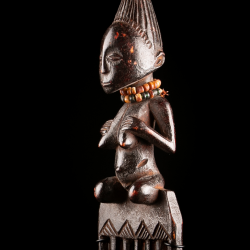
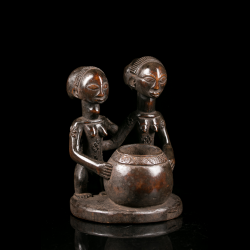
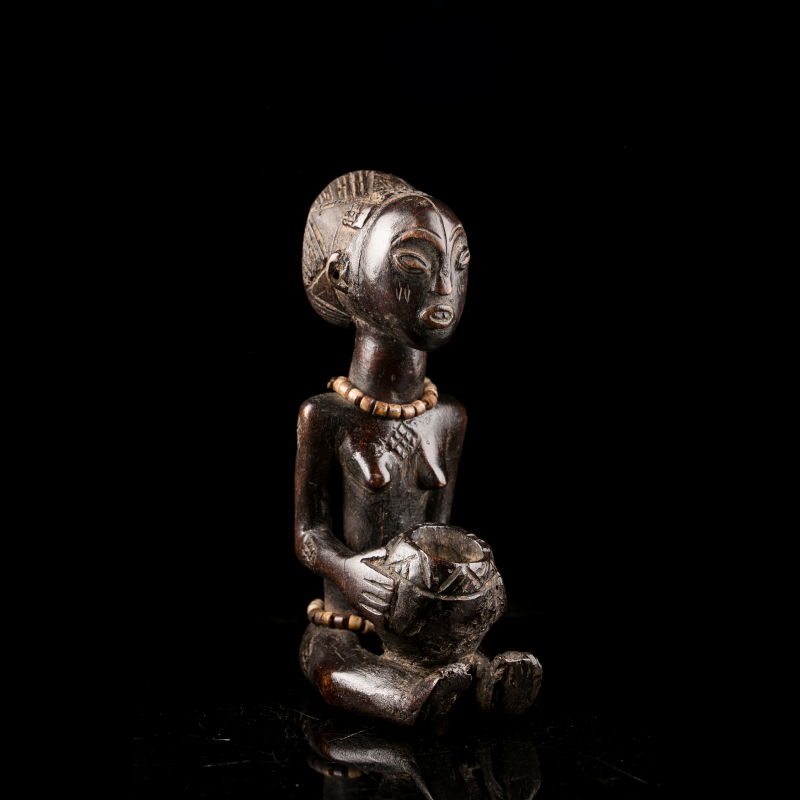
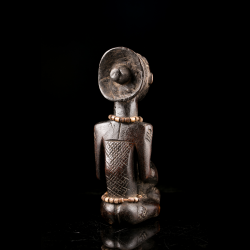
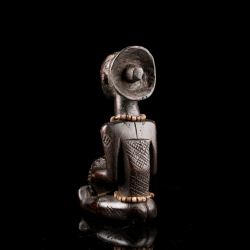
Intended for the collector seeking a genuine work of quality, combining authenticity, stylistic coherence, and documented provenance, this remarkable Luba bowl bearer figure, attributed to the Mboko subgroup, stands out for its highly refined stylization and strong formal presence. Carved from dense wood with an old, well-developed patina, it depicts a seated female figure holding a ceremonial bowl with both hands, presented in a frontal posture marked by restraint and dignity.
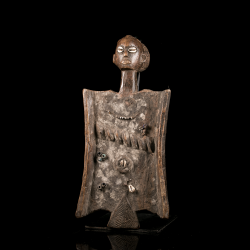
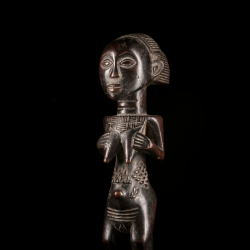
The sculpture is distinguished by a subtle and controlled treatment of volumes: the elongated torso, delicately modeled breasts, sloping shoulders, and seated position with folded legs reveal a masterful sense of balance and proportion. The face, elongated and serene, features finely incised details, half-closed eyes, and a slightly open mouth, giving the figure an introspective expression characteristic of Luba aesthetics. The elaborate coiffure, structured with incised geometric motifs, along with the decorative scarification patterns visible on the body, reinforces the symbolic and stately dimension of the work.
The bowl, carefully integrated into the composition, is not a mere accessory but a central element of the sculpture. Among the Luba, bowl bearer figures were closely associated with concepts of power, memory, and transmission. They were used in ritual and political contexts, particularly in connection with royal authority and initiation societies, serving to contain sacred substances, offerings, or objects linked to the legitimization of authority and communication with ancestors.
Luba bowl bearer figures are among the most emblematic and sought-after sculptures of Central African art. Early examples displaying strong stylistic coherence, authentic patina, and minimal restoration are today rare and highly valued by collectors and institutions alike. The Mboko subgroup is especially known for the sobriety of its forms, the contained tension of its postures, and the clarity of its symbolic language.
This sculpture comes from a Belgian private collection assembled during the 20th century and preserved in a strictly private setting. It has been carefully maintained and kept away from prolonged public display, which accounts for the quality of its surface and the depth of its patina.
Through its formal elegance, symbolic strength, and quality of execution, this Luba Mboko bowl bearer figure stands as a major work, fully embodying the Luba conception of memory, authority, and transmission. It represents a compelling acquisition for an informed collector as well as for an institutional or museum collection, and immediately inspires admiration through its quiet and timeless presence.
Data sheet
You might also like
Luba Mboko bowl bearer figure, Democratic Republic of the Congo
Intended for the collector seeking a genuine work of quality, combining authenticity, stylistic coherence, and documented provenance, this remarkable Luba bowl bearer figure, attributed to the Mboko subgroup, stands out for its highly refined stylization and strong formal presence. Carved from dense wood with an old, well-developed patina, it depicts a seated female figure holding a ceremonial bowl with both hands, presented in a frontal posture marked by restraint and dignity.
The sculpture is distinguished by a subtle and controlled treatment of volumes: the elongated torso, delicately modeled breasts, sloping shoulders, and seated position with folded legs reveal a masterful sense of balance and proportion. The face, elongated and serene, features finely incised details, half-closed eyes, and a slightly open mouth, giving the figure an introspective expression characteristic of Luba aesthetics. The elaborate coiffure, structured with incised geometric motifs, along with the decorative scarification patterns visible on the body, reinforces the symbolic and stately dimension of the work.
The bowl, carefully integrated into the composition, is not a mere accessory but a central element of the sculpture. Among the Luba, bowl bearer figures were closely associated with concepts of power, memory, and transmission. They were used in ritual and political contexts, particularly in connection with royal authority and initiation societies, serving to contain sacred substances, offerings, or objects linked to the legitimization of authority and communication with ancestors.
Luba bowl bearer figures are among the most emblematic and sought-after sculptures of Central African art. Early examples displaying strong stylistic coherence, authentic patina, and minimal restoration are today rare and highly valued by collectors and institutions alike. The Mboko subgroup is especially known for the sobriety of its forms, the contained tension of its postures, and the clarity of its symbolic language.
This sculpture comes from a Belgian private collection assembled during the 20th century and preserved in a strictly private setting. It has been carefully maintained and kept away from prolonged public display, which accounts for the quality of its surface and the depth of its patina.
Through its formal elegance, symbolic strength, and quality of execution, this Luba Mboko bowl bearer figure stands as a major work, fully embodying the Luba conception of memory, authority, and transmission. It represents a compelling acquisition for an informed collector as well as for an institutional or museum collection, and immediately inspires admiration through its quiet and timeless presence.