
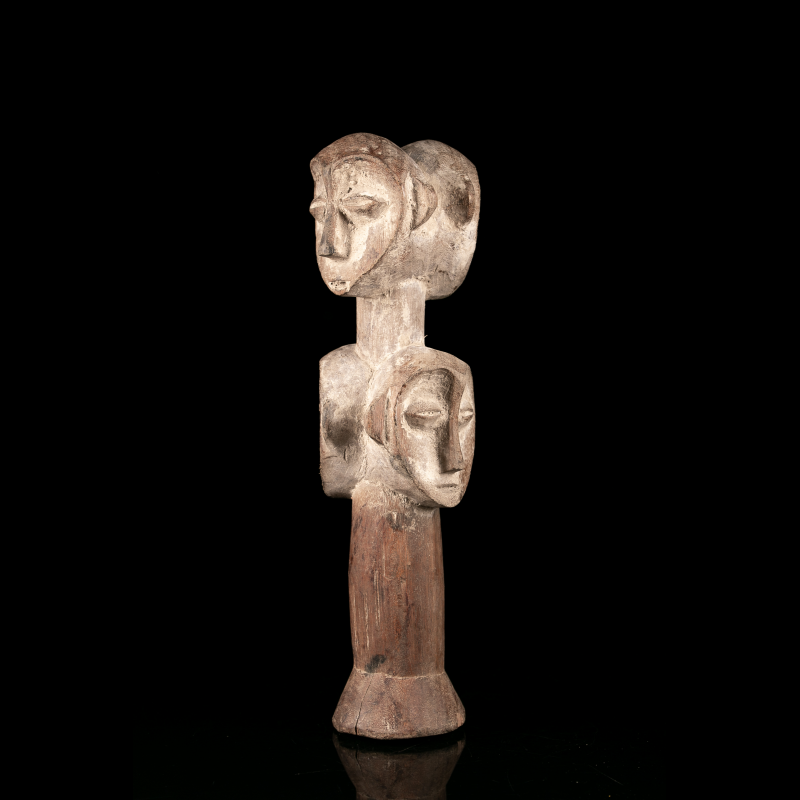
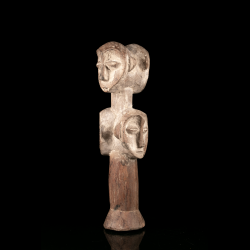
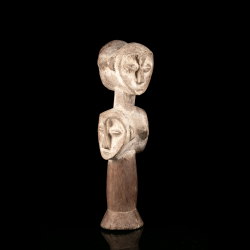
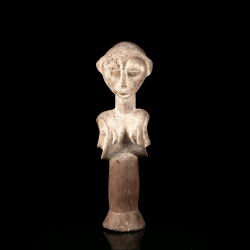
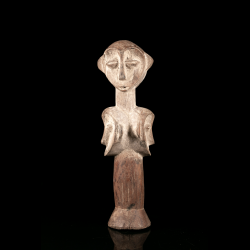
This remarkable Lega wooden figure is built around an unusually vertical composition in which two human heads are positioned one above the other on a long, simplified body. Both faces share the characteristic visual vocabulary of Lega sculpture: elongated eyelids, a long straight nose and a restrained mouth. A pale surface material, reminiscent of the kaolin preparations frequently encountered in Lega art, covers much of the figurative section and contrasts with the brown wood of the lower body.
Its multi-headed construction relates the sculpture to iginga figures associated with Bwami, the graded initiation association that played a fundamental moral, social and political role among Lega communities in eastern Democratic Republic of the Congo. Anthropomorphic figures, masks and other objects served as teaching devices whose meanings were developed through proverbs, performances and interpretation.
More specifically, the multiplication of heads recalls the concept of Sakimatwemtwe, or “many heads.” A celebrated example in the Brooklyn Museum connects this imagery with the ability to consider different perspectives, while the British Museum associates plurifrontal iginga figures with the enhanced understanding expected of highly initiated Bwami members.
Here, that concept is expressed with striking economy. Rather than spreading outward, the two heads rise along the same vertical axis, giving the sculpture an almost architectural quality. The pale faces, angular modelling and largely undecorated brown lower section create a particularly strong and restrained visual rhythm.
As museum scholarship emphasizes, individual Bwami figures could carry several meanings according to their context and level of initiation; a single fixed interpretation should therefore be approached with caution.
Data sheet
This remarkable Lega wooden figure is built around an unusually vertical composition in which two human heads are positioned one above the other on a long, simplified body. Both faces share the characteristic visual vocabulary of Lega sculpture: elongated eyelids, a long straight nose and a restrained mouth. A pale surface material, reminiscent of the kaolin preparations frequently encountered in Lega art, covers much of the figurative section and contrasts with the brown wood of the lower body.
Its multi-headed construction relates the sculpture to iginga figures associated with Bwami, the graded initiation association that played a fundamental moral, social and political role among Lega communities in eastern Democratic Republic of the Congo. Anthropomorphic figures, masks and other objects served as teaching devices whose meanings were developed through proverbs, performances and interpretation.
More specifically, the multiplication of heads recalls the concept of Sakimatwemtwe, or “many heads.” A celebrated example in the Brooklyn Museum connects this imagery with the ability to consider different perspectives, while the British Museum associates plurifrontal iginga figures with the enhanced understanding expected of highly initiated Bwami members.
Here, that concept is expressed with striking economy. Rather than spreading outward, the two heads rise along the same vertical axis, giving the sculpture an almost architectural quality. The pale faces, angular modelling and largely undecorated brown lower section create a particularly strong and restrained visual rhythm.
As museum scholarship emphasizes, individual Bwami figures could carry several meanings according to their context and level of initiation; a single fixed interpretation should therefore be approached with caution.