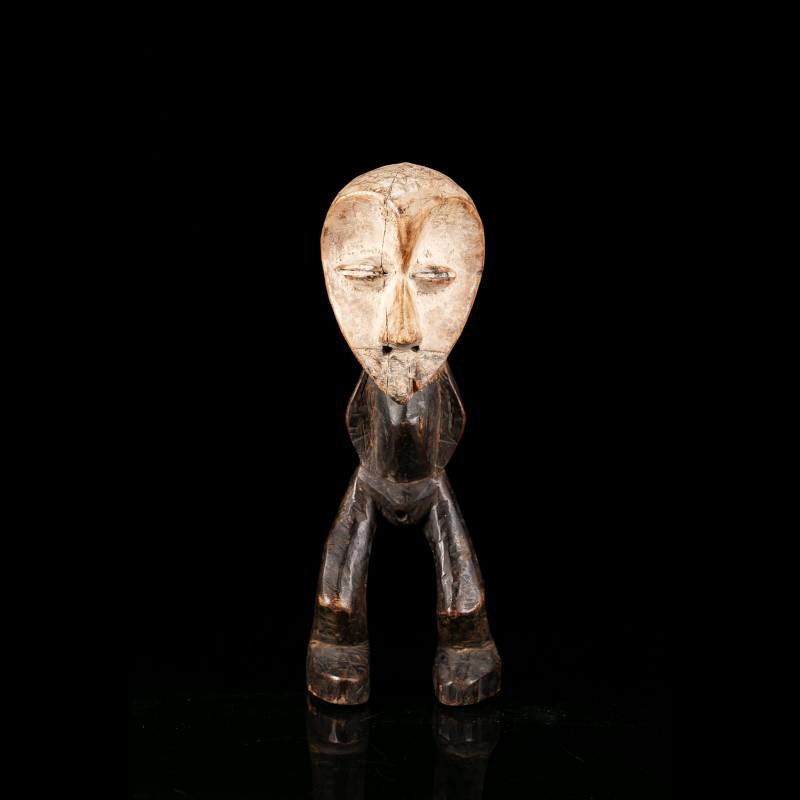
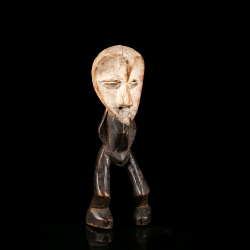
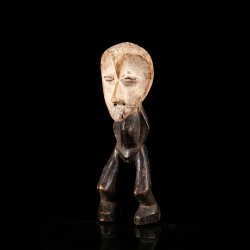
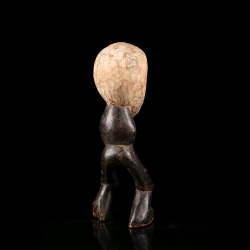
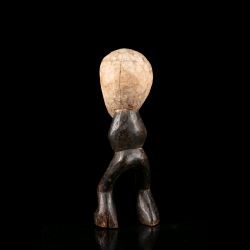
Lega Iginga initiation figure, Democratic Republic of the Congo, carved in wood and distinguished by the striking contrast between its dark body and pale face, probably coated with a kaolin-based material. The greatly enlarged head, narrow eyes, elongated nose and powerfully spread legs give the sculpture a strong and highly expressive presence.
Iginga figures formed part of the ritual repertoire of the Bwami initiation society, a central institution in Lega social and moral life. Displayed during initiation ceremonies, such figures served as visual supports for teachings conveyed through proverbs, stories, songs and performances. Their meaning therefore extended far beyond their physical appearance: individual figures could embody a particular character, behaviour or moral lesson that initiates were expected to interpret. Pale surfaces, often produced with kaolin, also formed part of the symbolic vocabulary of Bwami objects.
This sculpture may therefore confidently be classified as an iginga — plural maginga. Without documented ritual provenance, however, the specific character or proverb originally associated with it cannot be securely identified.
Data sheet
You might also like
Lega Iginga initiation figure, Democratic Republic of the Congo, carved in wood and distinguished by the striking contrast between its dark body and pale face, probably coated with a kaolin-based material. The greatly enlarged head, narrow eyes, elongated nose and powerfully spread legs give the sculpture a strong and highly expressive presence.
Iginga figures formed part of the ritual repertoire of the Bwami initiation society, a central institution in Lega social and moral life. Displayed during initiation ceremonies, such figures served as visual supports for teachings conveyed through proverbs, stories, songs and performances. Their meaning therefore extended far beyond their physical appearance: individual figures could embody a particular character, behaviour or moral lesson that initiates were expected to interpret. Pale surfaces, often produced with kaolin, also formed part of the symbolic vocabulary of Bwami objects.
This sculpture may therefore confidently be classified as an iginga — plural maginga. Without documented ritual provenance, however, the specific character or proverb originally associated with it cannot be securely identified.