
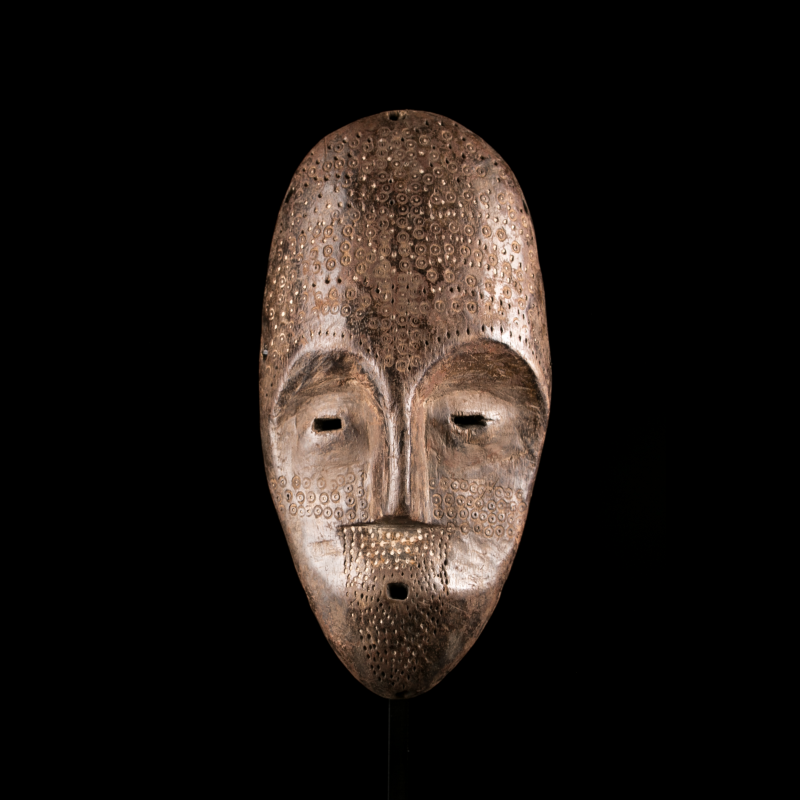
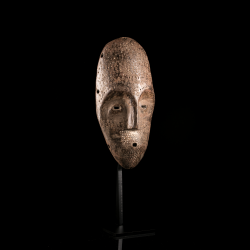
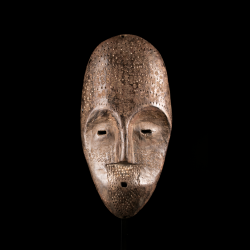
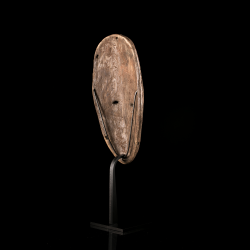
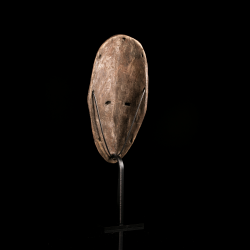
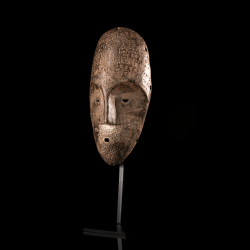
Luluwa (Lulua) mask, from the region between the Kasai and Sankuru rivers, southern Democratic Republic of the Congo.
This piece immediately stands out for its quiet authority and highly refined graphic presence. The face, elongated and restrained, is shaped with a soft, controlled modelling: half-closed eyelids, a straight nasal ridge, and a discreet mouth. The surface is then “animated” by a dense constellation of small punched pits, like a stippled skin, catching the light and giving the mask an exceptional sense of depth.
Through its spirit of synthesis, this aesthetic naturally resonates with certain Lega works: an economy of volumes, a silent intensity, and a rare balance between abstraction and humanity. Everything here is measured and coherent, without unnecessary effects—an object conceived to endure, and to assert itself within a serious collection.
Given the quality of execution, the construction of the planes, and this distinctive surface vocabulary, the mask can be related stylistically—and possibly attributed—to Jean Mandu or Mundilaayi Mushipu, both from Kalambayi, artists recognized for the graphic strength of their forms and their mastery of textured surfaces. A cautious attribution, yet a convincing stylistic connection that places this example among the stronger works within the Luluwa corpus.
Data sheet
Luluwa (Lulua) mask, from the region between the Kasai and Sankuru rivers, southern Democratic Republic of the Congo.
This piece immediately stands out for its quiet authority and highly refined graphic presence. The face, elongated and restrained, is shaped with a soft, controlled modelling: half-closed eyelids, a straight nasal ridge, and a discreet mouth. The surface is then “animated” by a dense constellation of small punched pits, like a stippled skin, catching the light and giving the mask an exceptional sense of depth.
Through its spirit of synthesis, this aesthetic naturally resonates with certain Lega works: an economy of volumes, a silent intensity, and a rare balance between abstraction and humanity. Everything here is measured and coherent, without unnecessary effects—an object conceived to endure, and to assert itself within a serious collection.
Given the quality of execution, the construction of the planes, and this distinctive surface vocabulary, the mask can be related stylistically—and possibly attributed—to Jean Mandu or Mundilaayi Mushipu, both from Kalambayi, artists recognized for the graphic strength of their forms and their mastery of textured surfaces. A cautious attribution, yet a convincing stylistic connection that places this example among the stronger works within the Luluwa corpus.