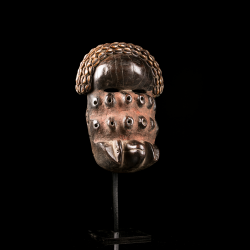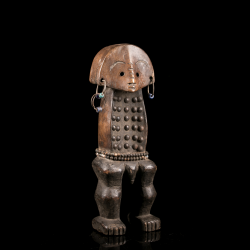
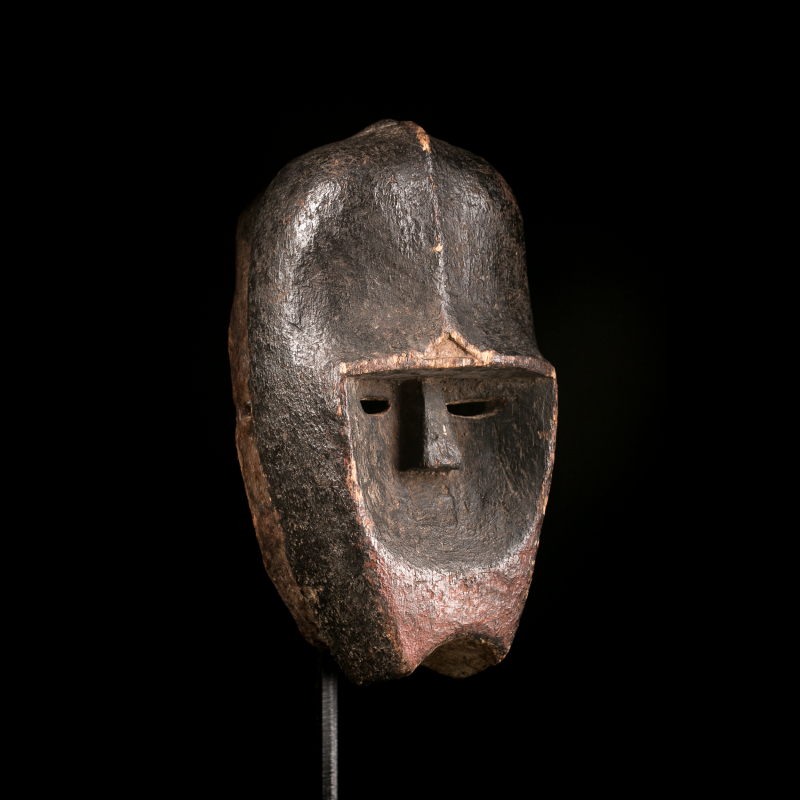
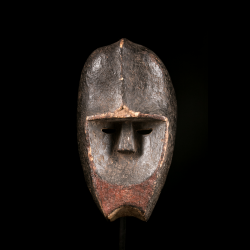
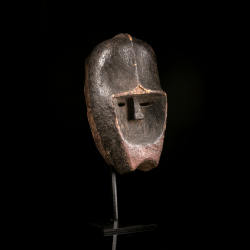
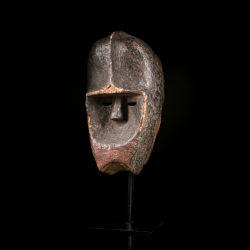
Gon masks, emblematic of the Kwele tribal art of Gabon and northern Congo-Brazzaville, represent the gorilla, a mythical ancestor and lord of the earth in the Beete cult.
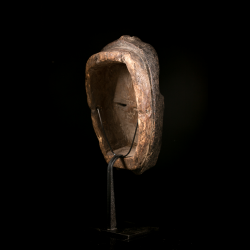
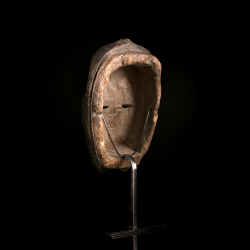
These zoomorphic pieces, carved from lightweight wood such as Alstonia congensis, exaggerate the features of the gorilla's skull: a prominent, domed forehead, an elongated and protruding snout, deep-set eyes, and a powerful jaw.
The Kwele Gon mask embodies a fierce presence used to ward off witchcraft, restore clan harmony, and honor ancestral lineages.
Worn by a dancer wrapped in raffia, it emerged from the darkness, projecting a supernatural aura during initiation or mourning rites, reinforcing Bakwele social cohesion.
Data sheet
Gon masks, emblematic of the Kwele tribal art of Gabon and northern Congo-Brazzaville, represent the gorilla, a mythical ancestor and lord of the earth in the Beete cult.
These zoomorphic pieces, carved from lightweight wood such as Alstonia congensis, exaggerate the features of the gorilla's skull: a prominent, domed forehead, an elongated and protruding snout, deep-set eyes, and a powerful jaw.
The Kwele Gon mask embodies a fierce presence used to ward off witchcraft, restore clan harmony, and honor ancestral lineages.
Worn by a dancer wrapped in raffia, it emerged from the darkness, projecting a supernatural aura during initiation or mourning rites, reinforcing Bakwele social cohesion.