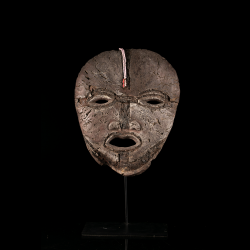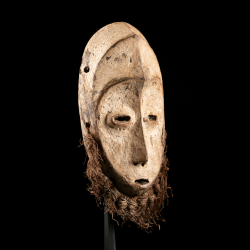
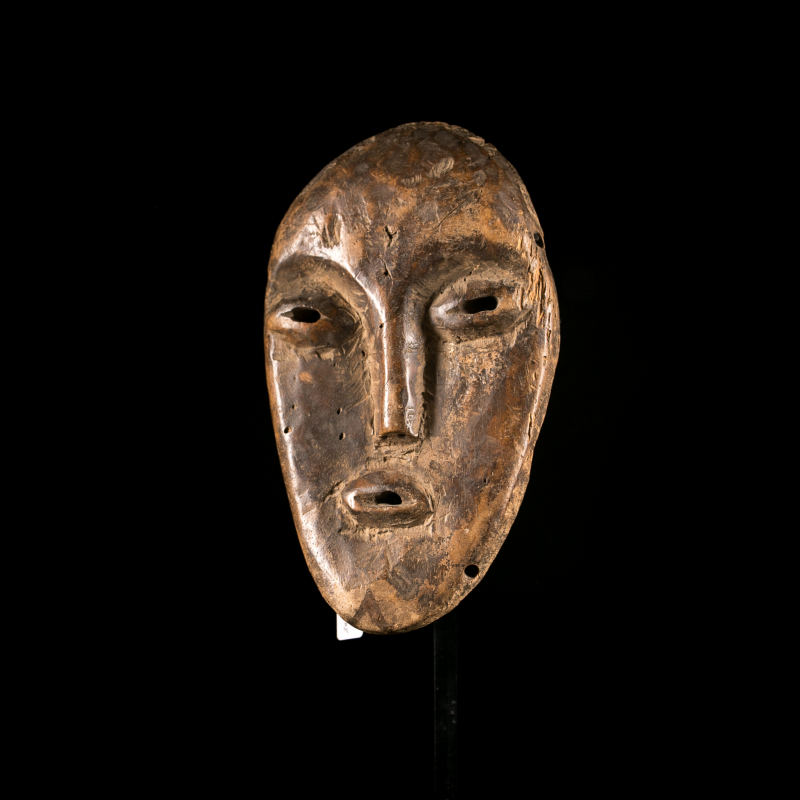

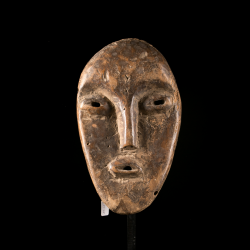
This remarkable Lega mask, originating from the Democratic Republic of the Congo, belongs to the initiatory world of the Bwami, the fundamental social and moral institution of Lega society. Striking in its formal simplicity, it perfectly embodies the refined minimalism characteristic of Lega sculpture, where a few essential volumes are sufficient to create a deeply introspective and powerful presence.
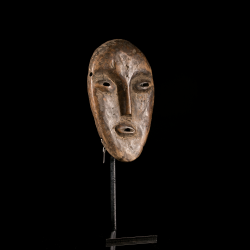
The composition is particularly well balanced, with an elongated oval face, narrow deeply carved eyes, a long straight nose, and a small projecting open mouth. The subtle asymmetry of the features and the deliberately restrained carving give the mask an almost archaic expression, far removed from purely decorative concerns.
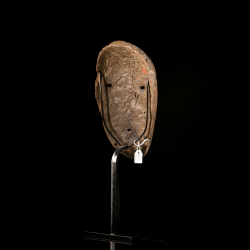
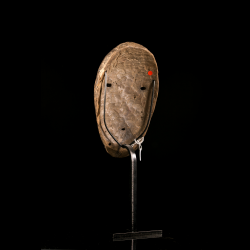
The surface is one of the most compelling aspects of the piece. The wood displays a complex and deeply aged patina, with abrasions, deposits, rubbing, and numerous traces of handling accumulated over time. The perforations visible around the perimeter are also characteristic of the functional conception of such masks and relate to their former methods of attachment or presentation.
Within the Bwami initiatory society, masks and sculptures served as vehicles for the transmission of knowledge and were associated with teachings, proverbs, moral principles, and the successive stages of initiation. Depending on their category and ritual context, such objects could be worn, handled, or displayed during ceremonies.
The European provenance of this piece is equally noteworthy. It comes from a Belgian private collection and was acquired in the early 2000s from a specialized tribal art dealer during an African and tribal art fair in the historic Sablon district of Brussels, one of Belgium’s most renowned centers for the African art market.
With its remarkable simplicity, powerful sculptural presence, deeply aged patina, and documented Belgian provenance, this mask represents a compelling example of Lega aesthetics and a highly appealing work for a collection devoted to the traditional arts of the Democratic Republic of the Congo.
Belgian private collection
Acquired from a specialized tribal art dealer during an art fair in the Sablon district of Brussels, early 2000s
Data sheet
You might also like
This remarkable Lega mask, originating from the Democratic Republic of the Congo, belongs to the initiatory world of the Bwami, the fundamental social and moral institution of Lega society. Striking in its formal simplicity, it perfectly embodies the refined minimalism characteristic of Lega sculpture, where a few essential volumes are sufficient to create a deeply introspective and powerful presence.
The composition is particularly well balanced, with an elongated oval face, narrow deeply carved eyes, a long straight nose, and a small projecting open mouth. The subtle asymmetry of the features and the deliberately restrained carving give the mask an almost archaic expression, far removed from purely decorative concerns.
The surface is one of the most compelling aspects of the piece. The wood displays a complex and deeply aged patina, with abrasions, deposits, rubbing, and numerous traces of handling accumulated over time. The perforations visible around the perimeter are also characteristic of the functional conception of such masks and relate to their former methods of attachment or presentation.
Within the Bwami initiatory society, masks and sculptures served as vehicles for the transmission of knowledge and were associated with teachings, proverbs, moral principles, and the successive stages of initiation. Depending on their category and ritual context, such objects could be worn, handled, or displayed during ceremonies.
The European provenance of this piece is equally noteworthy. It comes from a Belgian private collection and was acquired in the early 2000s from a specialized tribal art dealer during an African and tribal art fair in the historic Sablon district of Brussels, one of Belgium’s most renowned centers for the African art market.
With its remarkable simplicity, powerful sculptural presence, deeply aged patina, and documented Belgian provenance, this mask represents a compelling example of Lega aesthetics and a highly appealing work for a collection devoted to the traditional arts of the Democratic Republic of the Congo.
Belgian private collection
Acquired from a specialized tribal art dealer during an art fair in the Sablon district of Brussels, early 2000s