
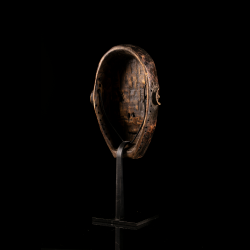
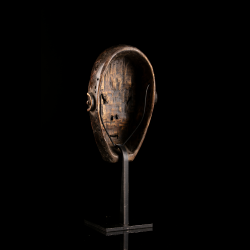
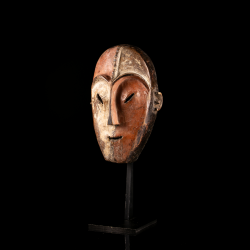
The Jonga (or Djonga), a Bantu group from Central Africa, are established in a region located between southern Gabon and northern Republic of Congo.
Their culture, marked by extensive exchanges with neighboring peoples, is distinguished by its original artistic and ritual production, notably through the use of masks with both symbolic and social functions.
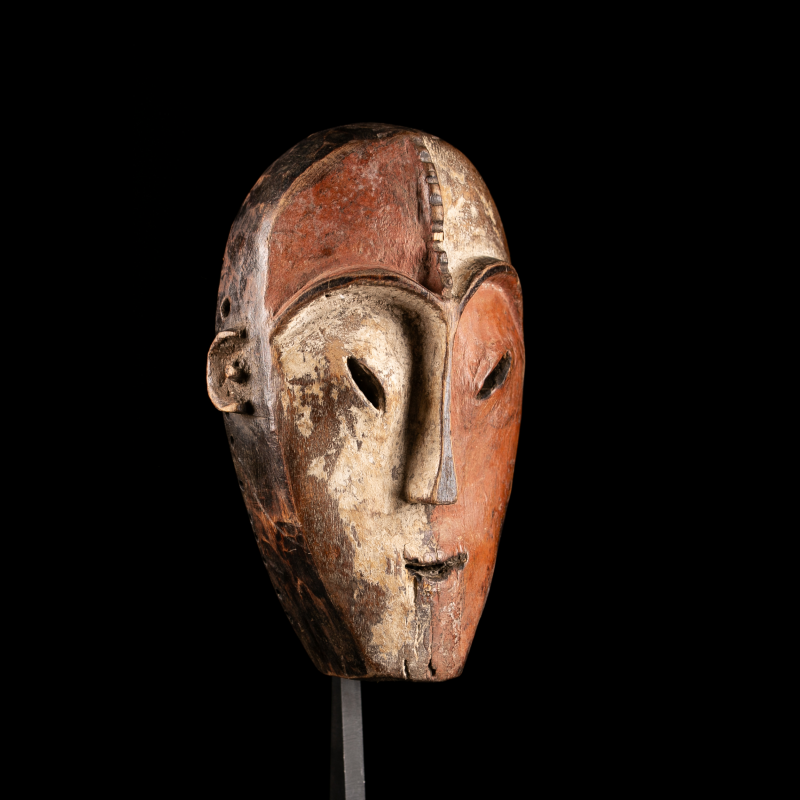
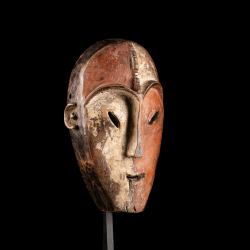
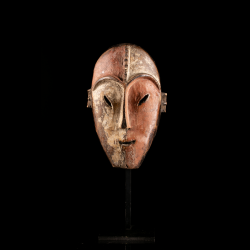
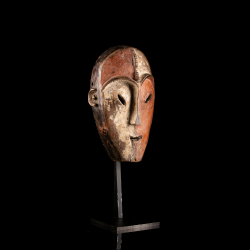
Traditional Jonga art masks, often characterized by a chromatic division of the face into diagonal surfaces (black, white, red), are part of a system of thought where each color refers to a specific dimension: black evokes the invisible world and the ancestors, white symbolizes purity or transition, and red embodies vitality and power.
Their style, both refined and expressive, reflects a controlled abstraction, where the simplicity of the forms serves to intensify the spiritual presence of the object.
These masks are primarily associated with the Nkoumi (nkumi) society, a male initiation institution responsible for preserving and transmitting ritual, medical, and symbolic knowledge. Within this framework, the mask is not simply an aesthetic accessory, but an active entity capable of mediating invisible forces and ensuring balance between the community, ancestors, and the spirit world. The ceremonies, often closed to the public, involve healing, divination, and rites of passage, highlighting the central role of the mask as a tool for transformation and protection.
The Jonga share common cultural traits with other groups in the region (Mbole, Yela, Lengola), notably the importance of scarification and ritual dyeing, which recall rites of passage and healing. Their art, although less well-known than that of the Luba or Songye, testifies to a living tradition, where each object carries the memory of the exchanges and beliefs that structure the social and spiritual life of these forest-dwelling populations.
Data sheet
The Jonga (or Djonga), a Bantu group from Central Africa, are established in a region located between southern Gabon and northern Republic of Congo.
Their culture, marked by extensive exchanges with neighboring peoples, is distinguished by its original artistic and ritual production, notably through the use of masks with both symbolic and social functions.
Traditional Jonga art masks, often characterized by a chromatic division of the face into diagonal surfaces (black, white, red), are part of a system of thought where each color refers to a specific dimension: black evokes the invisible world and the ancestors, white symbolizes purity or transition, and red embodies vitality and power.
Their style, both refined and expressive, reflects a controlled abstraction, where the simplicity of the forms serves to intensify the spiritual presence of the object.
These masks are primarily associated with the Nkoumi (nkumi) society, a male initiation institution responsible for preserving and transmitting ritual, medical, and symbolic knowledge. Within this framework, the mask is not simply an aesthetic accessory, but an active entity capable of mediating invisible forces and ensuring balance between the community, ancestors, and the spirit world. The ceremonies, often closed to the public, involve healing, divination, and rites of passage, highlighting the central role of the mask as a tool for transformation and protection.
The Jonga share common cultural traits with other groups in the region (Mbole, Yela, Lengola), notably the importance of scarification and ritual dyeing, which recall rites of passage and healing. Their art, although less well-known than that of the Luba or Songye, testifies to a living tradition, where each object carries the memory of the exchanges and beliefs that structure the social and spiritual life of these forest-dwelling populations.