The traditional Mwana Pwo mask, one of the most famous in African art, occupies a central place in Chokwe culture, primarily established in Angola, the Democratic Republic of Congo, and Zambia.
This female mask, whose name means "young woman" or "beautiful woman," embodies the female ancestor and plays an essential role in rituals related to fertility and the transmission of social values.
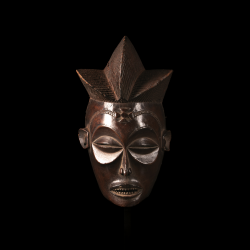
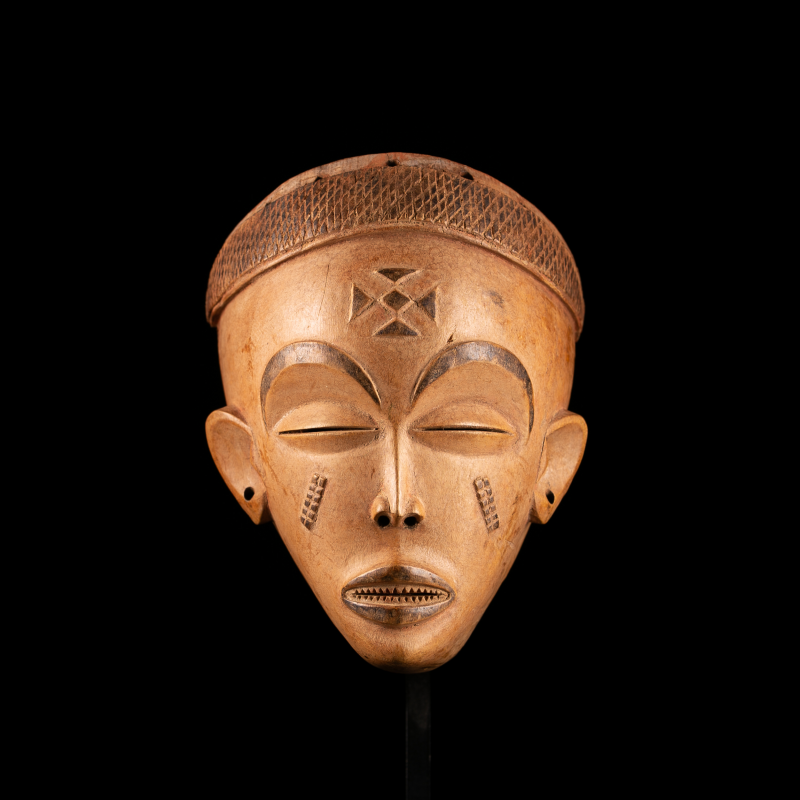
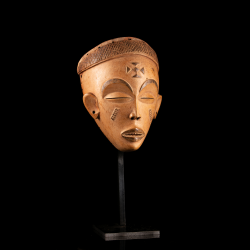
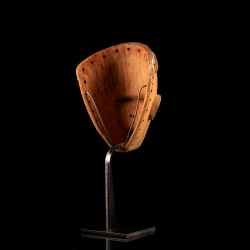
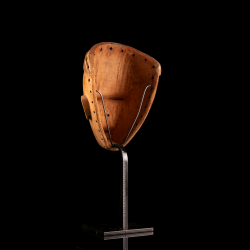
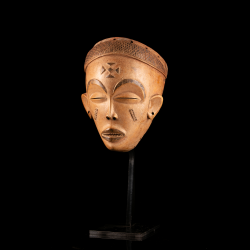
Stylistically, the Mwana Pwo is distinguished by the delicacy of its features: an oval face, almond-shaped eyes, a mouth often slightly open revealing filed teeth, and an elaborate hairstyle, sometimes integrated into the sculpture. The patina, obtained using natural pigments such as tukula, gives the mask a hue ranging from dark brown to red, reinforcing its sacred and aesthetic character. Chokwe sculptors, renowned for their mastery, seek an idealized beauty, reflecting the canons of feminine grace and seduction valued in their society.
Data sheet
You might also like
The traditional Mwana Pwo mask, one of the most famous in African art, occupies a central place in Chokwe culture, primarily established in Angola, the Democratic Republic of Congo, and Zambia.
This female mask, whose name means "young woman" or "beautiful woman," embodies the female ancestor and plays an essential role in rituals related to fertility and the transmission of social values.
Stylistically, the Mwana Pwo is distinguished by the delicacy of its features: an oval face, almond-shaped eyes, a mouth often slightly open revealing filed teeth, and an elaborate hairstyle, sometimes integrated into the sculpture. The patina, obtained using natural pigments such as tukula, gives the mask a hue ranging from dark brown to red, reinforcing its sacred and aesthetic character. Chokwe sculptors, renowned for their mastery, seek an idealized beauty, reflecting the canons of feminine grace and seduction valued in their society.