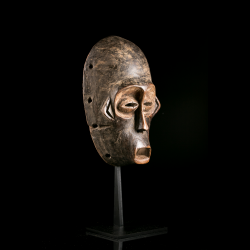
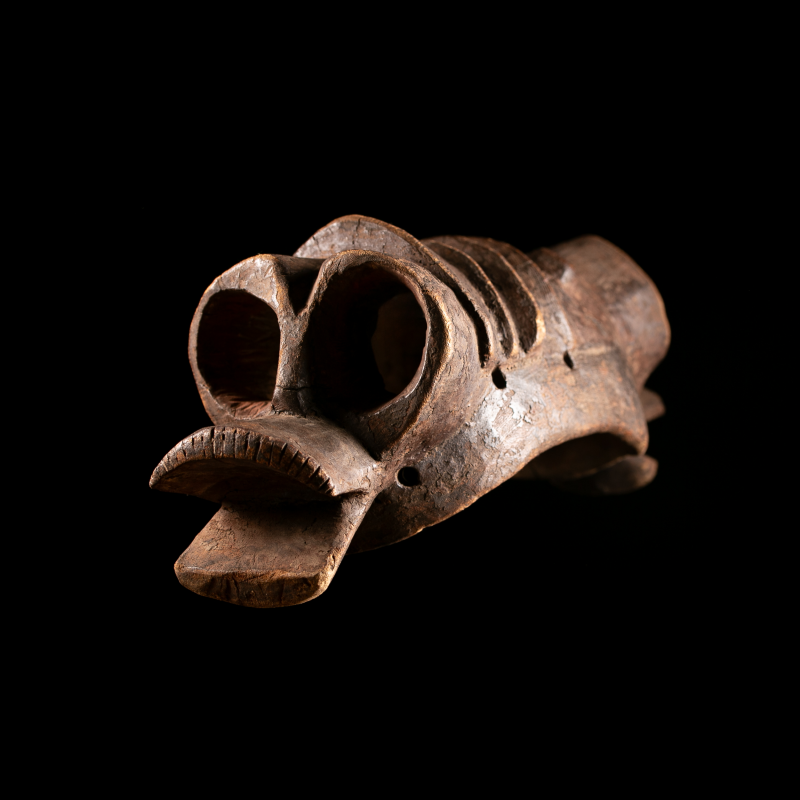
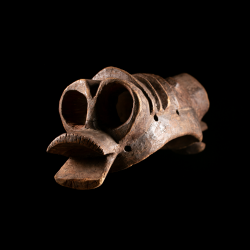
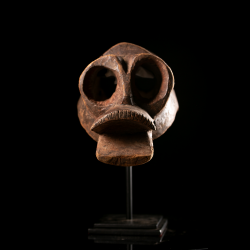
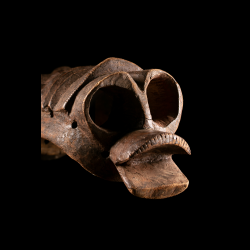
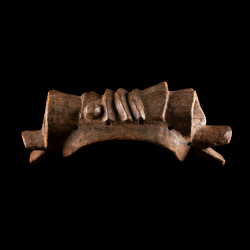
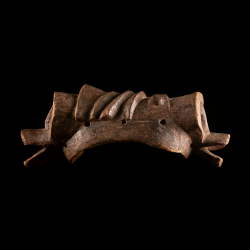
Mumuye face masks, originating from northeastern Nigeria, are among the most emblematic artistic expressions of this ethnic group.
Unlike the more well-known shoulder masks, Mumuye face masks are distinguished by their abstract style and pronounced geometric forms, often inspired by local wildlife (buffalo, monkeys, elephants).
These sacred objects played a central role in social and spiritual rituals, serving to invoke ancestors, regulate conflicts, or mark important transitions in community life.
Their use was reserved for initiates, reinforcing their mysterious nature and symbolic power.
Sylvia and Henry Gygax are a couple of collectors well-known in the Brussels and Parisian African art scene. True explorers, they crisscrossed West Africa, particularly Cameroon, to discover and study numerous ethnic groups. Their research led them to draft a seminal work on the Mambila people.
Originally from Switzerland, they later settled in Woluwe-Saint-Lambert, and their large home was a living testament to their travels: hundreds of objects of all kinds were displayed there.
Connoisseurs of their art, their expertise was also showcased in exhibitions at Parisian galleries.
The dispersal of their collection was a resounding success at the auction organized by Boisseau-Pomez.
Learn more about Sylvia and Henry Gygax: read here.
Data sheet
Mumuye face masks, originating from northeastern Nigeria, are among the most emblematic artistic expressions of this ethnic group.
Unlike the more well-known shoulder masks, Mumuye face masks are distinguished by their abstract style and pronounced geometric forms, often inspired by local wildlife (buffalo, monkeys, elephants).
These sacred objects played a central role in social and spiritual rituals, serving to invoke ancestors, regulate conflicts, or mark important transitions in community life.
Their use was reserved for initiates, reinforcing their mysterious nature and symbolic power.
Sylvia and Henry Gygax are a couple of collectors well-known in the Brussels and Parisian African art scene. True explorers, they crisscrossed West Africa, particularly Cameroon, to discover and study numerous ethnic groups. Their research led them to draft a seminal work on the Mambila people.
Originally from Switzerland, they later settled in Woluwe-Saint-Lambert, and their large home was a living testament to their travels: hundreds of objects of all kinds were displayed there.
Connoisseurs of their art, their expertise was also showcased in exhibitions at Parisian galleries.
The dispersal of their collection was a resounding success at the auction organized by Boisseau-Pomez.
Learn more about Sylvia and Henry Gygax: read here.