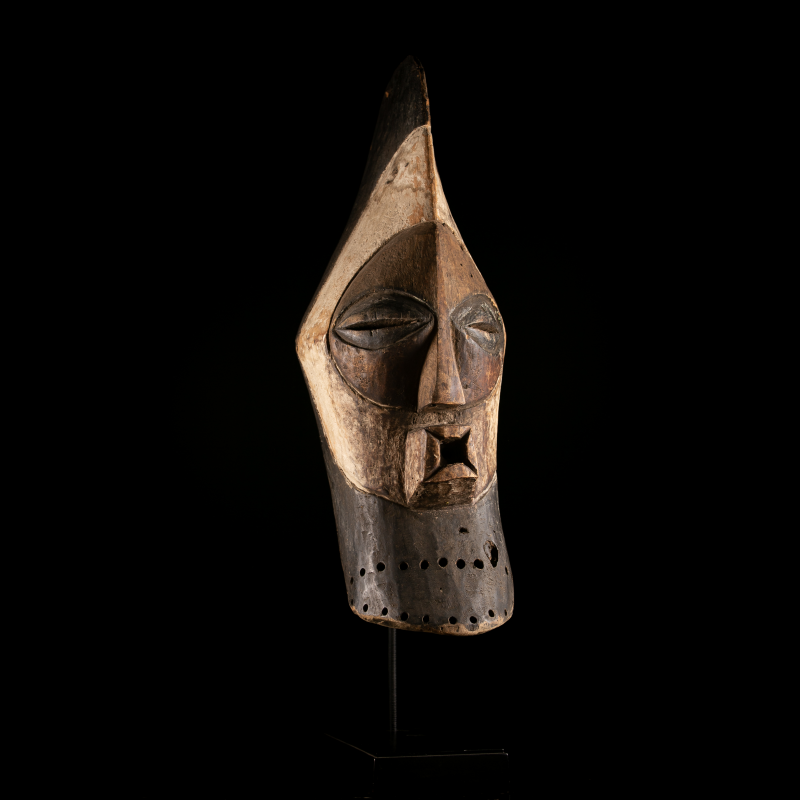
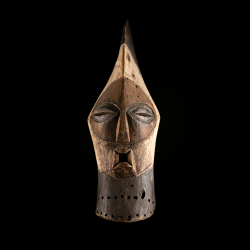
This Songye Kifwebe mask has a remarkably powerful vertical composition. A tall crest rises directly above the long central ridge of the nose, drawing the eye downward toward a strongly projecting, almost square-shaped mouth. Around this dominant axis, the face is constructed through a succession of sharply defined planes, elongated eyelids and broad areas of contrasting dark and light pigmentation.
Kifwebe masks belong to one of the most distinctive masking traditions of southeastern Democratic Republic of the Congo. The tradition is associated with both Songye and northern Luba communities, although each developed its own formal and performative interpretations. The Metropolitan Museum of Art notes that striated Kifwebe masks probably originated in northern Shaba, an area historically inhabited by both groups.
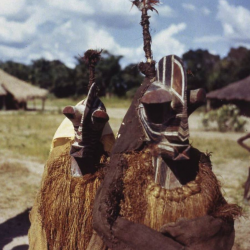
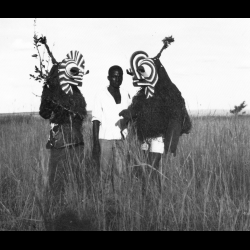
Among the Songye, Kifwebe masquerades were connected with the Bwadi bwa Kifwebe association and with expressions of authority and social regulation. These masks were not conceived as isolated sculptures: their visual power was completed through costume, movement and ceremonial performance.
This example is particularly striking for the clarity of its sculptural construction. Rather than covering the entire surface with dense parallel grooves, the composition relies upon large contrasting fields of dark and pale pigment. The narrow eyes emerge from strongly projecting orbital volumes, while the long angular nose creates a pronounced central ridge. Rows of holes around the lower section and edges relate to the attachment of the elements that once completed the masquerade ensemble.
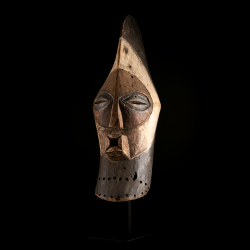
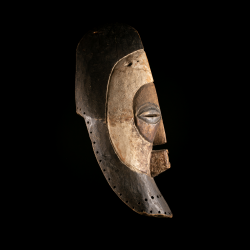
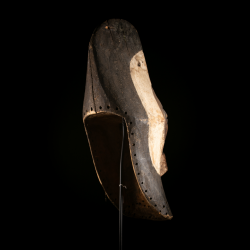
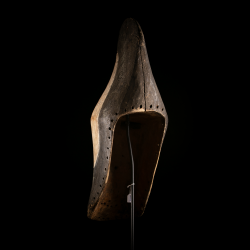
The side view is especially impressive, revealing the dramatic forward projection of the facial features and the soaring line of the crest. The deeply hollowed interior, visible from the reverse, provides an equally interesting view of the carving process.
With its bold geometry and highly architectural treatment of the human face, this Songye mask has a particularly strong sculptural presence.
Data sheet
You might also like
This Songye Kifwebe mask has a remarkably powerful vertical composition. A tall crest rises directly above the long central ridge of the nose, drawing the eye downward toward a strongly projecting, almost square-shaped mouth. Around this dominant axis, the face is constructed through a succession of sharply defined planes, elongated eyelids and broad areas of contrasting dark and light pigmentation.
Kifwebe masks belong to one of the most distinctive masking traditions of southeastern Democratic Republic of the Congo. The tradition is associated with both Songye and northern Luba communities, although each developed its own formal and performative interpretations. The Metropolitan Museum of Art notes that striated Kifwebe masks probably originated in northern Shaba, an area historically inhabited by both groups.
Among the Songye, Kifwebe masquerades were connected with the Bwadi bwa Kifwebe association and with expressions of authority and social regulation. These masks were not conceived as isolated sculptures: their visual power was completed through costume, movement and ceremonial performance.
This example is particularly striking for the clarity of its sculptural construction. Rather than covering the entire surface with dense parallel grooves, the composition relies upon large contrasting fields of dark and pale pigment. The narrow eyes emerge from strongly projecting orbital volumes, while the long angular nose creates a pronounced central ridge. Rows of holes around the lower section and edges relate to the attachment of the elements that once completed the masquerade ensemble.
The side view is especially impressive, revealing the dramatic forward projection of the facial features and the soaring line of the crest. The deeply hollowed interior, visible from the reverse, provides an equally interesting view of the carving process.
With its bold geometry and highly architectural treatment of the human face, this Songye mask has a particularly strong sculptural presence.