This striking Pende Mbangu mask, originating from the Pende people of the Democratic Republic of the Congo, is one of the most expressive creations of Central African tribal art. Rather than depicting an ancestor or protective spirit, the Mbangu mask portrays an individual affected by physical illness, most often interpreted as facial paralysis or a disease causing visible deformity.
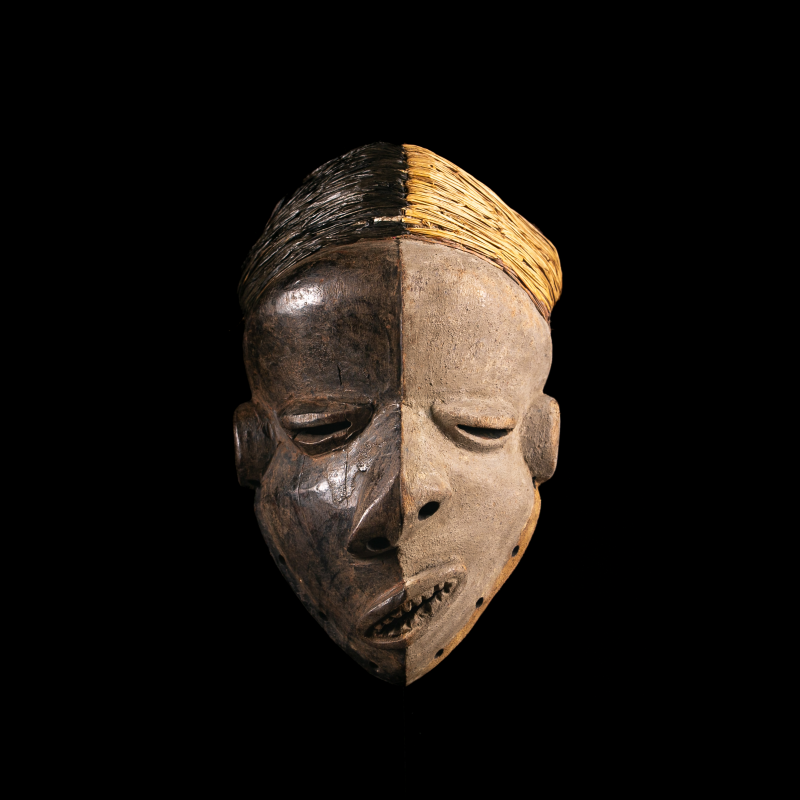
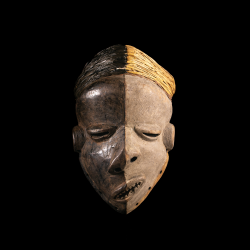
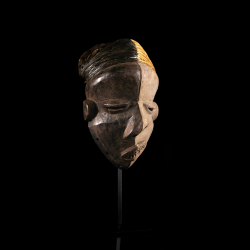
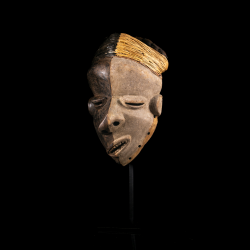
The sculptor intentionally emphasized asymmetry. One half of the face bears a deep dark patina, while the other is coated with a light pigment, creating a dramatic visual contrast. Narrow eyes, an uneven mouth revealing irregular teeth, and distorted facial volumes combine to produce an exceptionally powerful expression.
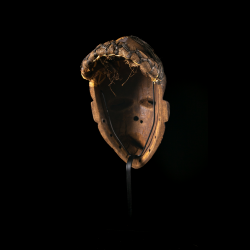
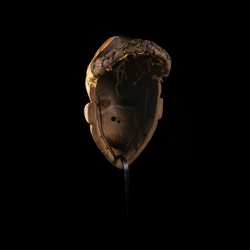
Its woven vegetal fiber coiffure remains attached, preserving an important element of the original ceremonial appearance. The small perforations around the edges once secured the raffia costume worn during masked performances.
Among the Pende, Mbangu masks appeared in public masquerades combining dance, music, and theatrical performance. Beyond their striking appearance, they fulfilled an important educational role by illustrating the consequences of improper behavior, encouraging moral reflection, and reinforcing social values through satire and exaggeration.
Today, Mbangu masks are highly appreciated for both their artistic originality and their anthropological significance. Their expressive carving and symbolic meaning make them sought-after works among collectors of authentic African tribal art.
Data sheet
You might also like
This striking Pende Mbangu mask, originating from the Pende people of the Democratic Republic of the Congo, is one of the most expressive creations of Central African tribal art. Rather than depicting an ancestor or protective spirit, the Mbangu mask portrays an individual affected by physical illness, most often interpreted as facial paralysis or a disease causing visible deformity.
The sculptor intentionally emphasized asymmetry. One half of the face bears a deep dark patina, while the other is coated with a light pigment, creating a dramatic visual contrast. Narrow eyes, an uneven mouth revealing irregular teeth, and distorted facial volumes combine to produce an exceptionally powerful expression.
Its woven vegetal fiber coiffure remains attached, preserving an important element of the original ceremonial appearance. The small perforations around the edges once secured the raffia costume worn during masked performances.
Among the Pende, Mbangu masks appeared in public masquerades combining dance, music, and theatrical performance. Beyond their striking appearance, they fulfilled an important educational role by illustrating the consequences of improper behavior, encouraging moral reflection, and reinforcing social values through satire and exaggeration.
Today, Mbangu masks are highly appreciated for both their artistic originality and their anthropological significance. Their expressive carving and symbolic meaning make them sought-after works among collectors of authentic African tribal art.