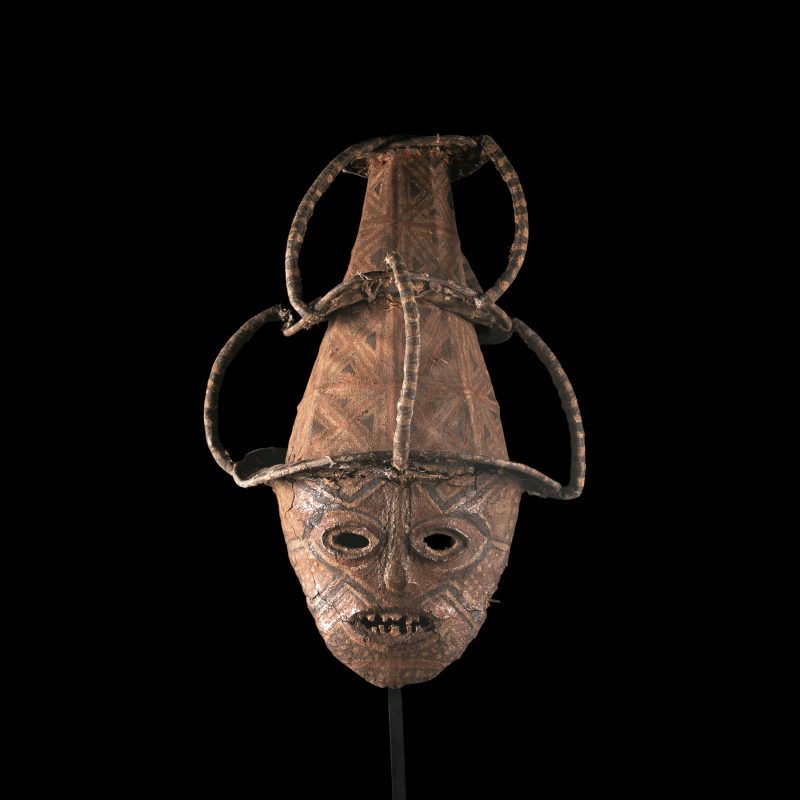
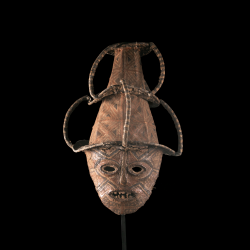
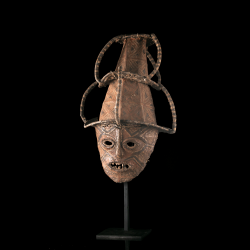
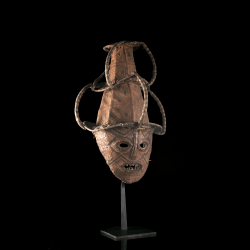
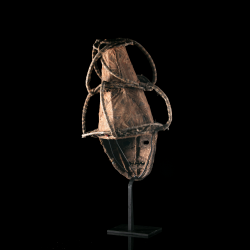
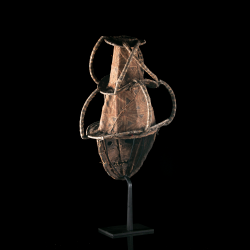
Attributed to the Luchazi, this mask immediately commands attention through an architecture extending far beyond the facial shell. Its compact, nearly oval face is structured by two deeply rimmed eye openings, a straight projecting nose and an open mouth displaying a row of small teeth. Painted or incised geometric patterns—chevrons, triangles and broken lines—animate the surface and lead the eye towards the monumental superstructure above.
The two-tiered conical headdress is covered with reddish-brown fabric bearing graphic ornamentation. A series of bound hoops expands around it, giving the mask an airy, almost architectural silhouette. Their curved movement contrasts strikingly with the dense, crust-like texture of the face.
This hardened surface is unlikely to consist of earth alone. Comparable masks belonging to the wider Makishi tradition were commonly made from bark cloth or textile stretched over a wooden framework, strengthened with a resinous coating and finished with pigments. Mineral or earth pigments may form part of the surface mixture, although scientific analysis would be needed to establish its precise composition.
The Luchazi participate in the Makishi masquerade tradition shared with Luvale, Chokwe and Mbunda communities in western and northwestern Zambia. Mask characters appear particularly in connection with mukanda initiation, whose public conclusion includes dancing and dramatic performances. Without field documentation, however, it would be unwise to assign this particular example a more specific character name or ritual function.
Through its composite construction, geometric decoration and remarkable looped headdress, this mask occupies a compelling position between sculpture, textile art and ceremonial architecture.
Data sheet
You might also like
Attributed to the Luchazi, this mask immediately commands attention through an architecture extending far beyond the facial shell. Its compact, nearly oval face is structured by two deeply rimmed eye openings, a straight projecting nose and an open mouth displaying a row of small teeth. Painted or incised geometric patterns—chevrons, triangles and broken lines—animate the surface and lead the eye towards the monumental superstructure above.
The two-tiered conical headdress is covered with reddish-brown fabric bearing graphic ornamentation. A series of bound hoops expands around it, giving the mask an airy, almost architectural silhouette. Their curved movement contrasts strikingly with the dense, crust-like texture of the face.
This hardened surface is unlikely to consist of earth alone. Comparable masks belonging to the wider Makishi tradition were commonly made from bark cloth or textile stretched over a wooden framework, strengthened with a resinous coating and finished with pigments. Mineral or earth pigments may form part of the surface mixture, although scientific analysis would be needed to establish its precise composition.
The Luchazi participate in the Makishi masquerade tradition shared with Luvale, Chokwe and Mbunda communities in western and northwestern Zambia. Mask characters appear particularly in connection with mukanda initiation, whose public conclusion includes dancing and dramatic performances. Without field documentation, however, it would be unwise to assign this particular example a more specific character name or ritual function.
Through its composite construction, geometric decoration and remarkable looped headdress, this mask occupies a compelling position between sculpture, textile art and ceremonial architecture.