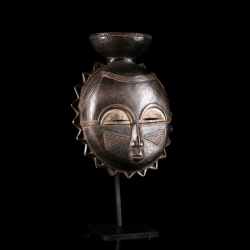
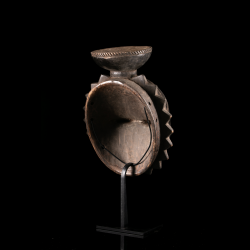
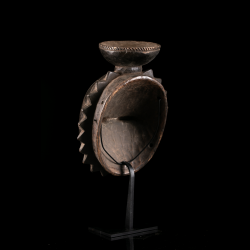
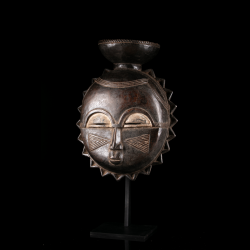
This striking Baule moon mask is built around an exceptionally strong circular composition. Carved in wood and displaying a deep dark surface, the mask combines restrained modelling with precisely organized geometric ornament, creating the visual balance associated with some of the most refined expressions of Baule sculpture from Côte d’Ivoire.
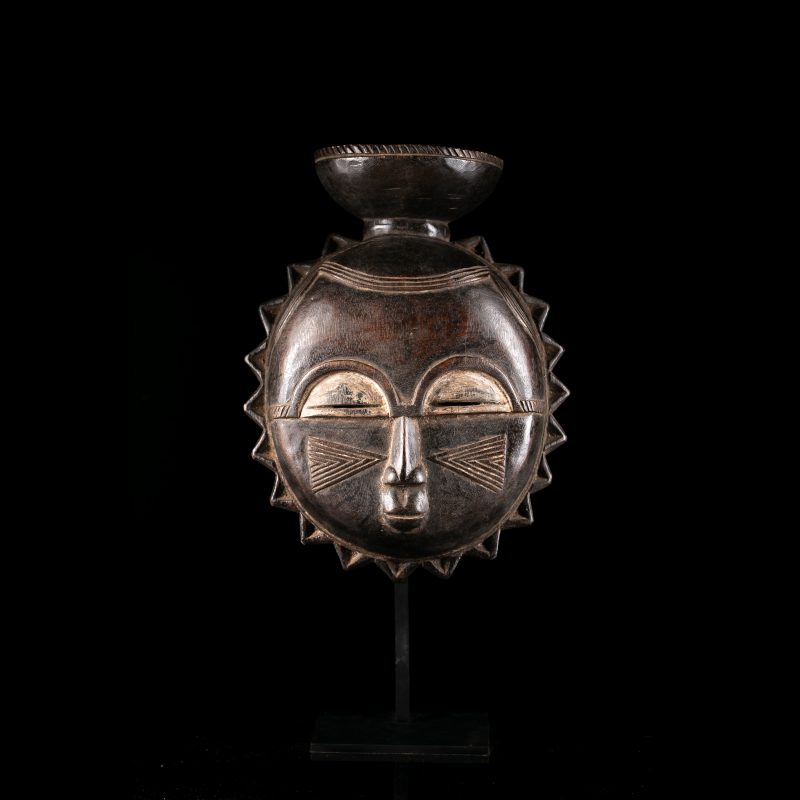
The almost perfectly round, domed face is framed by a distinctive serrated border, reinforcing the celestial character of the composition. Narrow, nearly closed eyes sit beneath broad curved brows, while the long slender nose establishes a strong vertical axis through the centre of the face. Incised triangular motifs on the cheeks introduce a graphic counterpoint to the smooth modelling, and the small projecting mouth remains deliberately understated. Above the forehead, a carved bowl-shaped element completes the silhouette and gives the mask a particularly distinctive sculptural presence.
These features invite comparison with a Baule moon face mask in the collection of The Metropolitan Museum of Art, which similarly combines a circular domed face, serrated surround, crescent-shaped eyes, slender nose, geometric cheek decoration and a vessel balanced above the head. The Met places such moon masks within the mblo performance tradition, in which representations of natural phenomena could appear during the opening stages of a performance.
Stylistically, the present mask may also be related to the body of work associated with the so-called “Kamer Master.” Art historian Bernard de Grunne used this conventional name while examining Baule master hands, referring in particular to a celebrated moon mask formerly associated with the Henri Kamer and later Udo Horstmann collections. Works grouped around this master share especially delicate treatments of the domed forehead, eyebrows, nose and overall facial balance.
Data sheet
You might also like
This striking Baule moon mask is built around an exceptionally strong circular composition. Carved in wood and displaying a deep dark surface, the mask combines restrained modelling with precisely organized geometric ornament, creating the visual balance associated with some of the most refined expressions of Baule sculpture from Côte d’Ivoire.
The almost perfectly round, domed face is framed by a distinctive serrated border, reinforcing the celestial character of the composition. Narrow, nearly closed eyes sit beneath broad curved brows, while the long slender nose establishes a strong vertical axis through the centre of the face. Incised triangular motifs on the cheeks introduce a graphic counterpoint to the smooth modelling, and the small projecting mouth remains deliberately understated. Above the forehead, a carved bowl-shaped element completes the silhouette and gives the mask a particularly distinctive sculptural presence.
These features invite comparison with a Baule moon face mask in the collection of The Metropolitan Museum of Art, which similarly combines a circular domed face, serrated surround, crescent-shaped eyes, slender nose, geometric cheek decoration and a vessel balanced above the head. The Met places such moon masks within the mblo performance tradition, in which representations of natural phenomena could appear during the opening stages of a performance.
Stylistically, the present mask may also be related to the body of work associated with the so-called “Kamer Master.” Art historian Bernard de Grunne used this conventional name while examining Baule master hands, referring in particular to a celebrated moon mask formerly associated with the Henri Kamer and later Udo Horstmann collections. Works grouped around this master share especially delicate treatments of the domed forehead, eyebrows, nose and overall facial balance.