Lega — Democratic Republic of the Congo
Carved wood, kaolin, dark brown patina
Two-faced ritual mask
Custom-made stand included
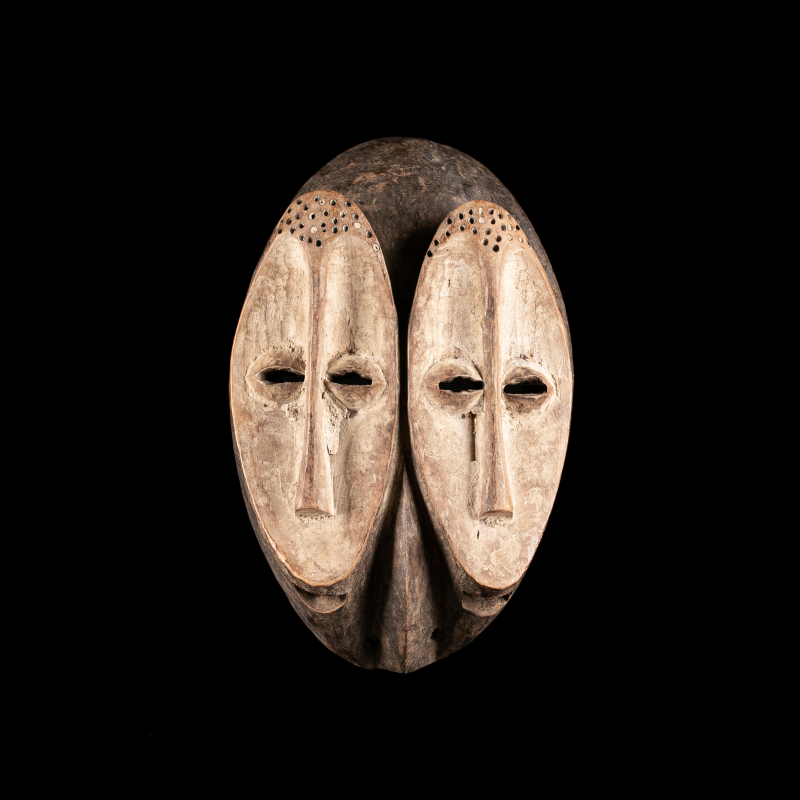
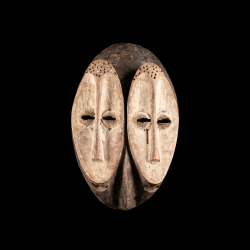
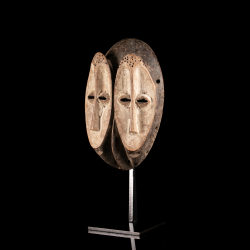
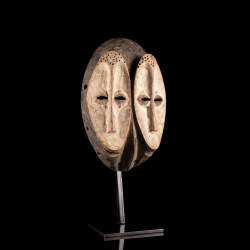
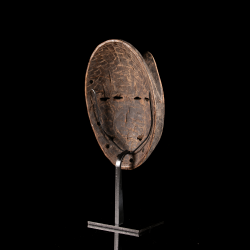
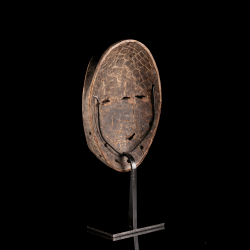
Rare and striking double Lega mask composed of two anthropomorphic faces set side by side within a broad oval structure. Both faces retain an old pale coating, probably kaolin-based, and display with remarkable economy the characteristic vocabulary of Lega sculpture: eyes reduced to narrow horizontal openings, exceptionally long straight noses and highly refined modelling. Numerous perforations punctuate the foreheads, while the deeply patinated outer shell retains several attachment holes. The hollowed reverse and visible traces of handling recall that such works were intended to be manipulated, suspended or displayed within a ritual setting rather than conceived simply as autonomous sculptures.
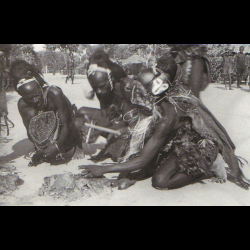
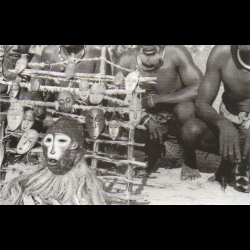
Among the Lega, art was inseparable from Bwami, the graded initiation association that structured social life while transmitting a complex body of ethical knowledge. Masks and figures served as visual supports for proverbs, narratives and ritual performances through which initiates were taught self-control, solidarity, wisdom and moral excellence. They were also emblems of status and created a symbolic connection between living initiates and distinguished deceased members of Bwami.
Double masks occupy an especially uncommon position within this corpus. Daniel P. Biebuyck explicitly notes their relative rarity and documents, among other examples, a double lukwakongo. Larger wooden Bwami masks are generally associated with the idimu category, collectively owned by ritual communities and passed from one generation to the next. The dual composition of the present example is therefore best understood as an exceptional variation within Lega symbolic language rather than as an entirely separate iconographic type. Earlier interpretations have occasionally associated double masks with twins; without documented field provenance, however, such an interpretation should remain cautious.
The strength of this work lies precisely in this duplication: two nearly identical presences united within a single dark form create an unusual sense of monumentality and visual tension. A particularly compelling work for a collection focused on the initiatory arts of the Democratic Republic of the Congo.
The custom-made metal stand is included, providing a gallery-quality presentation.
This exceptional piece has been entrusted to us by Lucien Mbungu Mbuka—an antique dealer, President of ASSONACO (National Association of Antique Dealers of the Congo), and an accredited expert for both MUSAFRICA (Namur) and the National Museum of the Democratic Republic of the Congo.
Data sheet
You might also like
Lega — Democratic Republic of the Congo
Carved wood, kaolin, dark brown patina
Two-faced ritual mask
Custom-made stand included
Rare and striking double Lega mask composed of two anthropomorphic faces set side by side within a broad oval structure. Both faces retain an old pale coating, probably kaolin-based, and display with remarkable economy the characteristic vocabulary of Lega sculpture: eyes reduced to narrow horizontal openings, exceptionally long straight noses and highly refined modelling. Numerous perforations punctuate the foreheads, while the deeply patinated outer shell retains several attachment holes. The hollowed reverse and visible traces of handling recall that such works were intended to be manipulated, suspended or displayed within a ritual setting rather than conceived simply as autonomous sculptures.
Among the Lega, art was inseparable from Bwami, the graded initiation association that structured social life while transmitting a complex body of ethical knowledge. Masks and figures served as visual supports for proverbs, narratives and ritual performances through which initiates were taught self-control, solidarity, wisdom and moral excellence. They were also emblems of status and created a symbolic connection between living initiates and distinguished deceased members of Bwami.
Double masks occupy an especially uncommon position within this corpus. Daniel P. Biebuyck explicitly notes their relative rarity and documents, among other examples, a double lukwakongo. Larger wooden Bwami masks are generally associated with the idimu category, collectively owned by ritual communities and passed from one generation to the next. The dual composition of the present example is therefore best understood as an exceptional variation within Lega symbolic language rather than as an entirely separate iconographic type. Earlier interpretations have occasionally associated double masks with twins; without documented field provenance, however, such an interpretation should remain cautious.
The strength of this work lies precisely in this duplication: two nearly identical presences united within a single dark form create an unusual sense of monumentality and visual tension. A particularly compelling work for a collection focused on the initiatory arts of the Democratic Republic of the Congo.
The custom-made metal stand is included, providing a gallery-quality presentation.
This exceptional piece has been entrusted to us by Lucien Mbungu Mbuka—an antique dealer, President of ASSONACO (National Association of Antique Dealers of the Congo), and an accredited expert for both MUSAFRICA (Namur) and the National Museum of the Democratic Republic of the Congo.