The art of the Bena Lulua, a Bantu group established in the south-central Democratic Republic of Congo, is distinguished by its refined sculpture associated with complex magico-religious practices.
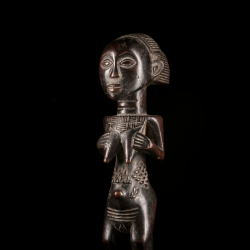
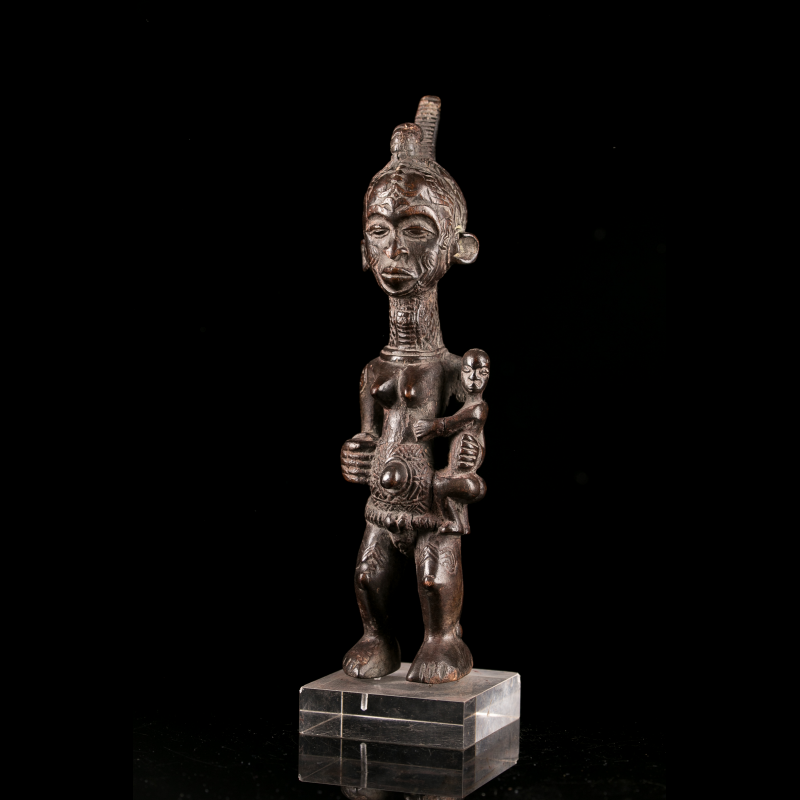
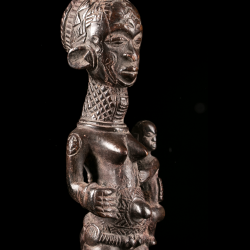
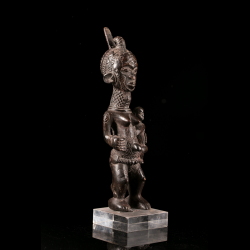
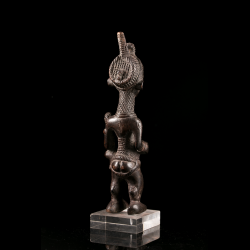
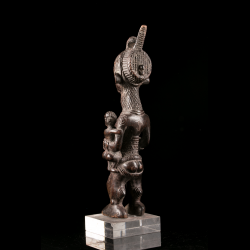
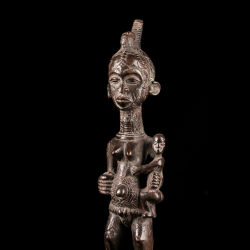
Lulua statues often feature numerous scarifications carved into the wood, reflecting aesthetic and symbolic ideals such as beauty, social status, and spiritual powers. A particularly significant form is that of maternity figures, linked to the Bwanga bwa Cibola cult, which focuses on fertility, the protection of pregnant women, the prevention of miscarriages, and the health of newborns.
These traditional art sculptures typically depict a mother holding her child, with stylized body proportions —a prominent head and a defined abdomen—incorporating aesthetic and spiritual symbols valued by Lulua society. Objects called mbulenga —a term that appears in catalogues and scholarly writings—often refer to protective figures or amulets, including carved female statuettes, which may include representations of motherhood.
The figures of Bwanga bwa Cibola are among the most expressive works of Lulua tribal art, considered both ritual objects and artistic masterpieces.
These sculptures testify to the cultural importance placed on lineage continuity, fertility, and the mediation between the world of the ancestors and that of the living, a fundamental theme in Lulua aesthetics and spirituality.
This highly refined piece comes from the B. Berete collection.
Data sheet
You might also like
The art of the Bena Lulua, a Bantu group established in the south-central Democratic Republic of Congo, is distinguished by its refined sculpture associated with complex magico-religious practices.
Lulua statues often feature numerous scarifications carved into the wood, reflecting aesthetic and symbolic ideals such as beauty, social status, and spiritual powers. A particularly significant form is that of maternity figures, linked to the Bwanga bwa Cibola cult, which focuses on fertility, the protection of pregnant women, the prevention of miscarriages, and the health of newborns.
These traditional art sculptures typically depict a mother holding her child, with stylized body proportions —a prominent head and a defined abdomen—incorporating aesthetic and spiritual symbols valued by Lulua society. Objects called mbulenga —a term that appears in catalogues and scholarly writings—often refer to protective figures or amulets, including carved female statuettes, which may include representations of motherhood.
The figures of Bwanga bwa Cibola are among the most expressive works of Lulua tribal art, considered both ritual objects and artistic masterpieces.
These sculptures testify to the cultural importance placed on lineage continuity, fertility, and the mediation between the world of the ancestors and that of the living, a fundamental theme in Lulua aesthetics and spirituality.
This highly refined piece comes from the B. Berete collection.