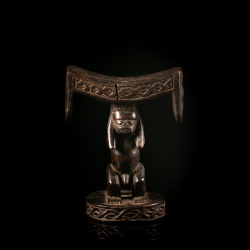
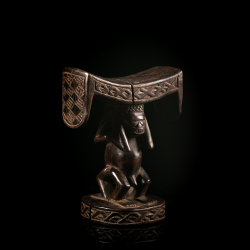
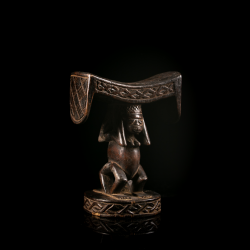
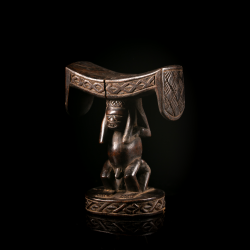
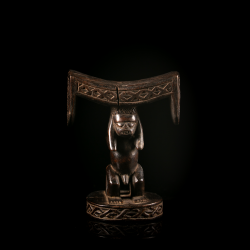
This remarkable Yaka headrest, known locally as a musaw or musawu, originates from the Kwango region in southwestern Democratic Republic of the Congo. A prestigious object of daily life, it perfectly illustrates the refinement of Yaka sculpture, where functional design is seamlessly combined with symbolic and artistic expression.
This exceptional example features a rare Janus configuration, with two finely carved faces positioned back-to-back. Such a composition symbolizes duality, vigilance, and the ability to look in multiple directions—qualities traditionally associated with authority, wisdom, and spiritual protection in Central African societies.
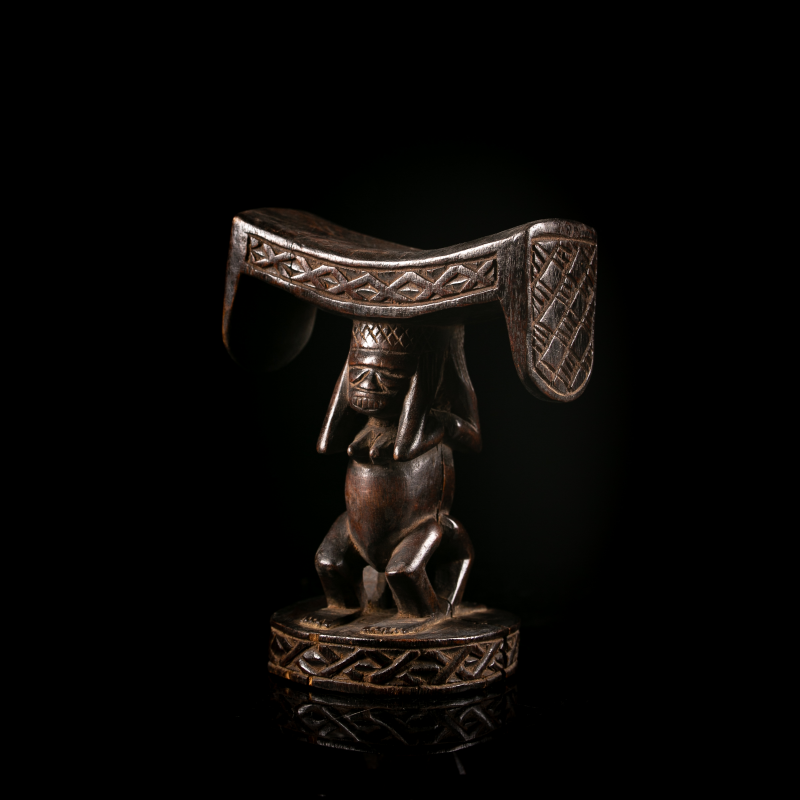
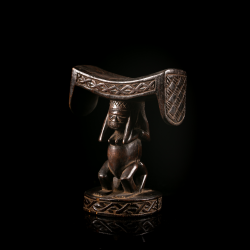
The elegantly curved upper support rests upon a standing anthropomorphic figure whose powerful bent legs provide both structural stability and sculptural dynamism. The two finely carved heads support the platform with remarkable balance, while the elaborately incised coiffures, geometric facial features, and diamond-patterned motifs decorating both the upper support and circular base reflect the exceptional craftsmanship of Yaka sculptors.
The surface displays a rich, deep aged patina, enhanced by natural polishing, handling marks, and coherent wear that attest to prolonged use. The overall composition possesses an elegant sculptural presence characteristic of the finest early Yaka headrests.
Among the Yaka, musaw headrests were prestigious personal objects belonging to respected individuals. Beyond their practical function of supporting the head during sleep and preserving elaborate hairstyles, they also served as symbols of social standing and personal identity. Anthropomorphic examples are uncommon, while Janus models are among the rarest and most desirable forms within Yaka sculpture.
With its exceptional carving, rare Janus typology, and outstanding state of preservation, this headrest represents an important work for collectors of African art and one of the finest expressions of traditional Yaka sculpture.
Data sheet
This remarkable Yaka headrest, known locally as a musaw or musawu, originates from the Kwango region in southwestern Democratic Republic of the Congo. A prestigious object of daily life, it perfectly illustrates the refinement of Yaka sculpture, where functional design is seamlessly combined with symbolic and artistic expression.
This exceptional example features a rare Janus configuration, with two finely carved faces positioned back-to-back. Such a composition symbolizes duality, vigilance, and the ability to look in multiple directions—qualities traditionally associated with authority, wisdom, and spiritual protection in Central African societies.
The elegantly curved upper support rests upon a standing anthropomorphic figure whose powerful bent legs provide both structural stability and sculptural dynamism. The two finely carved heads support the platform with remarkable balance, while the elaborately incised coiffures, geometric facial features, and diamond-patterned motifs decorating both the upper support and circular base reflect the exceptional craftsmanship of Yaka sculptors.
The surface displays a rich, deep aged patina, enhanced by natural polishing, handling marks, and coherent wear that attest to prolonged use. The overall composition possesses an elegant sculptural presence characteristic of the finest early Yaka headrests.
Among the Yaka, musaw headrests were prestigious personal objects belonging to respected individuals. Beyond their practical function of supporting the head during sleep and preserving elaborate hairstyles, they also served as symbols of social standing and personal identity. Anthropomorphic examples are uncommon, while Janus models are among the rarest and most desirable forms within Yaka sculpture.
With its exceptional carving, rare Janus typology, and outstanding state of preservation, this headrest represents an important work for collectors of African art and one of the finest expressions of traditional Yaka sculpture.