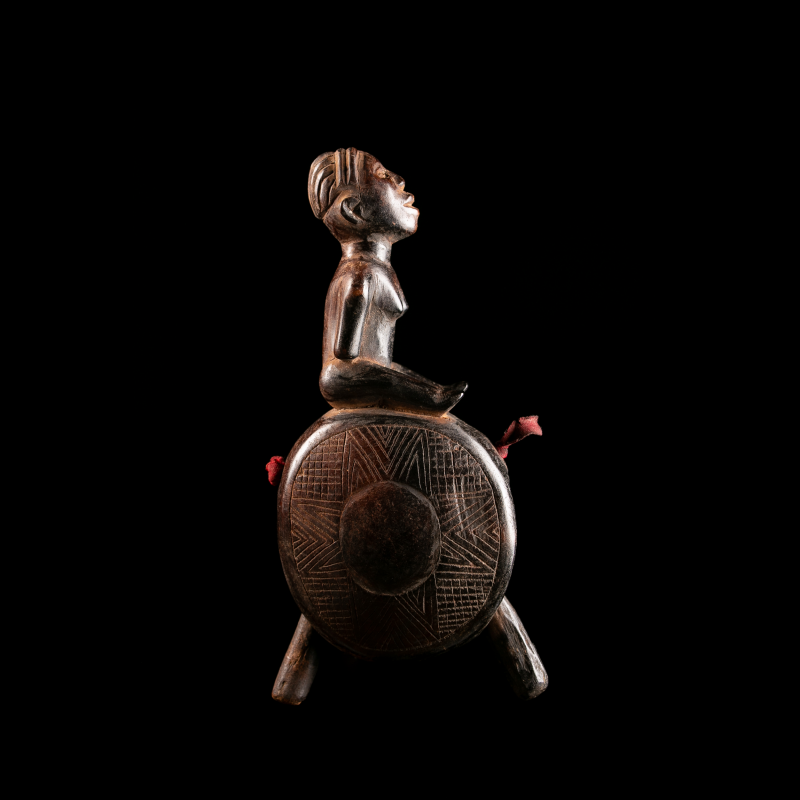
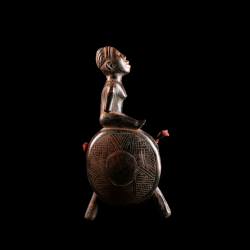
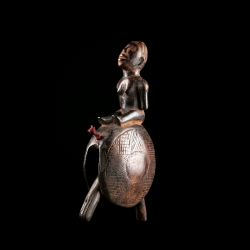
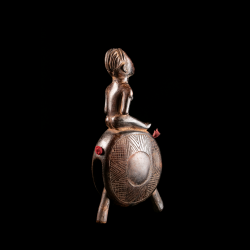
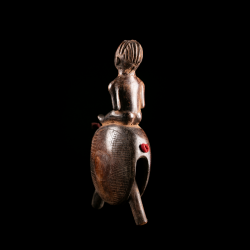
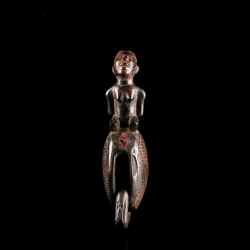
This african art Dibu ritual bell from the Kongo people of Central Africa combines elegant figurative sculpture with ceremonial function. Its circular hollow body, fitted with a side handle, is adorned with finely engraved geometric patterns that reflect the sophistication of Kongo artistic traditions. Seated on top is a stylized female figure with an elaborate hairstyle, balanced proportions, and an upward-looking face that conveys dignity and spiritual presence. Far more than a musical instrument, the bell embodies symbolic and cultural meanings deeply rooted in Kongo belief systems.
Dibu bells played an important role in ritual ceremonies, community gatherings, and events linked to social prestige. Their sound marked significant occasions, accompanied religious activities, and helped structure ceremonial performances. In Kongo cosmology, sound-producing objects often serve as intermediaries between the world of the living and the realm of the ancestors. The ringing of the bell could therefore be understood as a means of communication with protective spiritual forces and ancestral beings.
The female figure surmounting the bell symbolizes fertility, lineage continuity, and prosperity—core values within Kongo culture. Through the combination of sculpture, geometric decoration, and ritual sound, this Dibu bell exemplifies the richness of Kongo art, where functional objects become powerful expressions of memory, authority, and spiritual connection.
Data sheet
You might also like
This african art Dibu ritual bell from the Kongo people of Central Africa combines elegant figurative sculpture with ceremonial function. Its circular hollow body, fitted with a side handle, is adorned with finely engraved geometric patterns that reflect the sophistication of Kongo artistic traditions. Seated on top is a stylized female figure with an elaborate hairstyle, balanced proportions, and an upward-looking face that conveys dignity and spiritual presence. Far more than a musical instrument, the bell embodies symbolic and cultural meanings deeply rooted in Kongo belief systems.
Dibu bells played an important role in ritual ceremonies, community gatherings, and events linked to social prestige. Their sound marked significant occasions, accompanied religious activities, and helped structure ceremonial performances. In Kongo cosmology, sound-producing objects often serve as intermediaries between the world of the living and the realm of the ancestors. The ringing of the bell could therefore be understood as a means of communication with protective spiritual forces and ancestral beings.
The female figure surmounting the bell symbolizes fertility, lineage continuity, and prosperity—core values within Kongo culture. Through the combination of sculpture, geometric decoration, and ritual sound, this Dibu bell exemplifies the richness of Kongo art, where functional objects become powerful expressions of memory, authority, and spiritual connection.