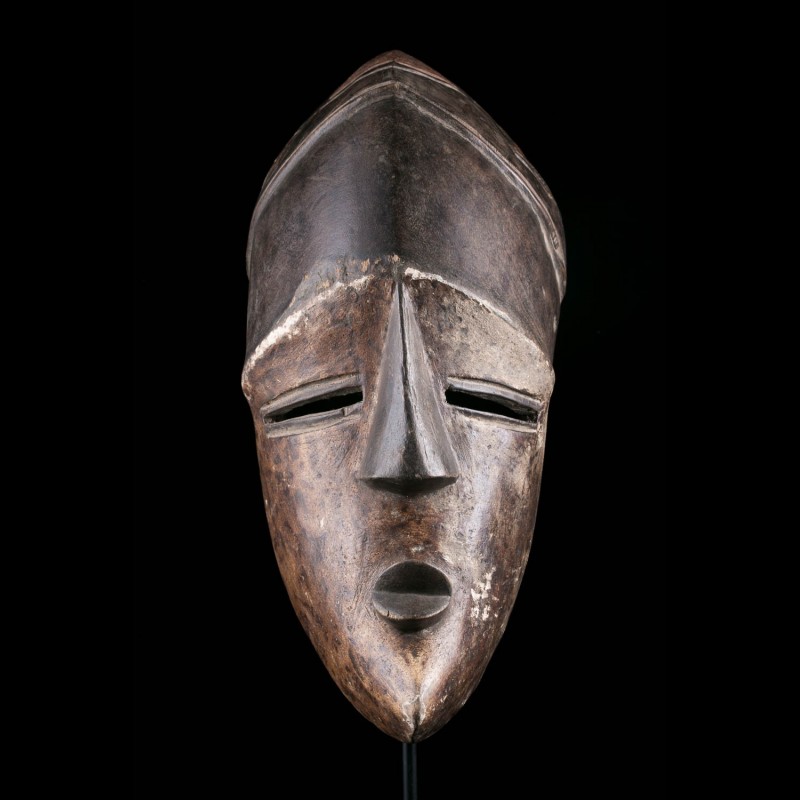
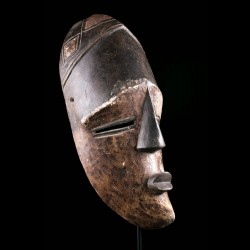
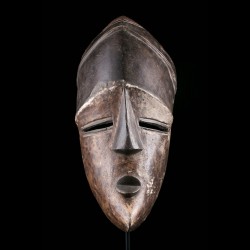
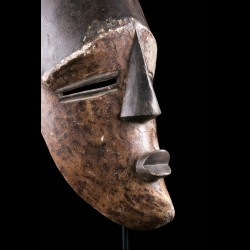
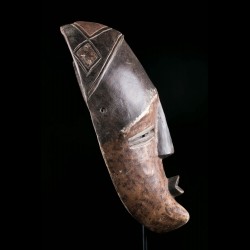
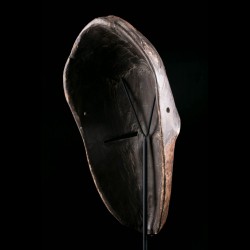
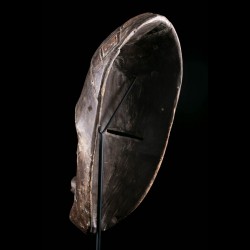
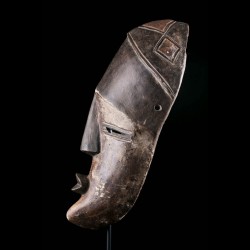
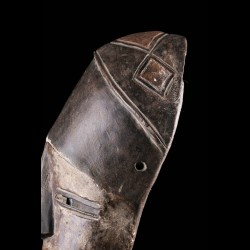
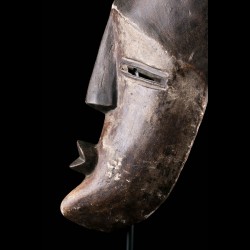
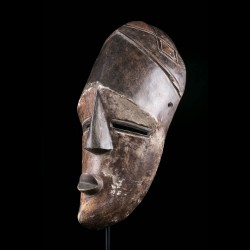
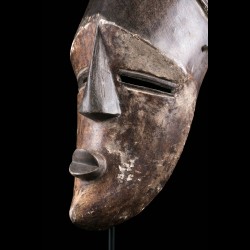
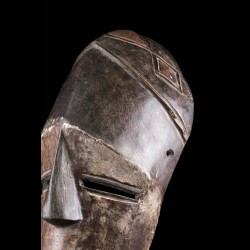
The Lwalwa, living in the western Kasai region, have a long tradition of cultural and linguistic exchange with other central African people, including the Mbagani, Salampasu, Kete, Lunda, Yaka, Suku and Kongo (Felix 1987: 94). The Lwalwa pantheon is dominated by the Supreme Being Mvidie Mukulu, and Nzambi, the first creator, who is omniscient. Lwalwa art is most famous for the powerful, highly cubistic masks of which the Tranin mask is a magnificent example with perfect proportion and elegant lines. While the nose-profile according to Ceyssens (in MRAC 1995: 327) refers to the long beak of the calao bird, the characteristic protrusions on the temples represent skin decoration, dejindula or kankolo.In its unbending line from the forehead to the tip of the nose, it is possible to imagine that Picasso borrowed from this mask form in his portrayals of Marie-Therese Walter. While she, herself, had an aquiline nose, Picasso's incorporation of the strong abstraction and borrowing of visual motifs of African art is well-known (see Rubin in 'Primitivism', 1984, Vol 1, p.324).Origin : private collection, BelgiumDating : 1960'sSize : 30 x 17 cm Material : wood
Data sheet
You might also like
The Lwalwa, living in the western Kasai region, have a long tradition of cultural and linguistic exchange with other central African people, including the Mbagani, Salampasu, Kete, Lunda, Yaka, Suku and Kongo (Felix 1987: 94). The Lwalwa pantheon is dominated by the Supreme Being Mvidie Mukulu, and Nzambi, the first creator, who is omniscient. Lwalwa art is most famous for the powerful, highly cubistic masks of which the Tranin mask is a magnificent example with perfect proportion and elegant lines. While the nose-profile according to Ceyssens (in MRAC 1995: 327) refers to the long beak of the calao bird, the characteristic protrusions on the temples represent skin decoration, dejindula or kankolo.In its unbending line from the forehead to the tip of the nose, it is possible to imagine that Picasso borrowed from this mask form in his portrayals of Marie-Therese Walter. While she, herself, had an aquiline nose, Picasso's incorporation of the strong abstraction and borrowing of visual motifs of African art is well-known (see Rubin in 'Primitivism', 1984, Vol 1, p.324).Origin : private collection, BelgiumDating : 1960'sSize : 30 x 17 cm Material : wood