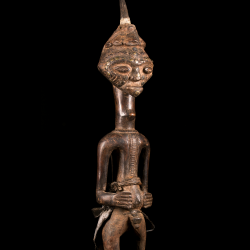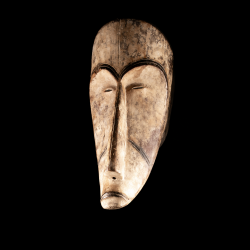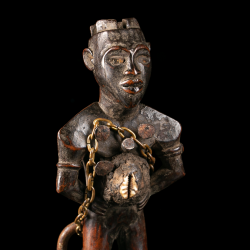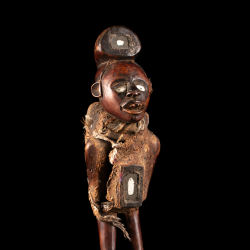
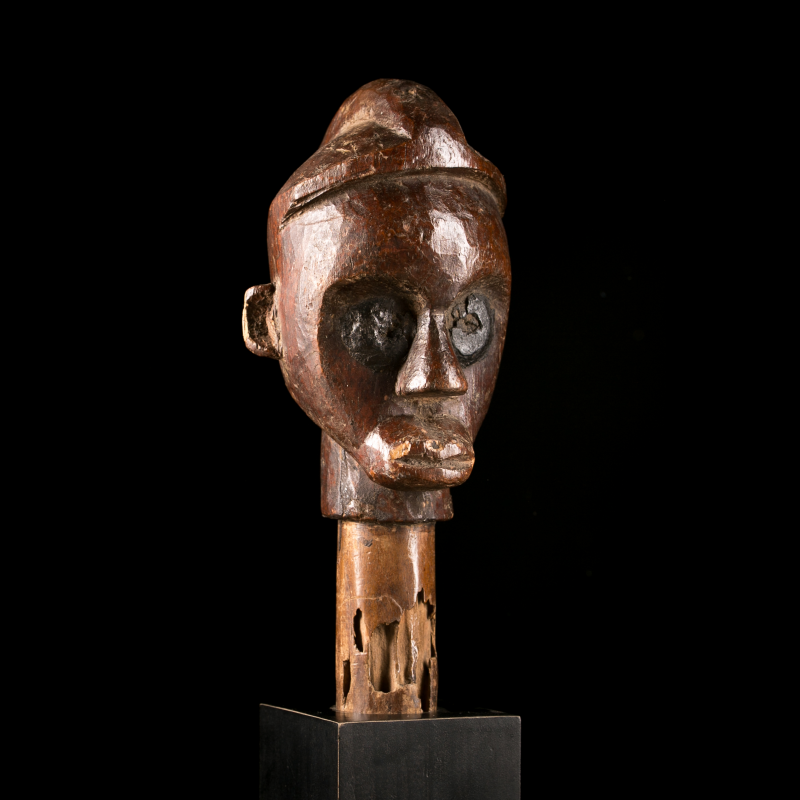
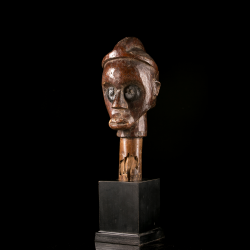
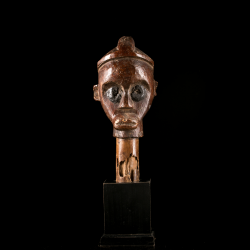
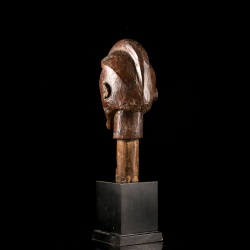

This remarkable Fang reliquary head, known as Añgokh-Nlô-Byeri or Nlô Byeri, belongs to one of the most emblematic sculptural traditions of African art from Gabon: works associated with the ancestral Byeri cult.
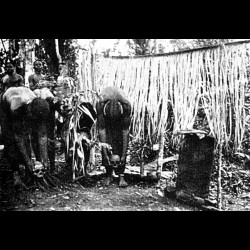
Among the Fang, the Byeri was closely connected to ancestral memory and the continuity of the lineage. Family relics were preserved in bark containers surmounted by a carved head or figure serving as a reliquary guardian. The Metropolitan Museum of Art preserves several comparable examples of Nlô Byeri, described as ancestral representations associated with such reliquary ensembles.
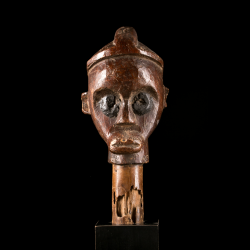
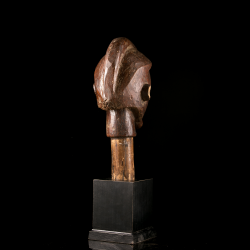
This Fang wood sculpture is distinguished by a particularly expressive construction: a high, rounded forehead, strongly defined brows, a short geometric nose, projecting lips, and an architectural coiffure rising into a pronounced volume at the top of the head.
The deeply recessed eyes, accentuated with a dark material, intensify the presence of the face. The dark brown surface displays areas of sheen that contrast with the lighter lower section of the neck. This elongated extension was intended to secure the head into the reliquary structure, in keeping with the function of Nlo Byeri sculptures.
Through the strength of its modelling, its frontal presence and the balance of its volumes, this Fang head from Gabon offers a powerful sculptural expression and stands as a striking example of the aesthetic language associated with Byeri reliquary guardians.
This presumably late Fang head shows certain similarities in patina and wear to a copy in the Musée du quai Branly, Paris, ref. 71.1954.67.13.
Data sheet
You might also like
This remarkable Fang reliquary head, known as Añgokh-Nlô-Byeri or Nlô Byeri, belongs to one of the most emblematic sculptural traditions of African art from Gabon: works associated with the ancestral Byeri cult.
Among the Fang, the Byeri was closely connected to ancestral memory and the continuity of the lineage. Family relics were preserved in bark containers surmounted by a carved head or figure serving as a reliquary guardian. The Metropolitan Museum of Art preserves several comparable examples of Nlô Byeri, described as ancestral representations associated with such reliquary ensembles.
This Fang wood sculpture is distinguished by a particularly expressive construction: a high, rounded forehead, strongly defined brows, a short geometric nose, projecting lips, and an architectural coiffure rising into a pronounced volume at the top of the head.
The deeply recessed eyes, accentuated with a dark material, intensify the presence of the face. The dark brown surface displays areas of sheen that contrast with the lighter lower section of the neck. This elongated extension was intended to secure the head into the reliquary structure, in keeping with the function of Nlo Byeri sculptures.
Through the strength of its modelling, its frontal presence and the balance of its volumes, this Fang head from Gabon offers a powerful sculptural expression and stands as a striking example of the aesthetic language associated with Byeri reliquary guardians.
This presumably late Fang head shows certain similarities in patina and wear to a copy in the Musée du quai Branly, Paris, ref. 71.1954.67.13.