
Friction oracle, Kuba people, Democratic Republic of the Congo
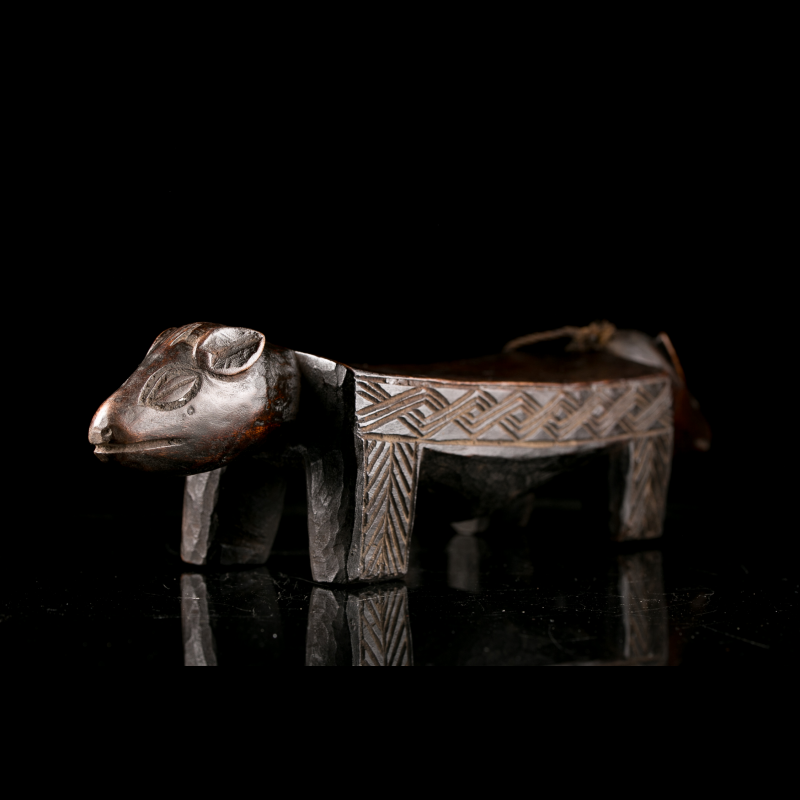
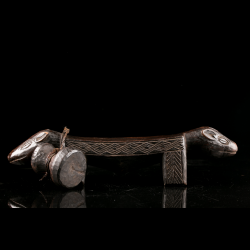
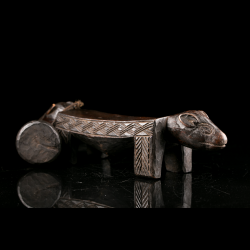
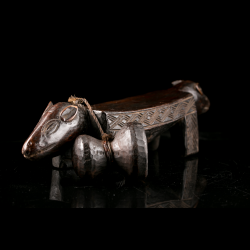
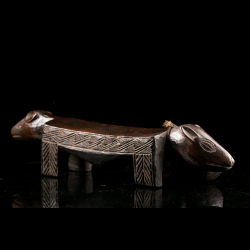
This Kuba friction oracle, carved from dense wood with an old, well-developed patina, takes the form of a stylized animal with elongated proportions. The body, conceived as a continuous horizontal volume, is entirely covered with incised geometric motifs arranged in regular registers, whose rhythm and precision reflect a high level of formal mastery characteristic of Kuba aesthetics.
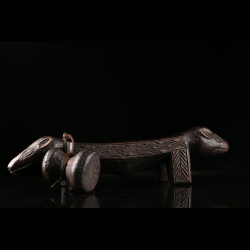
The object is distinguished by a highly accomplished janiform conception: both extremities are carved with sculpted heads facing in opposite directions, giving the piece a bilateral reading. This formal duality, common within Central African symbolic systems, reinforces the liminal nature of the object, positioned at the threshold between the visible and the invisible, the past and the future, the question and the response. The faces, deliberately stylized, feature prominent circular eyes and a restrained expression, heightening the symbolic tension inherent to divinatory objects.
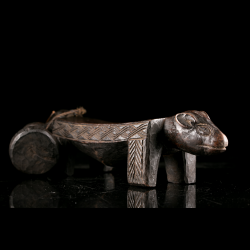
Complete and perfectly legible, the oracle retains its posterior friction surface, an essential element for ritual activation. Objects of this type belonged to an intimate divinatory practice, used to consult invisible forces in moments of crisis such as illness, family conflict, or uncertainty related to hunting or fertility. The sound, vibration, and resistance produced through friction were interpreted as indirect responses from ancestors or tutelary spirits.
More discreet and significantly rarer than prestige sculptures or masks, Kuba friction oracles were generally preserved within a single lineage and rarely circulated. Their gradual disappearance accounts for the rarity today of early, complete, and unaltered examples.
The object is attributed to the historical region of the Kuba Kingdom, within the forested area of the Kasai, and may be dated to the late 19th century or the first half of the 20th century.
According to a family tradition, the oracle was collected in the early 1960s by Émile Van der Straeten, a Belgian engineer on an independent assignment in the region. During an extended stay in a Kuba village removed from the main routes, he is said to have established a relationship of trust with a former local dignitary. Having converted several years earlier, the latter nonetheless preserved certain ritual objects that had become inactive, too charged with memory to be abandoned or destroyed. The oracle was reportedly transferred voluntarily, not as an object still invested with ritual power, but as a silent witness to a world in transition.
Upon returning to Europe, the object remained for decades in a strictly private setting, sheltered from public display, thereby preserving its formal integrity and undiminished presence.
Through its subtle interplay of symmetry and tension, the symbolic force of its dual orientation, and the depth of its former use, this Kuba oracle fully embodies the African conception of the ritual object: an instrument of dialogue, memory, and vibration, intended less to be viewed than to be activated, listened to, and transmitted.
Data sheet
Friction oracle, Kuba people, Democratic Republic of the Congo
This Kuba friction oracle, carved from dense wood with an old, well-developed patina, takes the form of a stylized animal with elongated proportions. The body, conceived as a continuous horizontal volume, is entirely covered with incised geometric motifs arranged in regular registers, whose rhythm and precision reflect a high level of formal mastery characteristic of Kuba aesthetics.
The object is distinguished by a highly accomplished janiform conception: both extremities are carved with sculpted heads facing in opposite directions, giving the piece a bilateral reading. This formal duality, common within Central African symbolic systems, reinforces the liminal nature of the object, positioned at the threshold between the visible and the invisible, the past and the future, the question and the response. The faces, deliberately stylized, feature prominent circular eyes and a restrained expression, heightening the symbolic tension inherent to divinatory objects.
Complete and perfectly legible, the oracle retains its posterior friction surface, an essential element for ritual activation. Objects of this type belonged to an intimate divinatory practice, used to consult invisible forces in moments of crisis such as illness, family conflict, or uncertainty related to hunting or fertility. The sound, vibration, and resistance produced through friction were interpreted as indirect responses from ancestors or tutelary spirits.
More discreet and significantly rarer than prestige sculptures or masks, Kuba friction oracles were generally preserved within a single lineage and rarely circulated. Their gradual disappearance accounts for the rarity today of early, complete, and unaltered examples.
The object is attributed to the historical region of the Kuba Kingdom, within the forested area of the Kasai, and may be dated to the late 19th century or the first half of the 20th century.
According to a family tradition, the oracle was collected in the early 1960s by Émile Van der Straeten, a Belgian engineer on an independent assignment in the region. During an extended stay in a Kuba village removed from the main routes, he is said to have established a relationship of trust with a former local dignitary. Having converted several years earlier, the latter nonetheless preserved certain ritual objects that had become inactive, too charged with memory to be abandoned or destroyed. The oracle was reportedly transferred voluntarily, not as an object still invested with ritual power, but as a silent witness to a world in transition.
Upon returning to Europe, the object remained for decades in a strictly private setting, sheltered from public display, thereby preserving its formal integrity and undiminished presence.
Through its subtle interplay of symmetry and tension, the symbolic force of its dual orientation, and the depth of its former use, this Kuba oracle fully embodies the African conception of the ritual object: an instrument of dialogue, memory, and vibration, intended less to be viewed than to be activated, listened to, and transmitted.