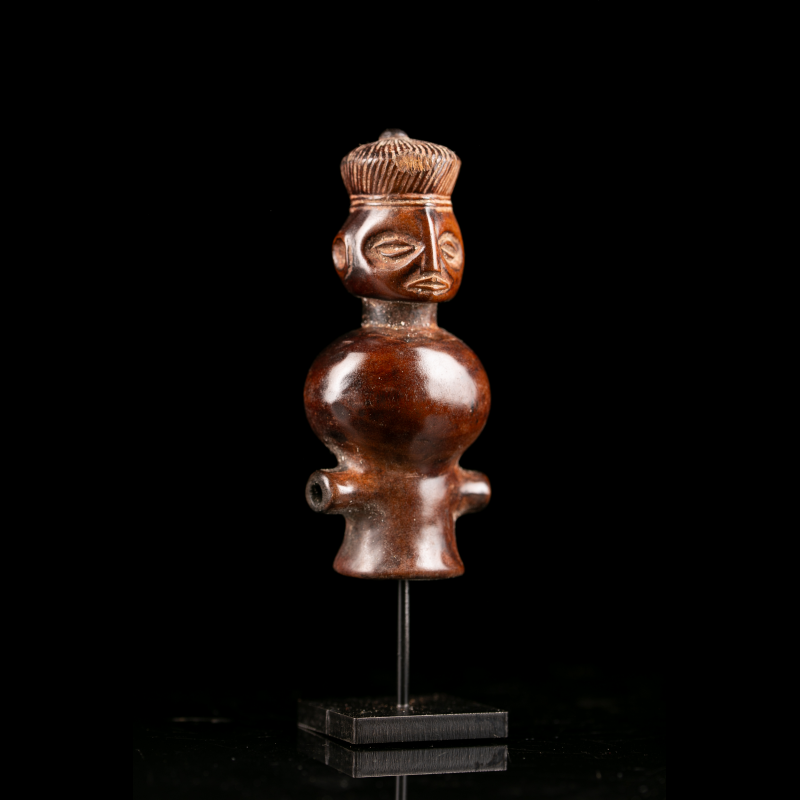
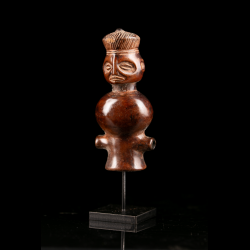
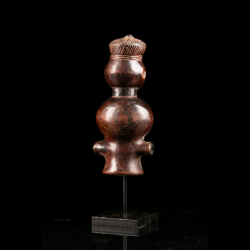
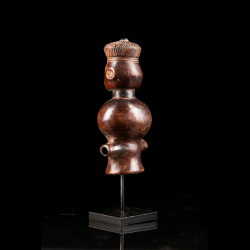
This remarkable Lwena / Chokwe hunting whistle, originating from the cultural region spanning Angola and the Democratic Republic of the Congo, beautifully illustrates the sophistication of the miniature arts developed by the Chokwe peoples. Far more than a simple utilitarian object, whistles of this type were prestigious personal possessions that combined practical function with artistic expression and symbolic meaning.
The sculpture takes the form of an elegant anthropomorphic figure whose harmonious proportions immediately reflect the refined aesthetics of Chokwe carving. The face displays the classical features associated with the tradition: almond-shaped eyes, a finely modeled mouth, circular ears, and a delicately carved cylindrical coiffure. Despite its modest size, the piece demonstrates remarkable craftsmanship and the balanced sculptural quality for which Chokwe artists are renowned.
The surface retains a rich aged patina, enhanced by natural polishing and numerous traces of handling accumulated over years of use. These authentic signs of age reinforce the object's historical character and are highly appreciated by collectors of early African art.
Among the Lwena and Chokwe, hunting whistles accompanied experienced hunters during expeditions through the forest. They were used to communicate over long distances, coordinate movements within the hunting party, or attract game. Their anthropomorphic decoration also conveyed symbolic meaning, expressing the owner's prestige while reinforcing connections with protective spiritual forces.
Through its refined carving, elegant proportions, and beautiful aged patina, this whistle stands as an excellent example of early Chokwe art and represents a distinguished addition to any collection devoted to Central African tribal art.
Data sheet
You might also like
This remarkable Lwena / Chokwe hunting whistle, originating from the cultural region spanning Angola and the Democratic Republic of the Congo, beautifully illustrates the sophistication of the miniature arts developed by the Chokwe peoples. Far more than a simple utilitarian object, whistles of this type were prestigious personal possessions that combined practical function with artistic expression and symbolic meaning.
The sculpture takes the form of an elegant anthropomorphic figure whose harmonious proportions immediately reflect the refined aesthetics of Chokwe carving. The face displays the classical features associated with the tradition: almond-shaped eyes, a finely modeled mouth, circular ears, and a delicately carved cylindrical coiffure. Despite its modest size, the piece demonstrates remarkable craftsmanship and the balanced sculptural quality for which Chokwe artists are renowned.
The surface retains a rich aged patina, enhanced by natural polishing and numerous traces of handling accumulated over years of use. These authentic signs of age reinforce the object's historical character and are highly appreciated by collectors of early African art.
Among the Lwena and Chokwe, hunting whistles accompanied experienced hunters during expeditions through the forest. They were used to communicate over long distances, coordinate movements within the hunting party, or attract game. Their anthropomorphic decoration also conveyed symbolic meaning, expressing the owner's prestige while reinforcing connections with protective spiritual forces.
Through its refined carving, elegant proportions, and beautiful aged patina, this whistle stands as an excellent example of early Chokwe art and represents a distinguished addition to any collection devoted to Central African tribal art.