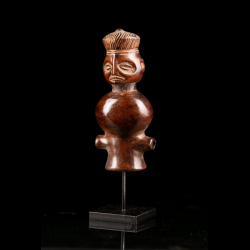
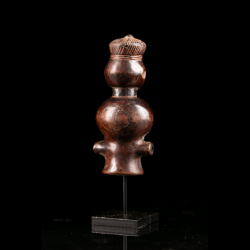
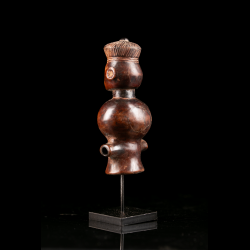
African Chokwe hunting whistles, and more specifically those of the Lwena people, occupy an important place in the daily and symbolic life of Central and Southern African societies.
Although seemingly utilitarian, these traditional African art objects extend far beyond their practical function.
Used during hunting expeditions, they serve to communicate over long distances, coordinate actions, or attract game, but they are also imbued with a strong social and ritual dimension.
Among the Lwena, the hunting whistle is often associated with the knowledge of the experienced hunter. Its possession and use reflect mastery of hunting techniques, but also a profound knowledge of the forest, the animals, and the invisible forces that reside there.
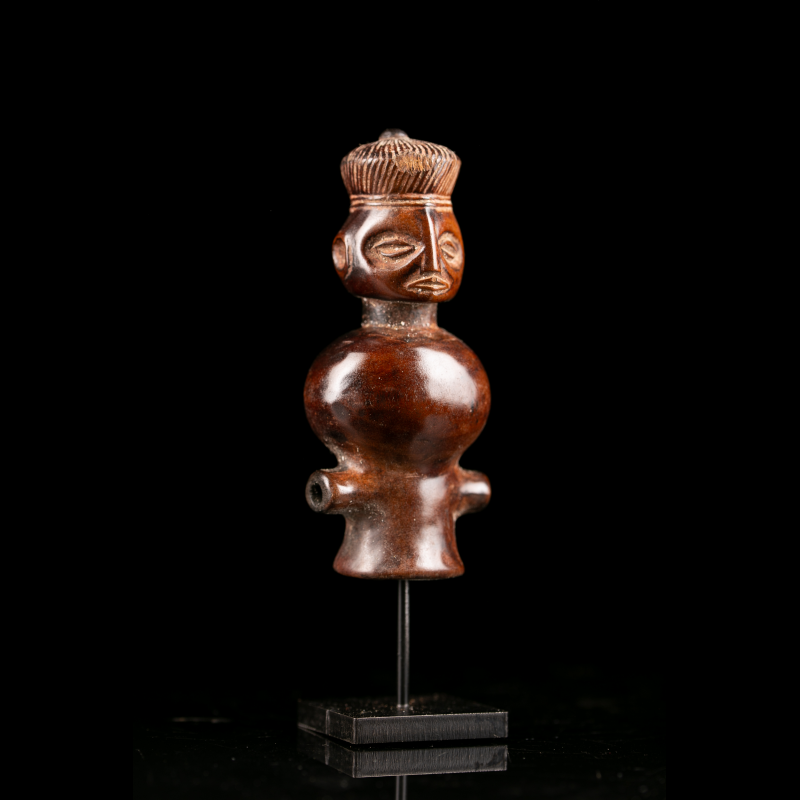
Some whistles are adorned with stylized human or animal figures, giving the object a protective and symbolic value.
The whistle thus becomes a mediator between humankind and its environment.
Its controlled and codified sound contributes to the harmony between the hunter, the group, and the natural world. Through these simple yet meaningful objects, the Chokwe and Lwena express a vision where technical efficiency, aesthetics, and spirituality are closely linked.
Data sheet
You might also like
African Chokwe hunting whistles, and more specifically those of the Lwena people, occupy an important place in the daily and symbolic life of Central and Southern African societies.
Although seemingly utilitarian, these traditional African art objects extend far beyond their practical function.
Used during hunting expeditions, they serve to communicate over long distances, coordinate actions, or attract game, but they are also imbued with a strong social and ritual dimension.
Among the Lwena, the hunting whistle is often associated with the knowledge of the experienced hunter. Its possession and use reflect mastery of hunting techniques, but also a profound knowledge of the forest, the animals, and the invisible forces that reside there.
Some whistles are adorned with stylized human or animal figures, giving the object a protective and symbolic value.
The whistle thus becomes a mediator between humankind and its environment.
Its controlled and codified sound contributes to the harmony between the hunter, the group, and the natural world. Through these simple yet meaningful objects, the Chokwe and Lwena express a vision where technical efficiency, aesthetics, and spirituality are closely linked.