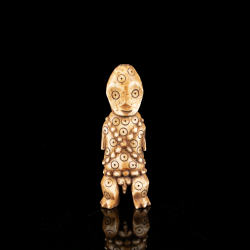
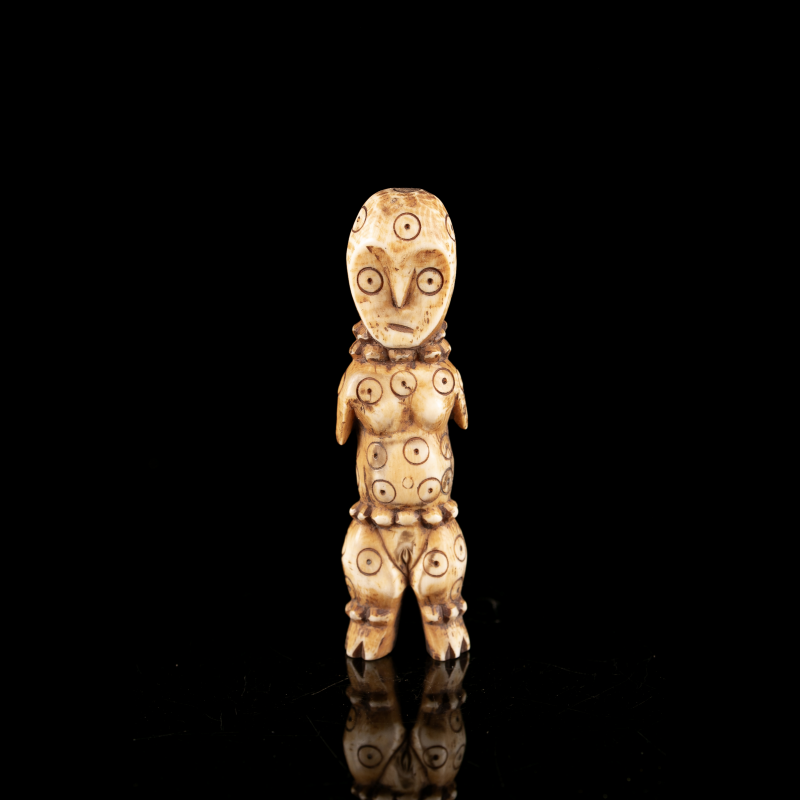
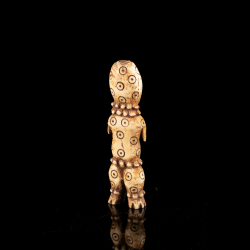
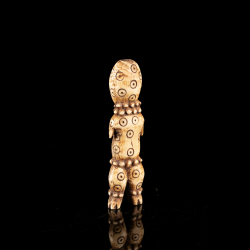
Rare small female iginga figure, distinguished by the profusion of incised circle-and-dot motifs covering the face, torso and limbs. Measuring only 14 cm in height, the figure nevertheless possesses a strikingly monumental presence: an ovoid head, wide circular eyes, pronounced breasts, powerful thighs and short legs create a form that is both archaic and highly expressive.
Among the Lega of eastern Democratic Republic of the Congo, iginga figures belonged to the initiatory world of Bwami, the association that structured much of Lega social, political and moral life. Small figures carved in wood, bone or ivory were associated with the higher grades of Bwami, particularly yananio and kindi. During initiation they functioned as proverb-images, whose meanings were deliberately multiple. Displayed, handled and interpreted, such objects helped communicate ideals including self-control, solidarity, respect and moderation.
Female representations occupy a particularly compelling place within this corpus. Bwami was open to both men and women, and female figures could embody exemplary personalities or, conversely, serve as cautionary characters within initiatory teaching. Without early documentation relating specifically to this piece, assigning a single interpretation would be speculative: ambiguity and multiple layers of meaning were integral to Bwami instruction.
The numerous circle-and-dot motifs, extending across the body and even around the head, lend this example an especially powerful graphic identity. Its warm, subtly varied surface bears traces of age and handling that enhance the intimate character of this small initiatory sculpture.
Data sheet
You might also like
Rare small female iginga figure, distinguished by the profusion of incised circle-and-dot motifs covering the face, torso and limbs. Measuring only 14 cm in height, the figure nevertheless possesses a strikingly monumental presence: an ovoid head, wide circular eyes, pronounced breasts, powerful thighs and short legs create a form that is both archaic and highly expressive.
Among the Lega of eastern Democratic Republic of the Congo, iginga figures belonged to the initiatory world of Bwami, the association that structured much of Lega social, political and moral life. Small figures carved in wood, bone or ivory were associated with the higher grades of Bwami, particularly yananio and kindi. During initiation they functioned as proverb-images, whose meanings were deliberately multiple. Displayed, handled and interpreted, such objects helped communicate ideals including self-control, solidarity, respect and moderation.
Female representations occupy a particularly compelling place within this corpus. Bwami was open to both men and women, and female figures could embody exemplary personalities or, conversely, serve as cautionary characters within initiatory teaching. Without early documentation relating specifically to this piece, assigning a single interpretation would be speculative: ambiguity and multiple layers of meaning were integral to Bwami instruction.
The numerous circle-and-dot motifs, extending across the body and even around the head, lend this example an especially powerful graphic identity. Its warm, subtly varied surface bears traces of age and handling that enhance the intimate character of this small initiatory sculpture.