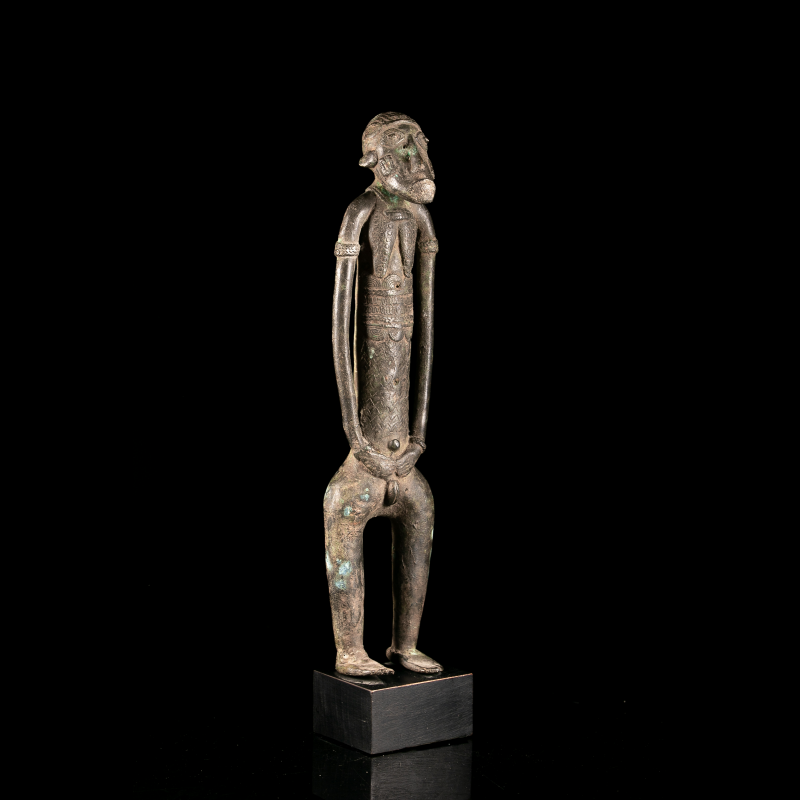
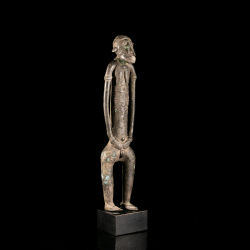
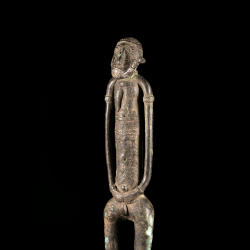
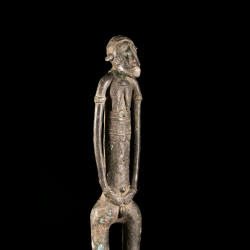
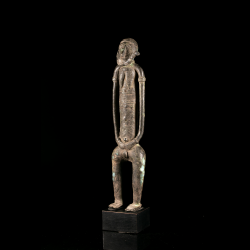
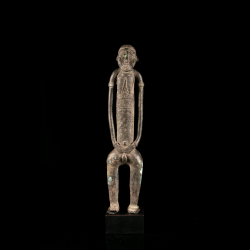
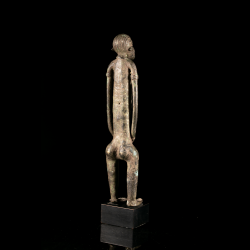
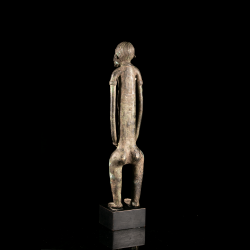
This remarkable male figure in copper alloy, attributed to the Inland Niger Delta region of Mali, possesses an extraordinary sculptural presence. Standing in a hieratic frontal pose, the figure develops an exceptionally elongated, almost architectural silhouette whose formal radicalism inevitably recalls, to the modern Western eye, certain explorations of twentieth-century sculpture, particularly the slender figures of Alberto Giacometti.
This comparison is, of course, purely aesthetic rather than historical; above all, it emphasizes the astonishing formal modernity of the work.
The body is organized around a powerful vertical axis. Long, slightly separated legs support an exceptionally elongated torso, while the slender arms descend parallel to the body and extend toward the pelvis like two continuous lines. This remarkable economy of volume, combined with the extreme elongation of the limbs, gives the figure a monumentality that greatly exceeds its actual dimensions.
The face possesses an equally distinctive personality: a slightly projecting head, prominent nose, deeply defined eyes, protruding ears, and strongly modeled mouth. The chin is extended by an imposing circular beard, a striking sculptural feature that reinforces the male identity of the figure.
The surface deserves particularly close attention. The body is extensively decorated with incised motifs and ornamental details, including bracelets, body adornments, geometric patterns, scarification-like markings, and a complex decorative treatment of the torso and abdomen. This graphic richness creates a subtle contrast with the radical simplicity and verticality of the overall silhouette.
The copper alloy displays a beautiful aged surface, dark and richly nuanced, punctuated in places by characteristic areas of green oxidation. Metal sculpture has a long history in Mali, supported in part by the circulation of copper through trans-Saharan trade networks. Dogon copper-alloy figures also demonstrate stylistic connections with the artistic traditions of Djenné and the Inland Niger Delta.
The exceptional character of this sculpture is further reinforced by its prestigious provenance.
The work was formerly in the collection of Émile M. Deletaille (1929–2021), an important Brussels figure in the field of African art, and subsequently in the collection of Merton D. Simpson (1928–2013), the renowned New York dealer, collector, and artist whose name is closely associated with major works of African art. It later passed through the hands of Bob Berete in Brussels.
This distinguished provenance — Émile Deletaille, Merton D. Simpson, and Bob Berete — places the sculpture within the history of international collecting and the specialist African art market.
Through its extraordinary verticality, sophisticated incised decoration, richly aged metal surface, and distinguished provenance, this figure represents a particularly compelling example of metal sculpture from Mali. Its striking formal modernity creates a fascinating dialogue between the ancient artistic traditions of West Africa and some of the major sculptural explorations of twentieth-century modernism.
Data sheet
You might also like
This remarkable male figure in copper alloy, attributed to the Inland Niger Delta region of Mali, possesses an extraordinary sculptural presence. Standing in a hieratic frontal pose, the figure develops an exceptionally elongated, almost architectural silhouette whose formal radicalism inevitably recalls, to the modern Western eye, certain explorations of twentieth-century sculpture, particularly the slender figures of Alberto Giacometti.
This comparison is, of course, purely aesthetic rather than historical; above all, it emphasizes the astonishing formal modernity of the work.
The body is organized around a powerful vertical axis. Long, slightly separated legs support an exceptionally elongated torso, while the slender arms descend parallel to the body and extend toward the pelvis like two continuous lines. This remarkable economy of volume, combined with the extreme elongation of the limbs, gives the figure a monumentality that greatly exceeds its actual dimensions.
The face possesses an equally distinctive personality: a slightly projecting head, prominent nose, deeply defined eyes, protruding ears, and strongly modeled mouth. The chin is extended by an imposing circular beard, a striking sculptural feature that reinforces the male identity of the figure.
The surface deserves particularly close attention. The body is extensively decorated with incised motifs and ornamental details, including bracelets, body adornments, geometric patterns, scarification-like markings, and a complex decorative treatment of the torso and abdomen. This graphic richness creates a subtle contrast with the radical simplicity and verticality of the overall silhouette.
The copper alloy displays a beautiful aged surface, dark and richly nuanced, punctuated in places by characteristic areas of green oxidation. Metal sculpture has a long history in Mali, supported in part by the circulation of copper through trans-Saharan trade networks. Dogon copper-alloy figures also demonstrate stylistic connections with the artistic traditions of Djenné and the Inland Niger Delta.
The exceptional character of this sculpture is further reinforced by its prestigious provenance.
The work was formerly in the collection of Émile M. Deletaille (1929–2021), an important Brussels figure in the field of African art, and subsequently in the collection of Merton D. Simpson (1928–2013), the renowned New York dealer, collector, and artist whose name is closely associated with major works of African art. It later passed through the hands of Bob Berete in Brussels.
This distinguished provenance — Émile Deletaille, Merton D. Simpson, and Bob Berete — places the sculpture within the history of international collecting and the specialist African art market.
Through its extraordinary verticality, sophisticated incised decoration, richly aged metal surface, and distinguished provenance, this figure represents a particularly compelling example of metal sculpture from Mali. Its striking formal modernity creates a fascinating dialogue between the ancient artistic traditions of West Africa and some of the major sculptural explorations of twentieth-century modernism.