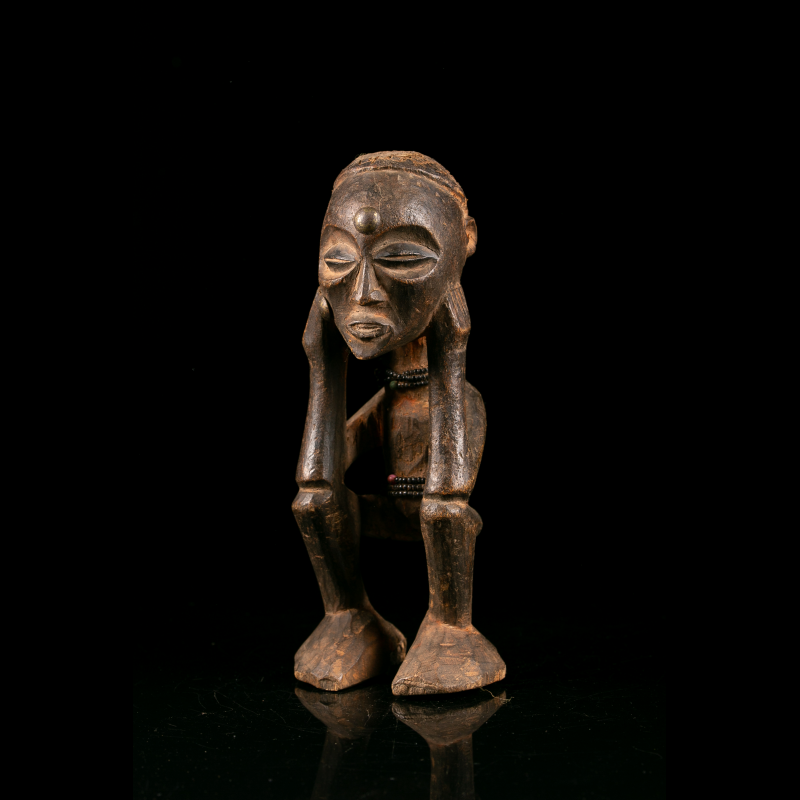
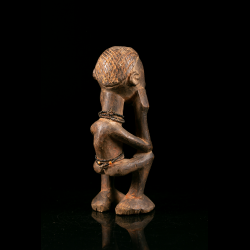
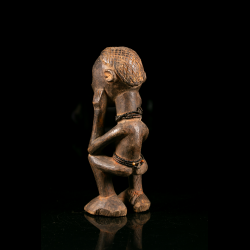
This carved wooden figure, attributed to the Chokwe, depicts a person crouching in a highly expressive pose. The Chokwe primarily inhabit Angola and neighbouring areas of the Democratic Republic of the Congo and Zambia. Their sculptural traditions give particular attention to posture, hairstyles, body markings and attributes conveying identity or social distinction.
The composition is structured through a striking sequence of angular lines. Deeply flexed legs end in broad feet that provide stability, while the elongated arms rise vertically towards the cheeks. This gesture frames the face and creates a contemplative expression, although its precise meaning cannot be established without documented collection information.
The sensitively modelled face features elongated, nearly closed eyes, an angular nose and a finely carved mouth. Two rounded metal elements applied to the forehead and cheek introduce a compelling asymmetry. The hairstyle is defined by a carefully incised crosshatched pattern, while several rows of small beads encircle the neck and waist. The nuanced dark surface enhances the sculptural volumes and the controlled tension of the pose.
In Chokwe commemorative sculpture, flexed limbs and taut anatomy may contribute to an image of vitality, composure and strength associated with a prestigious figure or important ancestor. In this instance, however, this interpretation should be understood as a stylistic comparison rather than a definite statement regarding function.
With its unusual posture, balanced construction and understated ornamental details, this Chokwe figure has a particularly compelling sculptural presence.
Data sheet
You might also like
This carved wooden figure, attributed to the Chokwe, depicts a person crouching in a highly expressive pose. The Chokwe primarily inhabit Angola and neighbouring areas of the Democratic Republic of the Congo and Zambia. Their sculptural traditions give particular attention to posture, hairstyles, body markings and attributes conveying identity or social distinction.
The composition is structured through a striking sequence of angular lines. Deeply flexed legs end in broad feet that provide stability, while the elongated arms rise vertically towards the cheeks. This gesture frames the face and creates a contemplative expression, although its precise meaning cannot be established without documented collection information.
The sensitively modelled face features elongated, nearly closed eyes, an angular nose and a finely carved mouth. Two rounded metal elements applied to the forehead and cheek introduce a compelling asymmetry. The hairstyle is defined by a carefully incised crosshatched pattern, while several rows of small beads encircle the neck and waist. The nuanced dark surface enhances the sculptural volumes and the controlled tension of the pose.
In Chokwe commemorative sculpture, flexed limbs and taut anatomy may contribute to an image of vitality, composure and strength associated with a prestigious figure or important ancestor. In this instance, however, this interpretation should be understood as a stylistic comparison rather than a definite statement regarding function.
With its unusual posture, balanced construction and understated ornamental details, this Chokwe figure has a particularly compelling sculptural presence.