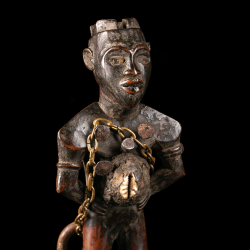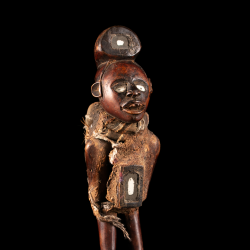
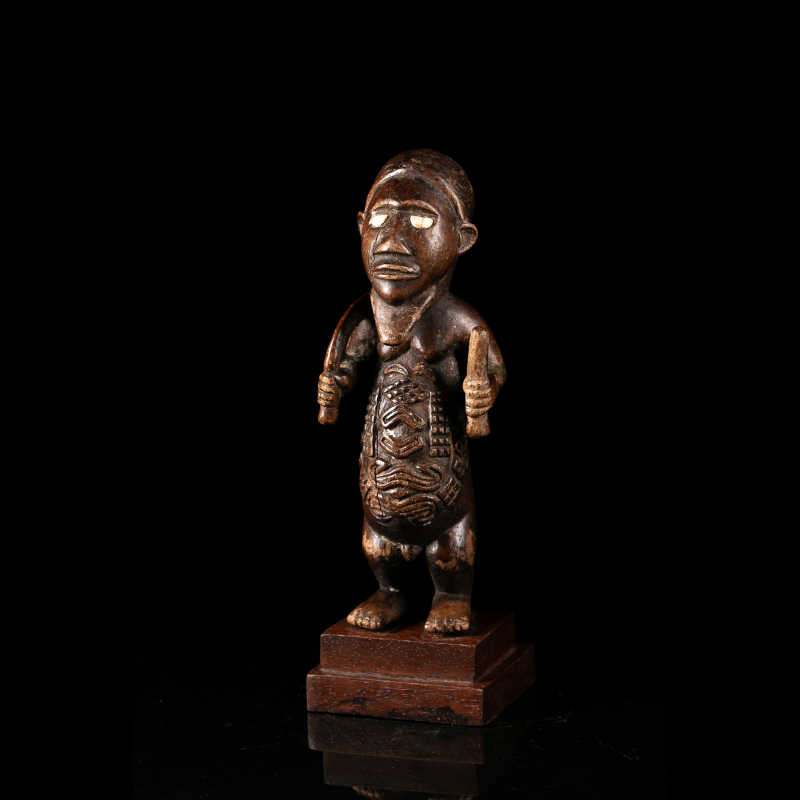
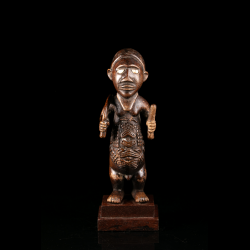
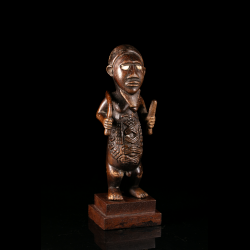
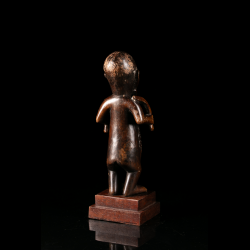
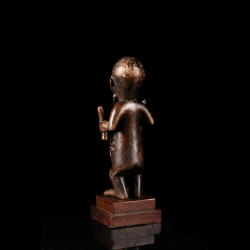
This striking Bembe, or Beembe, figure of the biteki type belongs to the rich tradition of ancestral sculpture associated with the Kongo cultural world of the Republic of the Congo. Human figures occupy a particularly important place in Bembe art, where sculptural representations could embody the memory and presence of significant ancestors. The Metropolitan Museum of Art identifies comparable works as Bembe-Kongo ancestor figures from the Republic of the Congo.
The present male figure has an especially commanding presence. Standing firmly on short, powerful legs, he holds an attribute in each hand. Such details can individualize the represented person: documented biteki sculptures have been described as male effigies or idealized ancestral portraits whose objects and attributes may evoke aspects of the ancestor's identity or role.
Particularly striking are the light-coloured inset eyes, which contrast dramatically with the dark surface of the wood. The combination of carved wood and ivory eye inlays is documented in Bembe sculpture held by both the Metropolitan Museum of Art and the Museum of Fine Arts, Houston. The broad mouth, angular nose and strongly modelled head further contribute to the figure's concentrated expression.
The most remarkable feature, however, is the extensive carved decoration covering the abdomen. Chevron patterns, intersecting lines and sinuous motifs form a dense ornamental field across the body. These designs evoke the elaborate scarification patterns that form an important part of the visual vocabulary associated with Bembe figural sculpture.
The result is a sculpture of considerable visual strength. Its compact proportions contrast with the remarkable precision of its surface decoration, while the inset eyes and hand-held attributes give the figure an immediately distinctive personality.
The figure is displayed on the wooden base shown in the photographs.
Provenance :
Aimé-Lucien Mbungu Mbuka is a respected Congolese expert, antiquarian, and collector specializing in ethnic and tribal art. Founder of the Antika Gallery at the Boboto Cultural Centre in Kinshasa, he has worked for more than thirty years to preserve and promote Congo’s traditional artistic heritage.
As President of the National Association of Antiquarians of Congo (ASSONACO), he emphasizes the historical, spiritual, and cultural significance of African masks, sculptures, and ritual objects. He is also involved in discussions surrounding the restitution of African heritage held abroad.
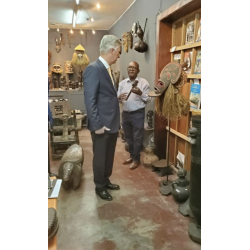
In June 2022, King Philippe of Belgium visited the Antika Gallery, where Mbungu Mbuka introduced him to various aspects of traditional Congolese art. He also published One Hundred Congolese Sculptures from the Antika Collection in 2009 and continues to promote Congolese art both in the DRC and in Europe.
Data sheet
You might also like
This striking Bembe, or Beembe, figure of the biteki type belongs to the rich tradition of ancestral sculpture associated with the Kongo cultural world of the Republic of the Congo. Human figures occupy a particularly important place in Bembe art, where sculptural representations could embody the memory and presence of significant ancestors. The Metropolitan Museum of Art identifies comparable works as Bembe-Kongo ancestor figures from the Republic of the Congo.
The present male figure has an especially commanding presence. Standing firmly on short, powerful legs, he holds an attribute in each hand. Such details can individualize the represented person: documented biteki sculptures have been described as male effigies or idealized ancestral portraits whose objects and attributes may evoke aspects of the ancestor's identity or role.
Particularly striking are the light-coloured inset eyes, which contrast dramatically with the dark surface of the wood. The combination of carved wood and ivory eye inlays is documented in Bembe sculpture held by both the Metropolitan Museum of Art and the Museum of Fine Arts, Houston. The broad mouth, angular nose and strongly modelled head further contribute to the figure's concentrated expression.
The most remarkable feature, however, is the extensive carved decoration covering the abdomen. Chevron patterns, intersecting lines and sinuous motifs form a dense ornamental field across the body. These designs evoke the elaborate scarification patterns that form an important part of the visual vocabulary associated with Bembe figural sculpture.
The result is a sculpture of considerable visual strength. Its compact proportions contrast with the remarkable precision of its surface decoration, while the inset eyes and hand-held attributes give the figure an immediately distinctive personality.
The figure is displayed on the wooden base shown in the photographs.
Provenance :
Aimé-Lucien Mbungu Mbuka is a respected Congolese expert, antiquarian, and collector specializing in ethnic and tribal art. Founder of the Antika Gallery at the Boboto Cultural Centre in Kinshasa, he has worked for more than thirty years to preserve and promote Congo’s traditional artistic heritage.
As President of the National Association of Antiquarians of Congo (ASSONACO), he emphasizes the historical, spiritual, and cultural significance of African masks, sculptures, and ritual objects. He is also involved in discussions surrounding the restitution of African heritage held abroad.
In June 2022, King Philippe of Belgium visited the Antika Gallery, where Mbungu Mbuka introduced him to various aspects of traditional Congolese art. He also published One Hundred Congolese Sculptures from the Antika Collection in 2009 and continues to promote Congolese art both in the DRC and in Europe.