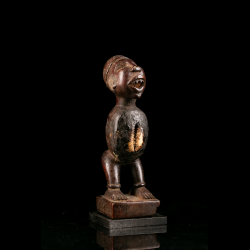
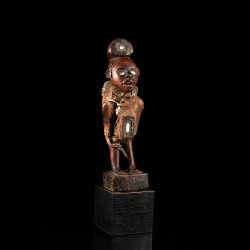
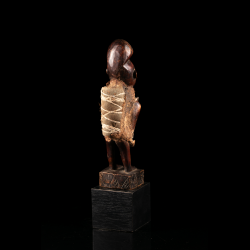
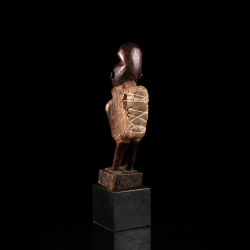
This remarkable Kongo power figure, measuring 23 cm in height, belongs to the broad category of minkisi — singular nkisi — objects in which carved sculpture and added materials formed an inseparable whole. Within Kongo ritual practice, the wooden figure alone did not embody the full efficacy of the object. Its potency depended upon the intervention of a ritual specialist, the nganga, and the addition of substances known as bilongo, selected from animal, vegetal and mineral materials. Such substances could be concealed in the abdomen or head, placed behind the eyes, or attached externally to the sculpture.
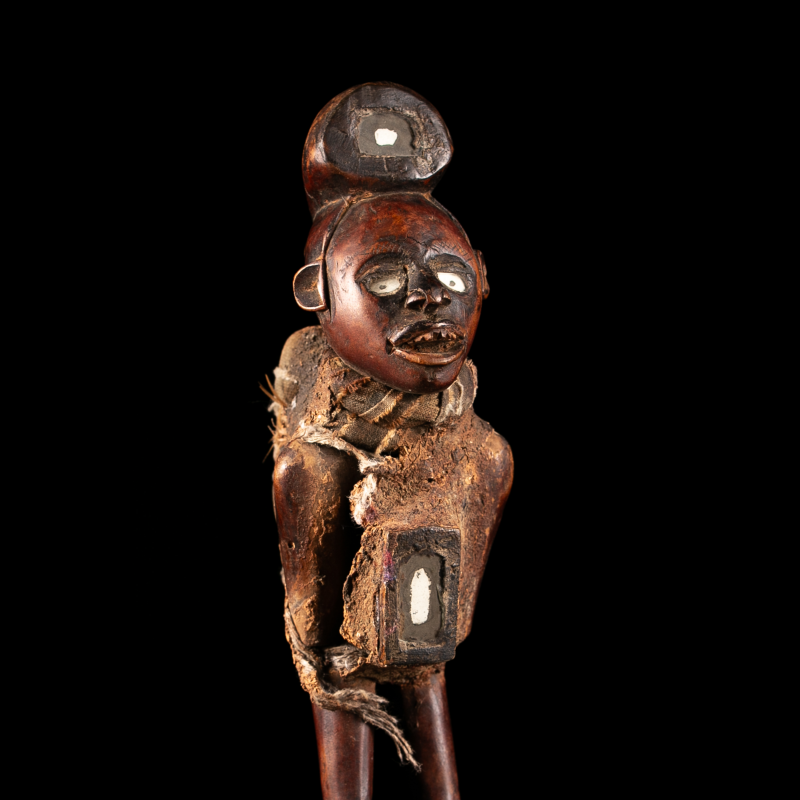
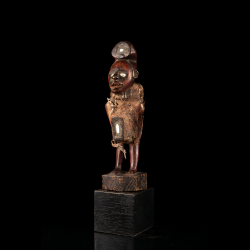
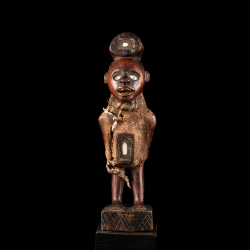
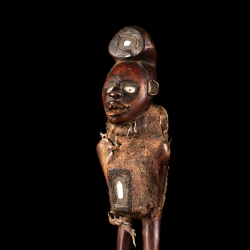
This example is especially compelling because that process of accumulation and empowerment remains visually apparent. The figure stands on an integral base decorated with incised geometric patterns. Its slender body supports an unusually large head surmounted by a dramatic curved coiffure or crest. Wide-open eyes are emphasized by white inlays, producing an intense and commanding gaze. Technical studies of Kongo power figures demonstrate that the eyes themselves could be significant locations for spiritually charged materials, although the precise substance used for the white elements on this figure cannot be established from photographs alone.
The face is highly expressive, with a compact nose, open mouth exposing carved teeth and strong contrasts between the reddish-brown wood and darker areas surrounding the eyes. A rectangular feature containing a white central element appears on the crest and visually echoes another rectangular device attached to the front of the torso.
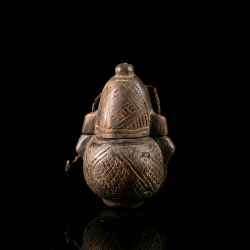
The treatment of the body is especially significant. Much of the upper torso is covered with a composite crust of resinous or earthy material, textile and fibres, while a small rectangular receptacle is attached to the abdomen. At the reverse, a substantial packet survives, wrapped in cloth and firmly bound with cord. Its precise contents cannot be identified without material analysis; structurally, however, these additions closely correspond to the documented use of external and internal receptacles for bilongo on Kongo minkisi. Museum examples demonstrate that the finished power object could combine carving, textiles, bound packets, resinous substances and medicinal compounds added by the ritual specialist.
The appeal of this work therefore lies not only in the expressive quality of its carving but also in the survival of its multiple material layers: wood, inlays, composite matter, textile, cords and attached receptacles. It vividly illustrates the collaborative character of Kongo power sculpture, created through the complementary interventions of the sculptor and the nganga.
Provenance :
Aimé-Lucien Mbungu Mbuka is a respected Congolese expert, antiquarian, and collector specializing in ethnic and tribal art. Founder of the Antika Gallery at the Boboto Cultural Centre in Kinshasa, he has worked for more than thirty years to preserve and promote Congo’s traditional artistic heritage.
As President of the National Association of Antiquarians of Congo (ASSONACO), he emphasizes the historical, spiritual, and cultural significance of African masks, sculptures, and ritual objects. He is also involved in discussions surrounding the restitution of African heritage held abroad.
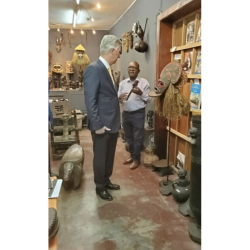
In June 2022, King Philippe of Belgium visited the Antika Gallery, where Mbungu Mbuka introduced him to various aspects of traditional Congolese art. He also published One Hundred Congolese Sculptures from the Antika Collection in 2009 and continues to promote Congolese art both in the DRC and in Europe.
Data sheet
You might also like
This remarkable Kongo power figure, measuring 23 cm in height, belongs to the broad category of minkisi — singular nkisi — objects in which carved sculpture and added materials formed an inseparable whole. Within Kongo ritual practice, the wooden figure alone did not embody the full efficacy of the object. Its potency depended upon the intervention of a ritual specialist, the nganga, and the addition of substances known as bilongo, selected from animal, vegetal and mineral materials. Such substances could be concealed in the abdomen or head, placed behind the eyes, or attached externally to the sculpture.
This example is especially compelling because that process of accumulation and empowerment remains visually apparent. The figure stands on an integral base decorated with incised geometric patterns. Its slender body supports an unusually large head surmounted by a dramatic curved coiffure or crest. Wide-open eyes are emphasized by white inlays, producing an intense and commanding gaze. Technical studies of Kongo power figures demonstrate that the eyes themselves could be significant locations for spiritually charged materials, although the precise substance used for the white elements on this figure cannot be established from photographs alone.
The face is highly expressive, with a compact nose, open mouth exposing carved teeth and strong contrasts between the reddish-brown wood and darker areas surrounding the eyes. A rectangular feature containing a white central element appears on the crest and visually echoes another rectangular device attached to the front of the torso.
The treatment of the body is especially significant. Much of the upper torso is covered with a composite crust of resinous or earthy material, textile and fibres, while a small rectangular receptacle is attached to the abdomen. At the reverse, a substantial packet survives, wrapped in cloth and firmly bound with cord. Its precise contents cannot be identified without material analysis; structurally, however, these additions closely correspond to the documented use of external and internal receptacles for bilongo on Kongo minkisi. Museum examples demonstrate that the finished power object could combine carving, textiles, bound packets, resinous substances and medicinal compounds added by the ritual specialist.
The appeal of this work therefore lies not only in the expressive quality of its carving but also in the survival of its multiple material layers: wood, inlays, composite matter, textile, cords and attached receptacles. It vividly illustrates the collaborative character of Kongo power sculpture, created through the complementary interventions of the sculptor and the nganga.
Provenance :
Aimé-Lucien Mbungu Mbuka is a respected Congolese expert, antiquarian, and collector specializing in ethnic and tribal art. Founder of the Antika Gallery at the Boboto Cultural Centre in Kinshasa, he has worked for more than thirty years to preserve and promote Congo’s traditional artistic heritage.
As President of the National Association of Antiquarians of Congo (ASSONACO), he emphasizes the historical, spiritual, and cultural significance of African masks, sculptures, and ritual objects. He is also involved in discussions surrounding the restitution of African heritage held abroad.
In June 2022, King Philippe of Belgium visited the Antika Gallery, where Mbungu Mbuka introduced him to various aspects of traditional Congolese art. He also published One Hundred Congolese Sculptures from the Antika Collection in 2009 and continues to promote Congolese art both in the DRC and in Europe.