This remarkable Kongo gunpowder flask belongs to a well-documented type of portable container. The National Museum of African Art preserves a Kongo example collected in the Congo as early as 1902, consisting of an ovoid two-part vessel joined by a fibre cord and specifically identified as a gunpowder flask. The museum notes that such a container could be used either by a hunter or by a ritual specialist charged with symbolically pursuing wrongdoers.
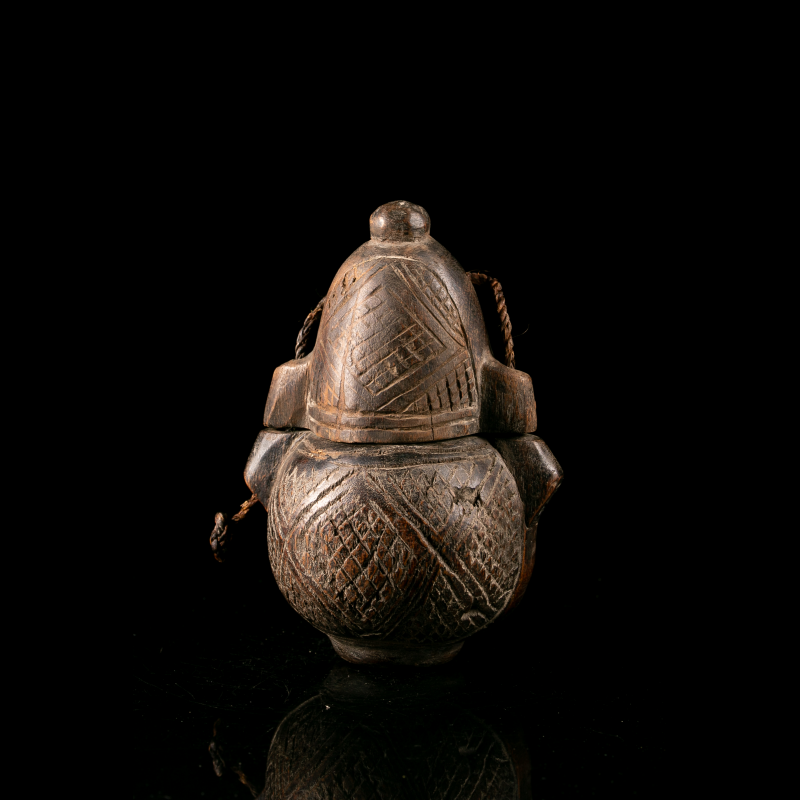
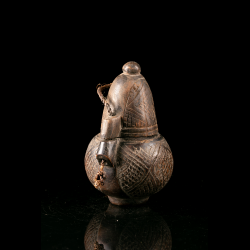
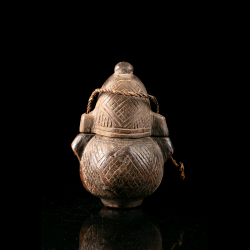
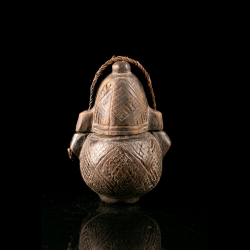
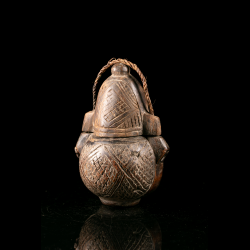
The present piece closely follows this typology: a globular body, removable domed lid, lateral projections for a suspension cord, and an extensive incised geometric decoration covering most of the surface. Cross-hatching, chevrons and intersecting linear patterns give the vessel a particularly strong graphic presence. The British Museum likewise holds a Congolese wooden gunpowder flask with a conical lid attached by fibre and a body decorated with interlocking lozenges.
Beyond its practical function, the object illustrates the care devoted in Kongo art to personal equipment associated with hunting, status and, in certain contexts, ritual practice.
Data sheet
You might also like
This remarkable Kongo gunpowder flask belongs to a well-documented type of portable container. The National Museum of African Art preserves a Kongo example collected in the Congo as early as 1902, consisting of an ovoid two-part vessel joined by a fibre cord and specifically identified as a gunpowder flask. The museum notes that such a container could be used either by a hunter or by a ritual specialist charged with symbolically pursuing wrongdoers.
The present piece closely follows this typology: a globular body, removable domed lid, lateral projections for a suspension cord, and an extensive incised geometric decoration covering most of the surface. Cross-hatching, chevrons and intersecting linear patterns give the vessel a particularly strong graphic presence. The British Museum likewise holds a Congolese wooden gunpowder flask with a conical lid attached by fibre and a body decorated with interlocking lozenges.
Beyond its practical function, the object illustrates the care devoted in Kongo art to personal equipment associated with hunting, status and, in certain contexts, ritual practice.