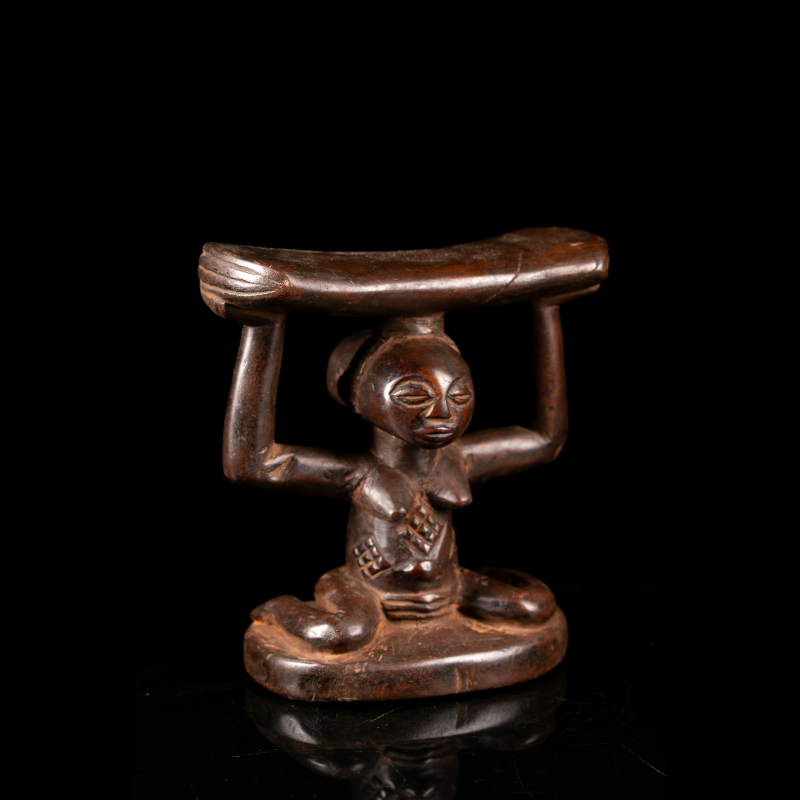
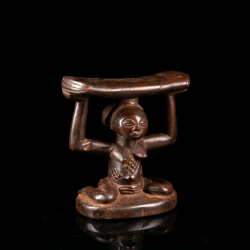
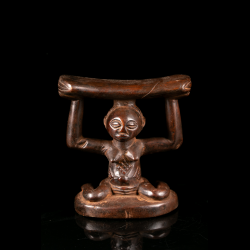
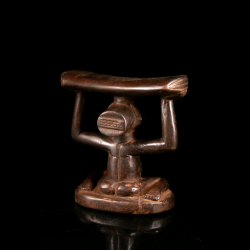
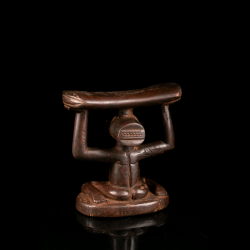
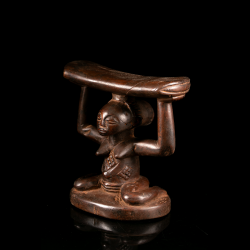
This african Luba headrest develops one of the major themes of prestige sculpture from the region: the female figure literally serving as the support for an object of status. Kneeling on an oval base, the caryatid raises both arms to support the curved upper platform. The half-closed eyes, backward-projecting coiffure and lozenge-shaped abdominal scarification structure a compact composition, while the reddish-brown patina, lighter on the raised areas, suggests prolonged handling.
Among the Luba, the headrest or musamo elevated the head during sleep while protecting elaborate hairstyles that could require considerable time to create. The Metropolitan Museum notes that such objects also belonged to the sphere of prestige and could be associated with members of the Luba elite. The female support therefore carries significance beyond its structural function: female imagery occupies a central position throughout Luba artistic traditions, appearing on stools, staffs, memory devices and headrests. Women could act as spiritual intermediaries and custodians of political and dynastic memory.
Through its balance of function and representation, this piece belongs to a Luba conception in which female beauty, memory, prestige and the protection of the sleeper intersect. On photographs alone, however, there is insufficient evidence to attribute it convincingly to a specific named master or workshop.
Data sheet
You might also like
This african Luba headrest develops one of the major themes of prestige sculpture from the region: the female figure literally serving as the support for an object of status. Kneeling on an oval base, the caryatid raises both arms to support the curved upper platform. The half-closed eyes, backward-projecting coiffure and lozenge-shaped abdominal scarification structure a compact composition, while the reddish-brown patina, lighter on the raised areas, suggests prolonged handling.
Among the Luba, the headrest or musamo elevated the head during sleep while protecting elaborate hairstyles that could require considerable time to create. The Metropolitan Museum notes that such objects also belonged to the sphere of prestige and could be associated with members of the Luba elite. The female support therefore carries significance beyond its structural function: female imagery occupies a central position throughout Luba artistic traditions, appearing on stools, staffs, memory devices and headrests. Women could act as spiritual intermediaries and custodians of political and dynastic memory.
Through its balance of function and representation, this piece belongs to a Luba conception in which female beauty, memory, prestige and the protection of the sleeper intersect. On photographs alone, however, there is insufficient evidence to attribute it convincingly to a specific named master or workshop.