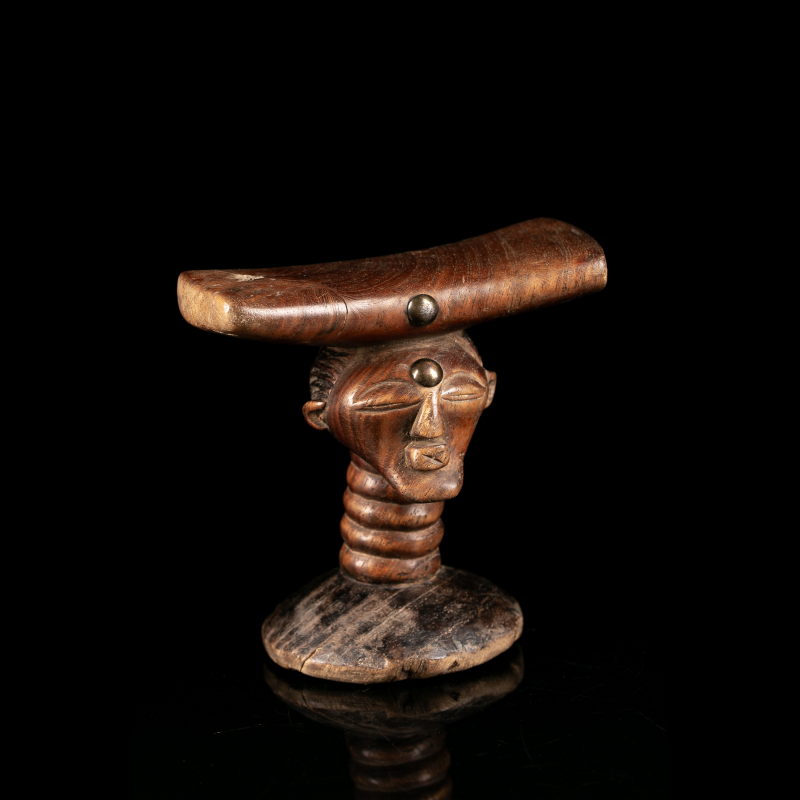
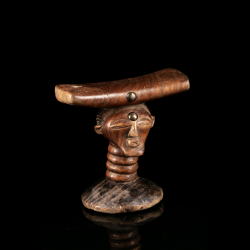
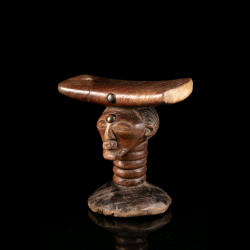
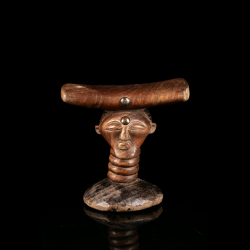
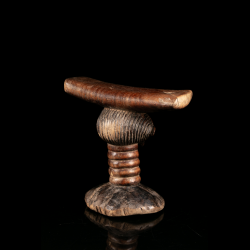
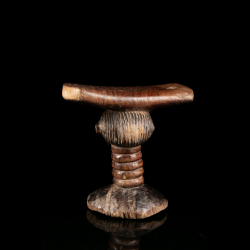
This Songye wooden headrest combines functional furniture with a strongly sculptural anthropomorphic design. Its broad, gently concave upper cradle rises slightly at both ends and rests directly upon a carved human head. Below, a sequence of horizontal rings forms the neck before expanding into a broad oval foot, giving the composition a remarkably balanced architectural structure.
The face is defined by narrow almond-shaped eyes, pronounced brows, a triangular nose and projecting geometric lips. Deep parallel grooves articulate the hairstyle at the back of the head. Two metal studs provide distinctive accents: one is set into the forehead and another decorates the front edge of the headrest itself, contrasting with the warm reddish-brown surface of the wood.
Attribution to the Songye cultural region of the Democratic Republic of the Congo is supported by documented museum examples. The British Museum holds several headrests identified as Songye, while the Smithsonian's National Museum of African Art preserves a related headrest attributed to a Luba or Songye artist from the Lomami, Sankuru or Haut-Lomami regions. That example likewise combines a rounded foot, human head and saddle-shaped cradle, reflecting the artistic exchanges that developed between neighbouring Luba and Songye communities.
Headrests served to support the head during sleep and, more broadly in Central Africa, could help protect carefully arranged hairstyles. Museum collections demonstrate how these functional objects also became sophisticated vehicles for sculptural invention and social expression.
Here the sculptor has reduced the supporting figure to its most expressive elements. The human head becomes the principal caryatid, while the ringed neck provides a rhythmic transition between the foot and the sweeping upper platform. The result is compact yet visually commanding, with the refined carving of the face and restrained use of metal lending the object much of its individual character.
Data sheet
You might also like
This Songye wooden headrest combines functional furniture with a strongly sculptural anthropomorphic design. Its broad, gently concave upper cradle rises slightly at both ends and rests directly upon a carved human head. Below, a sequence of horizontal rings forms the neck before expanding into a broad oval foot, giving the composition a remarkably balanced architectural structure.
The face is defined by narrow almond-shaped eyes, pronounced brows, a triangular nose and projecting geometric lips. Deep parallel grooves articulate the hairstyle at the back of the head. Two metal studs provide distinctive accents: one is set into the forehead and another decorates the front edge of the headrest itself, contrasting with the warm reddish-brown surface of the wood.
Attribution to the Songye cultural region of the Democratic Republic of the Congo is supported by documented museum examples. The British Museum holds several headrests identified as Songye, while the Smithsonian's National Museum of African Art preserves a related headrest attributed to a Luba or Songye artist from the Lomami, Sankuru or Haut-Lomami regions. That example likewise combines a rounded foot, human head and saddle-shaped cradle, reflecting the artistic exchanges that developed between neighbouring Luba and Songye communities.
Headrests served to support the head during sleep and, more broadly in Central Africa, could help protect carefully arranged hairstyles. Museum collections demonstrate how these functional objects also became sophisticated vehicles for sculptural invention and social expression.
Here the sculptor has reduced the supporting figure to its most expressive elements. The human head becomes the principal caryatid, while the ringed neck provides a rhythmic transition between the foot and the sweeping upper platform. The result is compact yet visually commanding, with the refined carving of the face and restrained use of metal lending the object much of its individual character.