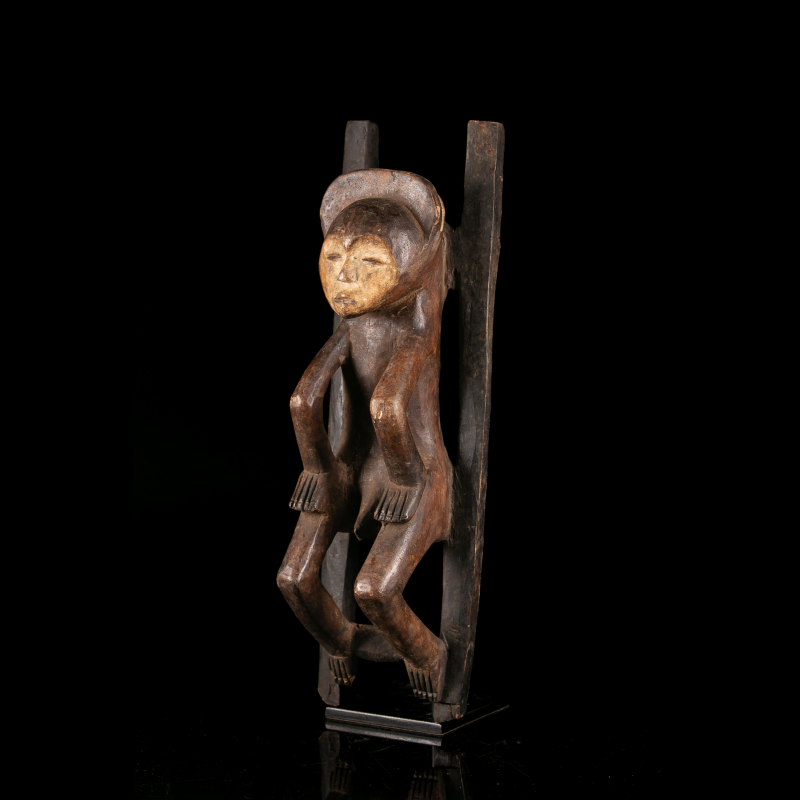
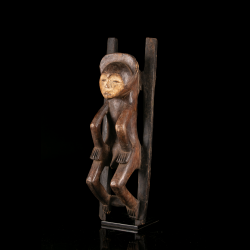
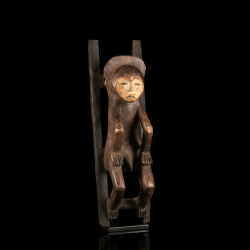
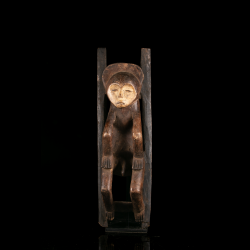
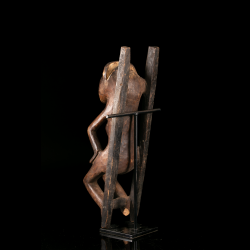
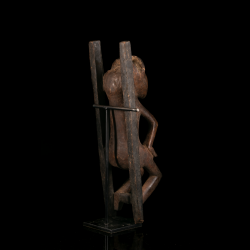
This Mbole sculpture belongs to the particularly striking category known as Ofika, figures symbolically representing a hanged individual. Its elongated body, suspended between two upright elements, and relaxed limbs create a powerful sense of vertical tension. The pale face, treated with remarkable restraint, stands out against the darker body and becomes the visual focus of the composition.
Among the Mbole of the Lomami region, such figures were closely associated with the Lilwa initiation society, a major institution combining moral, educational, judicial, social and political functions. Ofika figures were revealed during key stages of initiation and served as powerful visual warnings concerning the consequences of violating collective rules. They were used to teach respect for elders and to condemn theft, lying, adultery and other forms of antisocial behaviour.
Ethnographic sources cited by the Metropolitan Museum further indicate that these sculptures could preserve the memory of actual individuals condemned under Lilwa authority, although they were not intended as portraits. They were among the most powerful and restricted objects associated with the society and were generally kept from the sight of non-initiates. Their judicial, commemorative and initiatory dimensions give Ofika figures a distinctive position within the sculptural traditions of the Congo forest region.
Data sheet
You might also like
This Mbole sculpture belongs to the particularly striking category known as Ofika, figures symbolically representing a hanged individual. Its elongated body, suspended between two upright elements, and relaxed limbs create a powerful sense of vertical tension. The pale face, treated with remarkable restraint, stands out against the darker body and becomes the visual focus of the composition.
Among the Mbole of the Lomami region, such figures were closely associated with the Lilwa initiation society, a major institution combining moral, educational, judicial, social and political functions. Ofika figures were revealed during key stages of initiation and served as powerful visual warnings concerning the consequences of violating collective rules. They were used to teach respect for elders and to condemn theft, lying, adultery and other forms of antisocial behaviour.
Ethnographic sources cited by the Metropolitan Museum further indicate that these sculptures could preserve the memory of actual individuals condemned under Lilwa authority, although they were not intended as portraits. They were among the most powerful and restricted objects associated with the society and were generally kept from the sight of non-initiates. Their judicial, commemorative and initiatory dimensions give Ofika figures a distinctive position within the sculptural traditions of the Congo forest region.